But Grandpa never tried to explain himself to anyone.
He moved through the world like a man who knew exactly how much of himself he was willing to give — and no more.
That made people uncomfortable.
His house sat at the end of a narrow street lined with cracked sidewalks and chain-link fences where neighbors watched everything while pretending they did not. The town itself looked frozen somewhere in the late 1980s. A diner with cheap pie. Churches on nearly every corner. Storefronts faded by time and neglect.
To me, that house felt safer than anywhere else on earth.
Not because it was beautiful. It wasn’t. Wallpaper peeled in the hallway. The kitchen floor had an old burn mark near the stove. His recliner was worn smooth from years of use. But nothing in that house pretended to be something it wasn’t.
A chipped mug stayed beside the sink because it still worked.
Newspapers were stacked in the basement because Grandpa believed paper always had another use.
The kitchen clock ran three minutes fast because, as he liked to say, “Three minutes can save a person from looking foolish.”
My parents hated visiting him.
“He could at least try to be warmer,” my mother would complain.
My father was worse. He judged people by status, money, and usefulness. Since Grandpa never bragged about whatever military past he had, Dad dismissed him as just another stubborn old man in an old house.
My brother Tyler followed their lead.
“Grandpa’s special talent is making a room uncomfortable without even talking,” he joked once.
Everyone laughed.
Sometimes I laughed too, not because I agreed, but because I was young enough to confuse fitting in with survival.
But I never thought Grandpa was difficult.
I thought he was exact.
He never promised things he didn’t mean. Never flattered people just to keep peace. If he asked how school was going, he genuinely wanted the answer. If I said I hated a teacher, he asked why before telling me how to feel about it.
When I was eleven, I wanted to climb the giant maple tree in his yard. My mother said I would ruin my dress. My father said girls had better things to do than climb trees.
Grandpa studied the branches for a moment, then looked at me.
“Then you’d better learn where your weight belongs.”
He spent an hour teaching me how to test bark, where to place my feet, and how to shift my balance before trusting a branch.
“Don’t believe something is strong just because it looks strong,” he told me. “Trust it because you checked.”
That was how he taught everything.
Not through lectures.
Just one sentence at a time.
When I was thirteen, I found an old duffel bag buried deep in his closet. Inside were yellowed letters, a green military jacket, and a dented canteen. Before I could ask about them, Grandpa appeared in the doorway.
“Put it back.”
There was no anger in his voice. Only finality.
So I put it back.
Then he took me into the kitchen and quietly taught me how to sharpen a knife, as if the question had not been forbidden — only postponed.
People said Grandpa didn’t know how to show love.
They were wrong.
He showed it in ways that didn’t ask for applause. He cut crusts off my toast when I was sick. He kept orange Popsicles in the freezer because I liked them. He once drove through sleet to return a school project I had forgotten at his house.
When he handed it to me, he simply said:
“Don’t leave important things where forgetful people can lose them.”
I joined the Marines at nineteen.
My parents hated that too.
“The military is what people do when they don’t have better options,” my father scoffed.
But Grandpa only asked one question.
“Why Marines?”
Not “Are you sure?” Not “Isn’t it dangerous?” Just why.
It was one of the most respectful questions anyone had ever asked me.
“Because if I’m going to do something hard,” I answered, “I want it to mean something.”
He studied me for a long moment before nodding.
“Good reason,” he said. “A lot of people choose hard things because they mistake pain for purpose. Don’t run from something. Run toward something.”
I carried those words through boot camp and every difficult thing after it.
Whenever I came home on leave, Grandpa never asked dramatic questions. He asked the real ones.
“How are your feet?”
“How’s your shoulder?”
“Do you trust the people around you?”
Meanwhile, my parents treated my deployments like weather reports they barely listened to.
Eventually, I stopped explaining myself to them.
But never to Grandpa.
Then he got sick.
The call came from his neighbor, Mrs. Kessler.
“He collapsed in the kitchen,” she said shakily. “They took him to County Hospital.”
I requested emergency leave immediately.
The drive back to Ohio felt endless — gas station coffee, highway lights, and the kind of fear no military training prepares you for.
When I finally entered his hospital room, the sight of him nearly stopped me cold.
Illness had made him smaller.
The strongest man I had ever known looked fragile beneath thin hospital blankets.
Then his eyes opened.
The corner of his mouth lifted slightly.
“Guess you’re the one who didn’t forget me.”
I sat beside him and held his hand.
I told him I’d called Mom, Dad, and Tyler.
“They’ll come soon,” I lied.
Grandpa shook his head faintly.
“They won’t.”
He was right.
For two days, I stayed beside him while my family found excuses.
Hospitals made Mom anxious.
Dad was busy.
Tyler said the timing was bad.
No one came.
Only a nurse named Denise treated him with genuine care. She brought me crackers when she realized I’d been surviving on coffee and exhaustion.
On the second morning, snow drifted weakly outside the window when Grandpa squeezed my hand.
“In the drawer,” he whispered.
“What drawer?”
“Bedroom. Top right. Handkerchief. Keep it.”
“What is it?”
His eyes closed halfway.
“The ring knows better than the papers.”
Before I could ask what he meant, he drifted back to sleep.
He died that afternoon.
Quietly.
No final speech. No gathered family. Just one breath that never returned.
I arranged the funeral alone.
My parents didn’t come.
Tyler didn’t come either.
I stood beside Grandpa’s casket in an almost empty church while the priest spoke about peace and service. All I could think about was how the strongest man in our family was leaving this world with less attention than most people gave broken appliances.
After the funeral, I returned to his house alone.
That hurt worse than the hospital.
Hospitals belong to interruption.
Houses belong to continuation.
His mug still sat by the sink. His slippers waited beside the bed. His newspaper remained folded on the coffee table.
Eventually, I opened the top right drawer in his bedroom.
Inside a white handkerchief bundle was the ring.
Heavy silver. Worn smooth by decades of use. Inside it was a compass rose with one blackened point.
I slipped it onto my finger.
It felt like holding onto part of him.
Three weeks later, my parents sold his house.
“It’s just a house,” my mother said coldly.
But it wasn’t.
It was the only place in my childhood where silence never felt like punishment.
A few weeks after that, I attended a veterans recognition ceremony wearing my dress blues. I put Grandpa’s ring on without thinking.
That was when everything changed.
A general noticed the ring from across the room.
He walked straight toward me, pale and staring at my hand.
“Where did you get that?”
“It belonged to my grandfather,” I answered carefully.
“What was his name?”
“Thomas Hail.”
Something in his expression broke instantly.
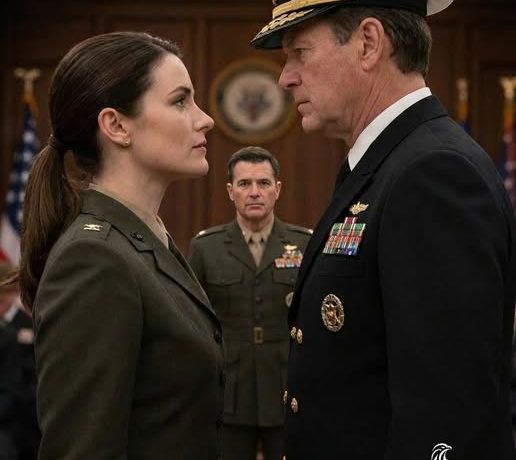
“We need to talk.”
Inside a private room, the general introduced himself as Samuel Mercer.
Then he told me the truth.
My grandfather hadn’t simply served in Vietnam.
He had saved lives during a disastrous classified mission in 1968. He went back into danger three separate times to recover wounded men others had already written off.
Mercer’s voice shook when he described it.
“He was hit while doing it,” he said quietly. “And he still wouldn’t leave anyone behind.”
Grandpa had been recommended for the Medal of Honor.
But there was a problem.
The official story erased certain people involved in the mission. Scouts. Civilians. Mistakes made by command.
“They were willing to honor him,” Mercer explained, “if he agreed to accept a lie.”
Grandpa refused.
“He said if the country needed a hero more than it needed the truth, it could find one somewhere else.”
Suddenly, everything about him made sense.
His silence.
His refusal to explain himself.
The way people mistook integrity for stubbornness.
Mercer told me the records had only recently been declassified. Letters had been sent to Grandpa’s next of kin, but no one responded.
My parents had ignored them.
At Quantico, Mercer showed me Grandpa’s archived footlocker.
Inside were maps, reports, photographs, witness statements, and six silver rings matching the one on my hand.
“One for every man who came home,” Mercer said softly.
Each ring carried a name.
And each one carried the same blackened compass point.
“The black mark,” Mercer explained, “meant north no longer guaranteed home.”
I cried reading Grandpa’s field notes.
Not because he had been a hero.
Because he refused to become one under dishonest terms.
Months later, the military finally corrected the record publicly.
Grandpa received a posthumous Navy Cross under a truthful citation.
At the ceremony, Mercer stood before a crowded hall and said:
“He was offered a version of honor that required him to accept a lie. He refused it. That refusal cost him recognition in his lifetime. It did not diminish what he did. It enlarged it.”
Then he looked directly at me.
“When Gunnery Sergeant Thomas Hail died, only one member of his family came to his bedside, arranged his funeral, preserved the ring he wore every day, and cared enough to ask what it meant.”
Every eye in the room turned toward me.
For one second, I wanted to disappear.
Then I remembered Grandpa teaching me how to test branches before trusting them.
So I stood.
After the ceremony, my father finally admitted the truth.
“I didn’t know,” he said quietly. “But I also never asked.”
That was the closest thing to honesty he had ever given me.
Months later, the new owners of Grandpa’s old house found one last envelope hidden deep inside the crawl space.
The front read:
For my granddaughter, if she ever asks the right question.
Inside was a single handwritten page.
Grandpa wrote that there was less glory in war than people liked to imagine. He warned me never to let others polish ugly truths into something easier to celebrate. He said the ring belonged to me now because I had always asked questions before obeying answers.
Then came the final line.
“I was proud of you from the moment you learned to ask why before you learned to obey.”
I cried harder reading that sentence than I did during the ceremony.
Because that was the real inheritance.
Not the medal.
Not the military record.
Not the ring.
The truth.
I still wear the ring every day.
Most people never notice it.
That feels right.
Some stories are not meant to shine loudly. Some are meant to survive quietly in the hands of people willing to protect them.
Grandpa understood that better than anyone.
And now, finally, so do I.