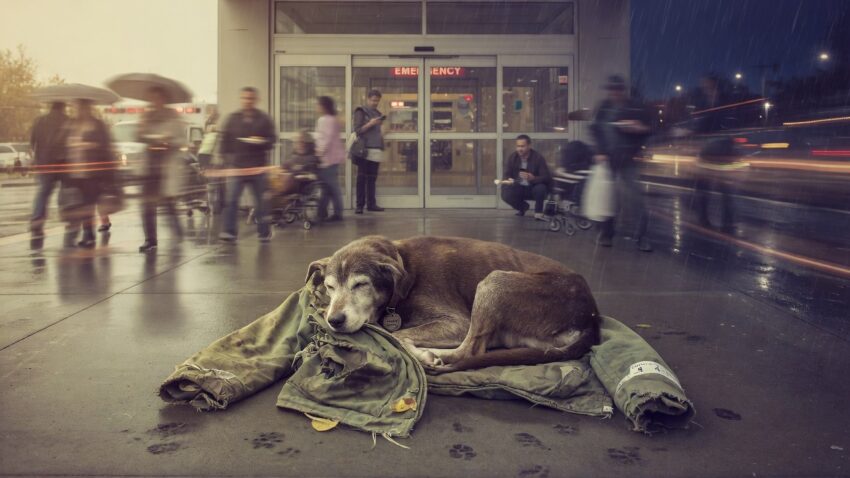
I’ve worked the graveyard shift as a security guard at St. Jude’s Medical Center in Chicago for nine years, but absolutely nothing could have prepared me for the freezing Tuesday night I saw it.
When you work the night shift in a hospital, you get used to the ghosts.
Not literal ghosts, of course.
But the echoes of people. The quiet sobbing in the waiting room at 3:00 AM. The frantic screech of ambulance tires. The empty, hollow stares of families walking out the sliding glass doors with one less person than they came in with.
You learn to numb yourself to it. You have to, or the job will eat you alive.
I used to be a cop in a rough precinct. I retired early because my nerves were shot. I took this security job because I wanted quiet. I wanted boring.
But at 2:14 AM on November 12th, the quiet was broken.
It was a brutal night. The kind of bitter, biting cold that cuts right through your layers and makes your bones ache. The wind was howling off Lake Michigan, whipping stray trash across the empty parking lot.
I was sitting in my heated booth, sipping stale coffee, keeping one eye on the bank of security monitors.
Everything was dead. Camera 1: Empty ER drop-off. Camera 2: Empty staff parking. Camera 3: Empty alleyway.
Then, I looked at Camera 4.
Camera 4 covers the long, dimly lit sidewalk leading up to the main entrance. The streetlights flickered on that side of the building, casting long, unsettling shadows.
At the very edge of the screen, something was moving.
It was just a dark, heavy mass at first. It didn’t look human.
It was low to the ground, moving with a painful, agonizing slowness.
My heart did a strange flutter in my chest. Old cop instincts kicked in.
I leaned closer to the grainy monitor, squinting.
Scrape. Pause. Scrape. Pause.
Even through the thick glass of my booth, I thought I could hear the sound. A heavy, wet dragging noise against the frosted concrete.
It looked like someone—or something—was hauling a body bag.
My breath hitched. I’ve seen terrible things in my life. I’ve seen the worst of what humans can do to each other in the dead of night.
The mass would move a few inches, stop, shudder, and then heave forward again.
I grabbed my heavy flashlight. I clicked my radio, making sure the battery was green.
“Dispatch, this is Marcus at the front gate. I’ve got a visual on something moving up the south sidewalk. Going to investigate.”
“Copy that, Marcus. Be careful out there. It’s below freezing.”
I pushed the heavy door of the booth open. The wind immediately slapped my face, stinging my cheeks like tiny needles.
I unclipped my flashlight and gripped it tight. My knuckles were white under my thick gloves.
I stepped out into the dark.
The hospital was a massive, looming shadow behind me. Ahead of me was just the long, empty stretch of pavement.
The streetlights buzzed overhead, casting an ugly yellow glow on the frost.
I walked slowly. Every crunch of my boots on the ice sounded like a gunshot in the silent night.
Scrape. There it was. Louder this time.
It was coming from behind a row of frozen bushes near the visitor drop-off.
My pulse pounded in my ears. I kept my flashlight off, not wanting to give away my position.
I crept closer, holding my breath.
Scrape. I rounded the corner of the bushes, raising my flashlight, bracing myself for a fight, for a crime scene, for a nightmare.
I clicked the heavy button. A blinding beam of white light cut through the darkness.
“Hey! Stop right there!” I yelled, my voice cracking slightly in the cold air.
The mass froze.
I kept the light pinned on it. I waited for a man to stand up. I waited to see a weapon.
But nothing stood up.
Instead, a pair of eyes caught the beam of my flashlight.
They weren’t human eyes. They were glowing, pale, and filled with an exhaustion so deep it made my stomach drop.
I lowered the beam slightly. The breath left my lungs in a white cloud.
It wasn’t a killer. It wasn’t a monster.
It was a dog.
But calling it just a dog feels like a massive understatement. It looked like a walking ghost.
It was a large breed, maybe a Golden Retriever mix, but it was ruined. Its fur was matted with mud, ice, and filth. The muzzle was completely white with age.
It was so emaciated I could count every single rib protruding against its sides. One of its back legs hovered off the ground, useless and trembling.
But it wasn’t the dog’s terrible condition that made my throat tighten.
It was what the dog had in its mouth.
The dog’s jaws were locked with a death grip around the collar of a heavy, waterlogged, frayed lumberjack jacket.
The jacket was enormous. Thick canvas, lined with faux fur, soaked through with freezing slush. It must have weighed twenty pounds in that state.
For a frail, dying dog, it was an impossible burden.
Yet, as I watched, the dog planted its front paws, lowered its head, and pulled.
Scrape. The heavy jacket dragged another two inches across the ice.
The effort clearly took everything the animal had. Its legs buckled. It collapsed onto the frozen concrete, panting rapidly, small clouds of steam rising from its nose.
But it did not let go of the jacket.
I stood there, totally frozen, the flashlight shaking in my hand.
“Hey, buddy…” I whispered, my voice softening.
I took a slow step forward. I reached into my pocket. I always kept a piece of beef jerky for the stray cats that hung around the dumpsters.
I pulled it out and held it in my palm.
“It’s okay. You’re okay. Look what I have.”
The dog’s ears twitched. It looked at the meat. I could see its nose flare. It was starving. I knew it hadn’t eaten in days.
But as I took another step, the dog’s demeanor changed.
It didn’t wag its tail. It didn’t beg.
It pulled the heavy jacket closer to its frail body. It looked up at me, bared its worn, broken teeth, and let out a low, rattling growl.
It wasn’t an aggressive growl. It was a desperate one.
Don’t touch this, the growl said. This is mine. I stopped. I put my hands up, dropping the jerky on the ground a few feet away.
“Okay. Okay. I won’t touch it.”
The dog watched me for a long moment. Then, satisfied that I wasn’t going to steal its prize, it ignored the food completely.
It gripped the collar of the jacket again.
Scrape. It resumed its agonizing journey.
I realized then where it was heading. It was heading straight for the bright, sliding glass doors of the Emergency Room.
I followed it. I couldn’t look away. I watched this broken creature drag that filthy coat for twenty agonizing minutes just to cover a distance of fifty yards.
When it finally reached the automatic doors, they didn’t open. The sensors didn’t pick up something so low to the ground.
The dog didn’t seem to care.
It let out a long, shuddering sigh. It dropped the collar.
Then, it did something that broke me completely.
The dog nudged the frayed jacket with its nose, spreading it out on the freezing concrete. It pawed at the collar, arranging it just right.
And then, the frail animal curled its emaciated body into a tight ball directly on top of the jacket, resting its head on the chest of the empty coat.
It closed its eyes, facing the glass doors. Waiting.
I slowly walked up and shone my light on the back of the jacket.
There, written in faded black sharpie across the worn canvas, was a name.
And I recognized that name.
My blood ran completely cold. I knew exactly who this jacket belonged to. And I knew exactly why this dog was waiting outside these specific doors.
Because I was there the night the owner went inside.
CHAPTER 2
The faded black sharpie on the back of the collar read: A. Pendleton.
I stared at those jagged, uneven letters until they blurred out of focus. My breath caught in my throat, turning into thick, white clouds in the freezing air.
Arthur Pendleton.
The name hit me like a physical blow to the chest. My mind violently snapped back to a chaotic Tuesday night, exactly three weeks and two days ago.
It was raining that night. A freezing, relentless Chicago downpour that turned the streets into black mirrors.
I was standing near the ambulance bay when Rescue 4 came screeching in. The sirens were deafening, bouncing off the concrete walls of the hospital.
The paramedics leaped out before the rig even fully stopped. They threw the back doors open and yanked the stretcher out into the rain.
On the stretcher was an old man.
He was incredibly frail, his skin a terrifying shade of gray. His eyes were wide open, staring blindly at the harsh overhead lights of the ER awning, terrified and lost.
An oxygen mask was strapped to his face, fogging up with rapid, shallow breaths. One paramedic was doing chest compressions right there on the moving stretcher, screaming for the trauma team to clear the hallway.
But what I remembered most vividly was what the old man was wearing.
It was that exact same heavy, faux-fur-lined lumberjack jacket.
As they rushed him past my security podium, one of the triage nurses grabbed a pair of trauma shears. She didn’t have time to undress him gently. She cut straight through the thick canvas of the jacket to get the defibrillator pads onto his chest.
They stripped it off him in one violent motion, tossing the heavy, soaked garment onto the linoleum floor like garbage.
They wheeled Arthur through the swinging doors into Trauma Room 1.
He never came out.
Arthur Pendleton was pronounced dead forty-five minutes later. Massive myocardial infarction. A widowmaker heart attack.
He was a John Doe for a few hours until they found a battered ID card in his pants pocket. No next of kin. No emergency contacts. He lived in a rundown trailer park near the industrial rail yards, about four miles from the hospital.
Just another lonely soul slipping through the cracks of a massive city.
But he wasn’t entirely alone.
I remember the jacket lying on the floor in a puddle of rainwater. A janitor came by with a rolling trash bin, scooped the ruined jacket up with a pair of tongs, and tossed it in.
I watched him roll that bin out the back doors toward the dumpsters near the loading dock.
What I didn’t know—what no one knew—was that someone had followed the ambulance that night.
As the memory faded and the bitter cold of the present reality snapped me back, I looked down at the emaciated, shivering dog curled up on the frozen concrete.
My heart felt like it was breaking into a thousand jagged pieces.
This dog had chased the ambulance.
He must have run behind the wailing sirens through the freezing rain, his paws pounding the wet pavement for four agonizing miles. He must have arrived at the hospital completely exhausted, only to find the glass doors shut, the ambulance gone, and his master nowhere in sight.
And then, he must have smelled the jacket.
Animals have a sense of smell we can’t even fathom. He must have caught the scent of Arthur on the wind, tracking it around the massive hospital building, past the humming generators, straight to the industrial dumpsters.
This poor, loyal creature had pulled his dead master’s ruined, discarded coat out of the trash.
And for three weeks, he had been waiting.
Three weeks. Through the freezing rain, the biting winds, the sleet, and the snow. He had dragged this heavy, waterlogged canvas jacket around the perimeter of the hospital, refusing to let it go. Refusing to leave.
Because to him, that jacket was Arthur. It was the last piece of his human left in the world.
He thought if he just kept the jacket safe, if he just brought it to the doors and waited long enough, Arthur would walk out and put it on, and they would go home together.
Tears prickled the corners of my eyes, instantly freezing on my eyelashes.
I’ve seen a lot of things as a cop. I’ve seen violence, betrayal, and the darkest depths of human cruelty. I thought I was numb. I thought my heart was a hardened piece of leather.
But looking at this dog, watching his frail ribcage heave as he shivered violently against the freezing pavement, I felt a sob lodge in my throat.
“Oh, buddy,” I whispered into the dark. “He’s not coming back. I’m so sorry. He’s not coming out of there.”
The dog didn’t open his eyes. He just let out a low, pathetic whine, pressing his gray muzzle deeper into the faux-fur collar of the jacket.
The wind howled again, a vicious gust that rattled the sliding glass doors. The temperature was dropping fast. The weather app on my phone had warned it would hit single digits tonight with the wind chill.
If I left him out here, he wouldn’t survive the night. He was already running on nothing but pure, stubborn loyalty, and his body was shutting down.
I had to get him inside.
But St. Jude’s Medical Center had a strict, zero-tolerance policy about animals. No pets allowed anywhere on the premises, except for registered service animals with proper documentation.
The night supervisor was a woman named Higgins. She was a brutal, uncompromising administrator who would write up a nurse for taking an extra packet of graham crackers from the breakroom. If she caught me bringing a filthy, stray dog into the hospital, I would be fired on the spot.
I needed this job. My pension from the police department barely covered my mortgage. If I lost this security gig, I’d be drowning in debt within a month.
I stood there, paralyzed by the choice.
Look away, walk back to my heated booth, and keep my job.
Or break the rules, risk my livelihood, and save this dog’s life.
The dog shivered so hard his teeth chattered. He opened one eye, looking at me through the dim, yellow glow of the streetlamp. His eye was cloudy with age, but the absolute, crushing sorrow in his gaze was unmistakable.
He wasn’t asking for help. He was just resigned to dying right here, waiting for a ghost.
“Screw Higgins,” I muttered under my breath.
I clipped my flashlight to my belt and took a step closer.
“Listen to me,” I said, keeping my voice low and soothing. “You can’t stay out here. You’re going to freeze to death. I’m taking you inside.”
I reached down slowly, intending to scoop him up.
The moment my thick leather glove brushed his matted fur, the dog snapped his head up. He bared his broken teeth and let out a raspy, threatening bark. He scrambled backward, his useless back leg dragging on the ice, positioning himself firmly between me and the jacket.
He was weak, but his protective instinct was fiercely intact.
You are not taking his coat. I stopped immediately, holding my hands up in surrender.
“Okay, okay,” I said quickly. “I get it. The coat stays with you. I’m not taking it.”
I had to think fast. I couldn’t carry him, and he wouldn’t walk.
I looked at the heavy, frayed jacket. It was essentially a sled.
I slowly crouched down, keeping my eyes locked on his. I reached out, not toward the dog, but toward the very bottom hem of the heavy canvas coat.
The dog watched me intensely, a low growl rumbling in his chest.
“I’m just going to pull it,” I whispered. “I’m just going to move you both. Together.”
I gripped the cold, stiff fabric of the hem. I didn’t pull away from him; I pulled toward the sliding glass doors.
The dog tensed, but as he felt the jacket move under him without being taken away, the growl slowly faded into a nervous whimper.
I took a step backward, dragging the heavy coat over the frost. The dog stayed curled tightly on top of it, essentially riding the jacket across the pavement.
It was agonizingly slow work. I had to walk backward, pulling this awkward, heavy mass inch by inch toward the entrance. My boots slipped on the icy concrete, and my lower back screamed in protest.
We finally reached the automatic doors.
I stood up, waving my arms wildly in front of the overhead sensor. With a mechanical hum, the heavy glass doors slid open, blasting me with a wave of glorious, artificial heat.
I grabbed the hem of the jacket again and pulled hard, dragging the dog and his makeshift bed over the metal threshold and into the hospital vestibule.
The vestibule was a small, enclosed glass room between the outside doors and the inner doors that led to the actual ER waiting room. It was fully heated, brightly lit, and completely empty at 3:00 AM.
The outer doors slid shut behind us, cutting off the howling wind instantly.
The silence inside the vestibule was deafening. The only sound was the hum of the overhead heaters and the ragged, wet breathing of the dog.
As the warm air hit him, the dog let out a long, heavy sigh. The violent shivering began to subside, replaced by a deep, exhausting lethargy. He rested his chin back on the faux-fur collar, his cloudy eyes slowly fluttering shut.
I stood up, wiping sweat from my forehead despite the cold. My heart was racing.
I looked through the inner glass doors. The ER waiting room was deserted. The triage nurse was sitting behind her bulletproof glass, staring at a computer screen, completely oblivious to what was happening in the vestibule.
We were safe. For now.
But we couldn’t stay here forever. Morning shift arrived at 6:00 AM. By 5:30 AM, the vestibule would be bustling with nurses grabbing coffee and early-morning patients.
I had two and a half hours to figure out what the hell to do.
I unzipped my heavy security parka and tossed it over a nearby wheelchair. I sat down on the clean linoleum floor, crossing my legs, settling in about three feet away from the dog.
He looked terrible in the harsh fluorescent light.
Out in the dark, he just looked like a sad stray. But under the bright, unforgiving hospital lights, I could see the true extent of his suffering.
He was severely dehydrated. His gums were pale, almost white. His paw pads were cracked, bleeding, and raw from walking miles on salted, frozen roads. The fur on his back was missing in large patches, revealing sores and scabs.
He was dying. The warmth of the vestibule was saving him from freezing, but his body was failing.
I felt a surge of helplessness that made my stomach clench. I didn’t know anything about veterinary medicine. I couldn’t give him an IV. I couldn’t fix his leg.
“What am I supposed to do with you, old man?” I whispered, rubbing my face with my rough hands.
The dog didn’t react. He was deeply asleep, exhausted beyond measure.
I leaned closer, wanting to check his breathing. As I shifted my weight, my knee bumped against the heavy jacket he was lying on.
I heard a strange sound.
It wasn’t the rustle of stiff canvas. It was a faint, metallic clink.
I paused, holding my breath.
I nudged the side of the jacket again.
Clink. Rattle. It sounded like metal hitting something hard inside one of the pockets.
Curiosity overrode my caution. The dog was too deeply asleep to notice. I carefully reached out, my fingers trembling slightly, and traced the outside of the thick, waterlogged coat.
I felt the heavy side pockets. Empty.
I felt the chest pockets. Empty.
Then, I slid my hand underneath the fold of the jacket, feeling along the inside lining near the chest.
My fingers brushed against something hard and bulky.
It was an inner pocket, hidden deep inside the lining. But it wasn’t just a pocket. It was sewn shut with heavy, thick black thread, heavily reinforced, as if the owner never wanted it to be opened casually.
Arthur had deliberately sealed something inside his coat.
My cop instincts flared up instantly. Was it drugs? Stolen goods?
I gently pulled the fabric toward me, careful not to disturb the sleeping dog. I reached into my tool belt and pulled out my tactical folding knife.
With extreme precision, I slid the sharp edge of the blade under the thick black thread and sliced upward.
The thread popped loudly. I cut the rest of the stitches, opening the hidden pocket.
I slid two fingers inside.
First, I pulled out a small, heavy object. It was cold and metallic.
I held it up to the fluorescent light.
It was a military dog tag. The chain was broken, but the silver tag was clear. It didn’t belong to Arthur. It belonged to a different name, a name I didn’t recognize, followed by USMC.
I set it gently on the floor.
I reached back into the pocket. There was something else. Something wrapped tightly in thick, clear plastic to protect it from water.
I pulled it out.
It was a small bundle. As I turned it over in my hands, I realized it was a thick stack of hundred-dollar bills. A lot of them. Judging by the thickness, it had to be at least ten thousand dollars.
My jaw dropped. Arthur lived in a rundown trailer park. He looked like he hadn’t bought new clothes in a decade. Where did a man like that get this kind of cash?
But the money wasn’t the most shocking thing.
Tucked under the rubber band holding the cash together was a folded piece of yellow notebook paper.
My hands were shaking as I carefully pulled the paper out from under the rubber band. The plastic wrapping had kept it perfectly dry.
I unfolded the yellow paper.
The handwriting was shaky, written in heavy blue ink by someone who clearly struggled to hold the pen steady.
I read the first line, and the breath vanished from my lungs.
I felt a cold sweat break out on the back of my neck. My eyes darted from the letter to the sleeping, emaciated dog, and then back to the letter.
I read the words again, just to make sure I wasn’t losing my mind.
I wasn’t.
Everything I thought I knew about Arthur Pendleton, everything I thought I knew about this dog, was completely, horrifyingly wrong.
The tragedy of the situation wasn’t just that a dog had lost his master.
The real tragedy was the horrific secret Arthur had been hiding from the world—a secret that explained exactly why this dog refused to let go of the jacket, and exactly why his life was now in terrible, imminent danger.
The yellow notebook paper was brittle, feeling more like a dried autumn leaf than a piece of stationery.
The edges were stained with what looked like dried coffee and something darker. Blood, maybe. The handwriting was jagged and frantic, written in a heavy blue ink by a hand that was clearly shaking violently.
I took a deep breath, the harsh fluorescent lights of the hospital vestibule buzzing above me, and began to read.
“To whoever finds this coat,” the letter began.
“If you are reading this, it means my heart finally gave out before I could finish the job. The doctors told me I was a walking time bomb. They told me I shouldn’t be walking around. But I didn’t have a choice. My name is Arthur Pendleton. The silver dog tag wrapped in this plastic doesn’t belong to me. It belonged to my son, First Lieutenant David Pendleton, United States Marine Corps. He was killed in the Korengal Valley twelve years ago.
The dog sleeping on this jacket is Major. He’s a retired Military Working Dog. He was David’s bomb-sniffer. Major was in the valley with my son. He took a piece of shrapnel to the back leg saving three Marines, but he couldn’t save my boy. The military retired Major and let me adopt him. Major is all I have left of my son. Except for Maya.”
I stopped reading. My throat suddenly felt like it was packed with dry sand. I swallowed hard, my eyes darting over to the frail, ruined dog curled up on the linoleum floor.
He wasn’t just a stray. He was a veteran. He was a war hero who had bled for this country.
And now he was starving to death on the floor of a hospital vestibule.
I wiped a bead of cold sweat from my forehead and forced my eyes back to the yellow paper.
“Maya is my granddaughter. David’s daughter. She is eight years old, and she is currently a patient on the 4th floor of your hospital. Pediatric Cardiology. Maya was born with the same defective heart valve that killed my wife. For eight years, we managed it. But three weeks ago, her heart started failing. The doctors at St. Jude’s told me she needs a specialized artificial valve replacement. It’s an experimental procedure. Her insurance denied the claim. They called it ‘non-essential life extension.’ They told me I needed a ten-thousand-dollar deposit out of pocket just to get her on the surgical schedule before her heart completely gives out. I am a retired mechanic living on social security. I didn’t have ten thousand dollars. So, I did what I had to do. I sold my truck. I sold my wife’s wedding ring. I sold my trailer. I borrowed the rest from some very, very bad men in the South Side who promised they would kill me if I didn’t pay them back with interest. I don’t care if they kill me. I’m already dying. I just need to save Maya. I wrapped the cash in this plastic. Ten thousand dollars exactly. But tonight, the chest pains started. They are blinding. I know I am having a massive heart attack. I know I won’t make it to the hospital doors. So I am giving the jacket to Major. Major is a Marine. He knows his commands. I told him ‘Guard’ and I told him ‘Deliver.’ He knows where we go when we visit Maya. He knows the route. If you find this, please. I am begging you on the soul of a dead Marine. Take this money to Dr. Aris on the 4th floor. Tell him to do the surgery. Tell Maya her grandpa loves her. And please, don’t let Animal Control take Major. He is a good boy. He was just completing his mission.”
The letter ended there. There was no signature. Just a long, jagged line of blue ink where Arthur’s pen had trailed off the page, likely as the widowmaker heart attack struck him down in the freezing rain.
I lowered the letter.
My hands were shaking so hard the brittle paper rattled in the quiet vestibule.
I looked at the thick stack of hundred-dollar bills sitting on my lap. Then, I looked at the dog.
Everything shifted. The entire universe tilted on its axis.
This wasn’t a story about a dog mourning his dead owner. This wasn’t a story about blind grief.
This was a story about duty.
Major hadn’t chased that ambulance three weeks ago because he was lost. He chased it because he was following orders.
When Arthur died, and the paramedics threw this heavy, waterlogged jacket into the hospital dumpster, Major had tracked it down. He dug it out of the trash.
And for twenty-three days, through sub-zero temperatures, freezing rain, and blinding snowstorms, this crippled, starving military dog had dragged twenty pounds of wet canvas around the perimeter of the hospital.
He couldn’t get past the automatic sliding doors. The sensors wouldn’t read him.
But he refused to abandon his post. He refused to drop the jacket. Because inside this jacket was the only thing that could save his fallen handler’s daughter.
He was standing guard. For three weeks. Waiting for someone to help him finish the mission.
Tears spilled over my eyelids, hot and fast, cutting tracks down my cold cheeks. I didn’t bother wiping them away.
I am a fifty-two-year-old man. I spent seventeen years as a Chicago police officer. I’ve seen the absolute darkest, ugliest parts of humanity. I retired from the force because I thought the world was completely devoid of goodness. I thought loyalty was a myth.
But looking at this emaciated, ruined animal, I felt a profound, crushing sense of awe.
“Major,” I whispered.
The dog’s ears twitched at the sound of his name. He slowly opened his cloudy, exhausted eyes. He lifted his heavy head from the faux-fur collar.
“I know who you are now,” I said, my voice cracking. “I know what you’re doing, soldier.”
I reached into my pocket and pulled out the piece of beef jerky I had dropped outside. I held it out on the flat of my palm.
This time, Major didn’t growl.
He looked at the jerky. Then he looked at the open hidden pocket on the jacket. He saw the money resting safely in my lap. He saw the letter in my hand.
Somehow, in that incredible way that dogs seem to understand the human soul, he knew that I understood. He knew the secret was out, and he didn’t have to carry the burden entirely alone anymore.
He let out a long, trembling sigh that sounded almost like a sob.
He leaned his head forward, his cracked nose touching my palm, and gently took the jerky from my hand. He chewed it slowly, his jaw clicking with exhaustion.
“Good boy,” I choked out, gently resting my hand on his head. His fur was coarse and matted with ice, but he leaned into my touch, closing his eyes. “You’re the best boy I’ve ever seen.”
I had to move. The clock was ticking.
If Maya had been waiting three weeks for this money, she was in critical danger. Or worse.
My stomach plummeted at the thought. What if I’m too late? What if she passed away while Major was trapped outside in the cold?
I carefully placed the money, the dog tag, and the letter into the deep breast pocket of my uniform jacket, zipping it shut.
I stood up, wincing as my stiff knees popped. “Stay here, Major. Rest. I’ll be right back.”
I ran out of the vestibule, pushing through the inner glass doors into the main ER waiting area.
The triage nurse, a young woman named Sarah, looked up from her computer, startled by my sudden sprint.
“Marcus? Everything okay out there?” she asked, pulling an earbud out of her ear.
“Sarah, I need you to check the inpatient registry right now,” I demanded, leaning over the high counter. “I need you to look up a pediatric patient. Maya Pendleton. Last name P-E-N-D-L-E-T-O-N.”
Sarah frowned, her fingers hovering over her keyboard. “Marcus, you know I can’t give out patient information to security. It’s a HIPAA violation. Night shift supervisor Higgins would have my head.”
“Sarah, look at me,” I said, my voice dropping to a dangerous, deadly serious pitch. “I am not asking as a security guard. I am telling you that it is a matter of life and death. Look up the name.”
She saw the completely unhinged, desperate look in my eyes. She swallowed hard and quickly started typing.
The seconds stretched into an eternity. The hum of the hospital ventilation system sounded like a jet engine in my ears.
“Okay,” Sarah whispered. “Pendleton, Maya. Age eight. She’s here.”
A massive wave of relief washed over me. She was alive.
“Where?” I asked.
“Fourth floor. Pediatric Intensive Care Unit. Room 412,” Sarah read from the screen. Her brow furrowed as she scanned the medical notes. “Oh, wow. This poor kid.”
“What? What does it say?”
“She was scheduled for an artificial valve replacement on November 14th,” Sarah explained, her voice dropping to a sympathetic whisper. “But the surgery was canceled by the billing department. Unfunded status. She was moved to palliative care last week.”
My blood ran completely cold.
Palliative care. Hospice.
They weren’t trying to cure her anymore. They were just making her comfortable until she died. All because a hospital administrator hadn’t seen a ten-thousand-dollar deposit hit their accounting software.
“Who is her attending physician?” I asked, my fists clenching at my sides.
“Dr. Aris,” Sarah said. “He’s actually on call tonight. He’s up on the 4th floor right now doing rounds.”
It was perfect. It was a miracle. Dr. Aris was here. I had the money. I just had to take the elevator up to the 4th floor, hand the cash to the doctor, and show him Arthur’s letter.
“Thanks, Sarah,” I said, turning away from the desk. “You just saved a life.”
“Marcus, wait!” Sarah called out, suddenly looking panicked. “Don’t go back out to the vestibule!”
I froze. “Why?”
“Because Higgins just walked in through the employee entrance,” Sarah hissed, pointing toward the hallway monitor. “She’s doing her 3:30 AM rounds. She’s heading straight for the front lobby.”
My heart stopped.
Eleanor Higgins was the night shift hospital administrator. She was a woman who practically worshipped protocol, rules, and liability laws. She had fired a janitor last month for taking a discarded magazine out of the waiting room trash.
If she saw Major in the vestibule, it was over.
I spun around and sprinted back toward the vestibule doors. I had to get Major out of sight. I had to hide him behind the security desk or shove him into the janitor’s closet.
But I was too late.
As I burst through the double doors back into the vestibule, I heard the sharp, rhythmic clack-clack-clack of high heels echoing down the adjacent hallway.
“Marcus?” a sharp, nasal voice barked out. “Why is the vestibule sensor deactivated?”
Higgins rounded the corner. She was a tall, severe woman in her fifties, wearing a pristine gray pantsuit, her hair pulled back into a painfully tight bun. She held an iPad clamped to her chest like a shield.
She stopped dead in her tracks.
Her cold, calculating eyes swept over the scene. She saw me, breathing heavily. She saw the heavy, soaked, sliced-open canvas jacket spread out on the floor.
And then, she saw the dog.
Major was awake now. The commotion had roused him. He struggled to sit up, his useless back leg slipping on the linoleum, a low, nervous rumble building in his chest. He looked terrifying under the bright lights—starving, scarred, and filthy.
Higgins’s face contorted into a mask of absolute disgust and fury.
“What in the name of God is that?” she shrieked, pointing a manicured finger at Major.
“Ms. Higgins, listen to me, I can explain—” I started, holding my hands up defensively.
“Explain what?!” she yelled, her voice echoing shrilly in the glass room. “Explain why there is a biohazard sitting on my floor? A filthy, disease-ridden stray animal inside my hospital? Are you completely out of your mind, Marcus?!”
“He’s not a stray,” I said firmly, stepping between Higgins and the dog. “He belongs to a patient’s family. He’s a retired military dog, and he’s in terrible shape. I brought him inside so he wouldn’t freeze to death.”
“I do not care if he won the Medal of Honor!” Higgins snapped, her face turning violently red. “This is a sterile medical facility! We have immunocompromised patients in this building! You have compromised the entire ground floor! You are fired, Marcus. Effective immediately. Hand over your badge.”
I didn’t move.
“I’ll give you my badge,” I said, keeping my voice dangerously calm. “But I need to go to the 4th floor first. I need to see Dr. Aris in Pediatric ICU.”
Higgins scoffed, a nasty, mocking sound. “You aren’t going anywhere except out the front door. I’m calling Animal Control.”
She reached into her pocket and pulled out her smartphone.
“No!” I shouted, taking a step toward her. “You can’t do that. They’ll euthanize him!”
“That is exactly what they are going to do,” Higgins said coldly, tapping the screen of her phone. “A feral animal that size is a liability. Now back away from me, or I’m calling the Chicago Police to have you escorted off the property.”
My mind raced.
If she called Animal Control, Major was dead. His body was failing. The city pound wouldn’t spend a dime on veterinary care for an old, crippled stray. They would put him down the second he arrived.
If she called the police, they would search me. They would find the ten thousand dollars in cash. I would have to explain it. They would confiscate the money as ‘civil asset forfeiture’ or hold it in an evidence locker for months while they investigated Arthur’s ties to the loan sharks.
By the time the bureaucracy sorted it out, Maya’s heart would have stopped beating.
I couldn’t let her make that call.
“Ms. Higgins,” I pleaded, lowering my voice, trying to appeal to whatever shred of humanity she had left. “Please. Just give me ten minutes. This dog dragged a jacket here for three weeks. Inside the jacket was ten thousand dollars. It’s for a little girl on the 4th floor named Maya Pendleton. She needs a heart valve, and this is the deposit. The dog was trying to deliver the money.”
Higgins paused. She slowly lowered her phone.
Her eyes darted to the slashed jacket on the floor, and then back up to my face. A deeply cynical, suspicious sneer crossed her lips.
“Ten thousand dollars?” she asked quietly. “Cash?”
“Yes,” I said, tapping my chest pocket. “I have it right here. Arthur Pendleton, her grandfather, died outside this hospital three weeks ago. He left a letter. I’m taking it to Dr. Aris so he can do the surgery.”
Higgins stared at me for a long, terrible moment.
Then, she let out a dry, humorless laugh.
“You really expect me to believe that ridiculous story?” she sneered. “A dog brought ten thousand dollars to the hospital? Do you think I’m an idiot, Marcus?”
“I have the letter!” I insisted, reaching for my zipper.
“Don’t touch your pockets!” she barked, stepping back. “You know what I think? I think you found a drug drop in the parking lot. I think you’re holding illicit cash, and you brought this filthy stray in here to use as some pathetic excuse.”
“That is insane,” I growled, my temper finally snapping. “Look at the dog! Look at the jacket!”
“I am looking at a felony!” Higgins shouted back. “Any found cash on hospital grounds over five hundred dollars must be immediately surrendered to administration and reported to the police. Hand over the money right now, Marcus. I will lock it in the main safe, and the authorities will deal with it in the morning.”
“If you lock this money up, a little girl dies tonight,” I said, my voice dropping to a dead, icy whisper.
“That is not my problem,” Higgins said, crossing her arms. “The hospital’s liability is my problem. Hand over the cash, and I’ll let you walk out of here without pressing charges for trespassing. Keep it, and I call 911 right now and tell them a disgruntled security guard is stealing thousands of dollars.”
She raised her phone again, her thumb hovering over the screen.
She wasn’t bluffing. She was completely dead inside. She cared more about a spreadsheet and a liability clause than a dying eight-year-old girl and a loyal war dog.
Major sensed the tension. He struggled to his feet, ignoring the agonizing pain in his back leg. He limped to my side and pressed his trembling body against my leg, baring his teeth at Higgins with a deep, rumbling growl.
He was ready to fight for me.
And right then, I made a choice.
I was a cop for seventeen years. I spent my whole life following the rules, filing the paperwork, and watching bad things happen to good people because the system was broken.
I wasn’t going to let the system kill this dog or that little girl. Not tonight.
“Okay, Higgins,” I said quietly.
I unclipped my heavy security radio from my belt and tossed it onto the floor. It clattered loudly against the linoleum.
I unpinned the silver security badge from my chest and dropped it next to the radio.
Higgins looked smug. “Smart decision. Now, the money.”
“No,” I said.
I reached down and scooped Major up into my arms.
He was incredibly heavy, his dead weight awkward and his matted fur smelling strongly of wet earth and copper. But he didn’t fight me. He rested his heavy head on my shoulder, letting out a soft sigh.
I looked Higgins dead in the eye.
“I don’t work for you anymore,” I said. “And I’m not handing over a damn thing.”
Before she could process what was happening, I turned my back on her and kicked the inner glass doors open.
“Hey!” Higgins shrieked, her voice echoing down the hall. “Stop! Security! Stop him! I’m calling the police!”
I didn’t stop.
I held Major tight against my chest, the ten thousand dollars burning a hole in my pocket, and I started running toward the main elevator banks.
I had exactly three minutes to get to the 4th floor before the Chicago Police Department locked down the entire hospital.
And I was going to war to make sure this dog’s final mission was a success.