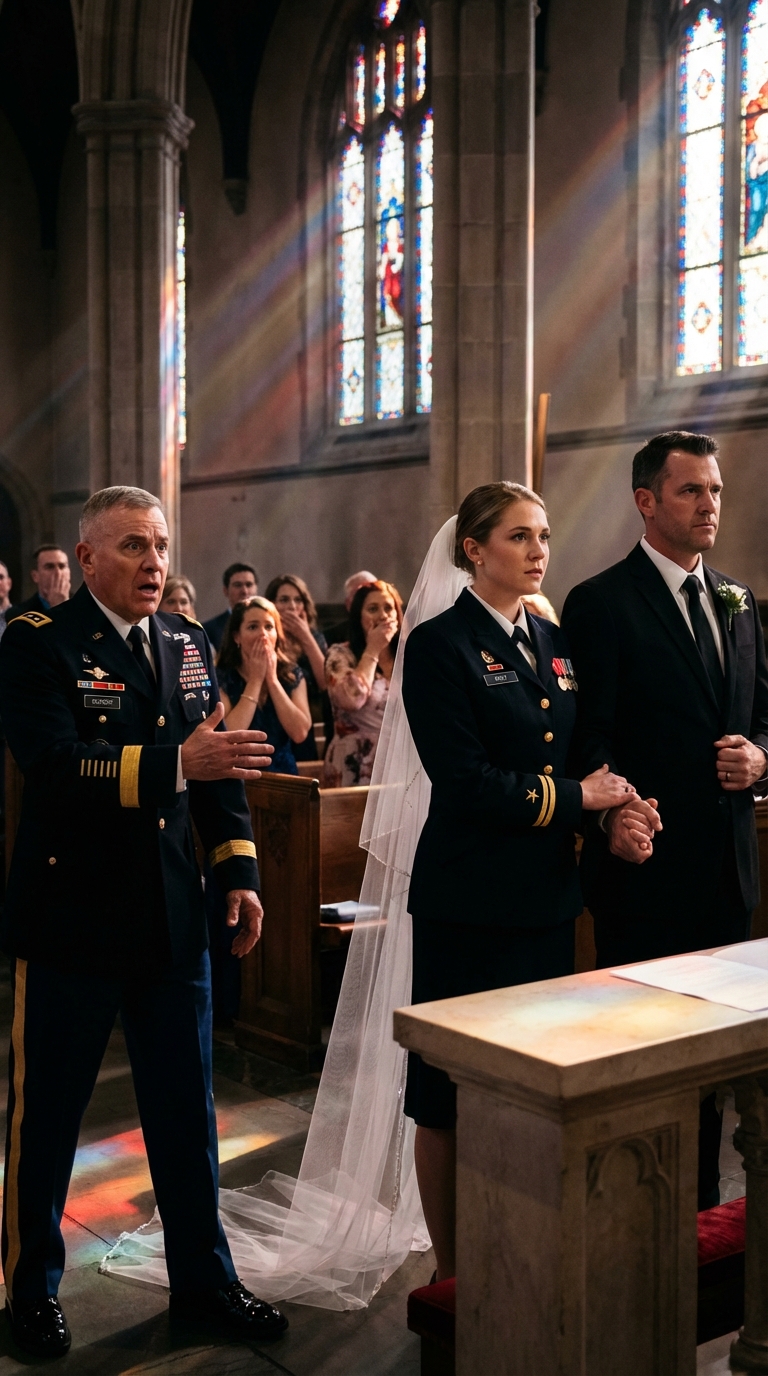
When the bride walked in wearing her Navy SEAL dress uniform instead of a traditional gown, the groom’s family laughed in disbelief. But everything changed when a general at the back of the church suddenly stood up.
There are weddings people remember because of the flowers, or the venue, or the kind of music that lingers just long enough to make everything feel cinematic. And then there are weddings that get remembered for reasons no one planned for—moments that crack through the surface of polite celebration and reveal something much deeper, something raw and real that no amount of preparation can script. The day Elena Torres walked down the aisle in her Navy dress uniform wasn’t supposed to become one of those stories. At least, not in the way it did. It was meant to be simple in intention, even if it didn’t look that way from the outside. She wasn’t trying to make a statement, not really. She just refused to pretend she was someone else for the sake of making other people comfortable, and that alone was enough to unsettle an entire room before the ceremony had even begun.
The first whisper didn’t come from the front, where the immediate family sat stiffly in their pressed outfits and carefully curated expectations. It started somewhere behind the second row, in that ambiguous zone where distant relatives and invited acquaintances tend to gather, the kind of people who feel just removed enough to comment freely. “Is she really wearing that?” someone murmured, not loudly, but not quietly enough either. The words slipped sideways, carried from one ear to another, reshaped slightly with each retelling until they became something more pointed, more amused, more judgmental. By the time the organist began to play the opening notes—steady, traditional, predictable—the whisper had grown into a quiet undercurrent that moved through the chapel like a draft.
Because the bride was not in white.
She stood at the back of the aisle in deep navy blue, the kind that absorbs light instead of reflecting it, her dress uniform pressed so precisely it almost seemed sculpted rather than worn. Lieutenant Commander Elena Torres—Naval Special Warfare—held her posture the way she had been trained to for years, spine aligned, shoulders squared, chin level, every detail deliberate without being rigid. The Trident pinned above her heart caught a sliver of stained-glass light and held it there, as if refusing to let it pass unnoticed. Her hair was secured in a regulation bun, not a strand out of place, and the ribbons on her chest told a story most of the people in that room would never fully understand, even if they stared long enough to memorize their colors.
At the altar stood Adrian Clarke, who looked like he had spent the last ten minutes trying to regulate his breathing without making it obvious. He wasn’t nervous in the way people expect a groom to be—no jittery hands or pacing energy—but there was something deeper in his expression, something steadier and more complicated, like a man who knew this moment mattered in ways that went beyond ceremony. He adjusted his cufflinks once, then stopped himself, as if catching the habit mid-motion. Beside him, his best man leaned in slightly and whispered something that might have been meant as reassurance, but Adrian didn’t respond. His attention had shifted entirely to the back of the room.
His father, Victor Clarke, noticed the uniform too, though his reaction was far less restrained. Victor had built his life on presentation, on the careful cultivation of an image that translated into trust, influence, and, most importantly to him, control. He leaned toward his wife, his voice low but edged with irritation. “This isn’t a ceremony,” he muttered. “It looks like a press conference waiting to happen.” His wife, Lillian, gave a tight smile that didn’t quite mask her discomfort, her fingers adjusting the pearl bracelet on her wrist as if it might ground her in something familiar.
Elena heard the whispers.
She heard the shift in tone, the subtle disapproval that rippled through the room like something alive. But she didn’t react. She had learned long ago that reacting to noise only amplified it, and this wasn’t noise she needed to engage with. The uniform wasn’t chosen for them. It wasn’t chosen to impress or provoke or challenge. It was chosen because it was hers.
Six months earlier, when Adrian had proposed, it hadn’t been in a grand, orchestrated setting. It was quiet, almost understated, on a rooftop that overlooked a city neither of them planned to stay in forever. Two days later, she had been called back to base for deployment orders that couldn’t be delayed, couldn’t be negotiated. They had postponed the wedding once, then again, each time telling themselves it didn’t matter because the timing would eventually work out.
During that last deployment, Elena lost someone.
Not in a dramatic, cinematic way. Not in a moment that could be easily explained. It was sudden, disorienting, and final in a way that left no room for closure. Senior Chief Aaron Velez had been the kind of operator people relied on without thinking about it, the kind who carried a steady calm into situations that demanded it. The night before one mission, he had joked with her over lukewarm coffee, saying, “If you ever get married, don’t tone yourself down for it. That’s the one day you’re allowed to be exactly who you are without apology.”
At the time, she had laughed it off.
After he was gone, the words stayed.
When she came back stateside, Adrian suggested a traditional dress, not out of pressure but out of instinct, because that’s what most people expect. Elena didn’t answer right away. Instead, she visited a cemetery she had avoided since returning. Arlington doesn’t feel like a place that demands silence, but it creates it anyway, the kind that presses inward rather than outward. She stood there longer than she meant to, reading names, dates, imagining the lives behind them, the families that had stood in places just like that and tried to make sense of absence.
By the time she left, the decision had already been made.
“I’m not choosing between parts of my life,” she told Adrian later that night. “I’m not leaving something behind just because it makes people uncomfortable.”
He had looked at her for a long moment, then nodded. “Then don’t,” he said simply.
He meant it.
But his father didn’t.
Victor Clarke believed in optics, in alignment, in the idea that every public moment contributed to a larger narrative. A bride in uniform disrupted that narrative in ways he couldn’t control, and that alone was enough to unsettle him. He had invited business partners, investors, people who evaluated everything through the lens of perception. This wasn’t what they had expected to see.

When the doors opened fully and Elena began walking down the aisle, the sound of her heels against the marble floor cut cleanly through the room, steady and unhurried. Her father, Miguel Torres, walked beside her, his hand firm around hers, his presence quiet but unmistakably proud. He had spent thirty years as a firefighter, and there was something in the way he carried himself that mirrored her own discipline, though his pride showed more openly in the slight lift of his chin, the way his eyes didn’t leave her for a second.
Halfway down the aisle, someone let out a soft laugh, quickly stifled but not entirely hidden.
Elena didn’t break stride.
At the altar, Adrian’s expression shifted the moment she reached him. Whatever tension had been building in the room seemed to fall away, at least for him. “You look exactly like yourself,” he said under his breath, his voice low enough that only she could hear.
She allowed the smallest hint of a smile. “That was the goal.”
The ceremony began, the officiant’s voice steady, measured, moving through familiar words that were meant to ground the moment in tradition. For a few minutes, it almost worked. The whispers faded, replaced by something closer to attention, if not full acceptance.
Then the doors opened again.
This time, no one whispered.
They turned.
A tall man in full military dress stepped inside, his presence immediate, undeniable. Four stars rested on his shoulders, catching the same stained-glass light that had touched Elena’s uniform moments earlier. Behind him, two officers followed, along with a chaplain whose expression was solemn enough to shift the entire mood of the room before a single word was spoken.
Brigadier General Thomas Rourke didn’t hurry.
He walked with the kind of deliberate pace that signals authority without needing to announce it, each step measured, each movement purposeful. The air in the chapel changed as he moved forward, not dramatically, but enough that people straightened in their seats without realizing why.
The officiant faltered mid-sentence. “General… is there something—”
“Yes,” Rourke said, his voice calm but carrying easily. “There is.”
Elena’s posture tightened, almost imperceptibly.
“Ma’am?” Adrian whispered.
She already knew.
The general’s gaze settled on her. “Commander Torres,” he said, his tone respectful but firm. “I apologize for the interruption. But I wouldn’t be here if it wasn’t necessary.”
Victor Clarke stood up abruptly. “This is completely inappropriate,” he snapped. “Whatever this is can wait.”
Rourke didn’t look at him.
“There’s been a development overseas,” he continued. “A situation involving civilian personnel that has escalated faster than anticipated. We’re assembling a rapid response unit.”
Elena didn’t ask why.
She asked, “What’s the timeline?”
“Mobilization within twelve hours.”
The words landed heavily.
Adrian’s hand tightened around hers. “You’d have to leave… now?” he asked quietly.
“Soon,” she answered, her voice steady but softer than before.
Victor scoffed, shaking his head. “This is exactly what I was talking about,” he said, louder now. “This—this inability to separate personal life from—”
“From what?” Elena interrupted, turning to face him fully for the first time. “From responsibility?”
The room went still.
Adrian stepped forward slightly, placing himself beside her rather than between them. “How long do we have?” he asked the general.
Rourke glanced at his watch. “You have time to finish this,” he said. “But not much more.”
The decision hung in the air, unspoken but unavoidable.
Victor shook his head again. “If she walks out of here today, you need to understand what that looks like,” he said to Adrian. “To everyone.”
Adrian looked at him, really looked this time, and something in his expression shifted—not anger, not defiance, but clarity. “I know exactly what it looks like,” he said. Then he turned back to Elena. “We’re not stopping,” he added. “We’re just moving faster.”
The officiant blinked, clearly trying to process the situation. “Shall… we continue?”
“Yes,” Adrian said.
And so they did.
The vows were spoken with a different kind of intensity now, not rushed, but sharpened by the awareness that time was no longer a given. When Adrian slipped the ring onto Elena’s finger, his hand was steady, even if his breathing wasn’t. When she did the same, there was a brief moment where her composure faltered, just enough for the emotion beneath it to show through.
When they kissed, it wasn’t performative.
It was grounding.
The applause that followed wasn’t polite.
It was something stronger, something that carried a shift in perception, even among those who had been whispering earlier.
General Rourke stepped forward once the sound faded, reaching into his jacket. “There’s one more thing,” he said. “This wasn’t how I intended to present it, but circumstances rarely align with intention.”
He opened a small box.
Inside was a Distinguished Service Medal.
The room fell silent again.
“For leadership under conditions that most people in this room will never fully understand,” he said, pinning it carefully onto Elena’s uniform. “And for a level of commitment that doesn’t pause for convenience.”
Victor Clarke sat down slowly.
This time, no one laughed.
Six weeks later, Elena returned.
No cameras.
No announcements.
Just Adrian waiting near the base entrance, hands in his pockets, trying to look less like he had been standing there for longer than he wanted to admit.
When she stepped out, she looked tired in a way that couldn’t be fixed with sleep alone, but she was there.
That was enough.
“Permission to come home?” she asked, echoing the same quiet humor she had used at the altar.
He pulled her into an embrace before answering. “Always,” he said.
Months later, when people asked about the wedding, about the uniform, about the interruption, Elena never framed it as something extraordinary.
“It wasn’t about making a point,” she said once in an interview. “It was about not pretending that one part of your life matters less than another. You don’t stop being who you are just because the setting changes.”
Lesson of the story:
Authenticity often makes people uncomfortable before it earns their respect, but that discomfort is not a sign that you are wrong—it is a sign that you are refusing to shrink yourself to fit expectations. True strength lies in honoring every part of who you are, even when the world expects you to choose just one.