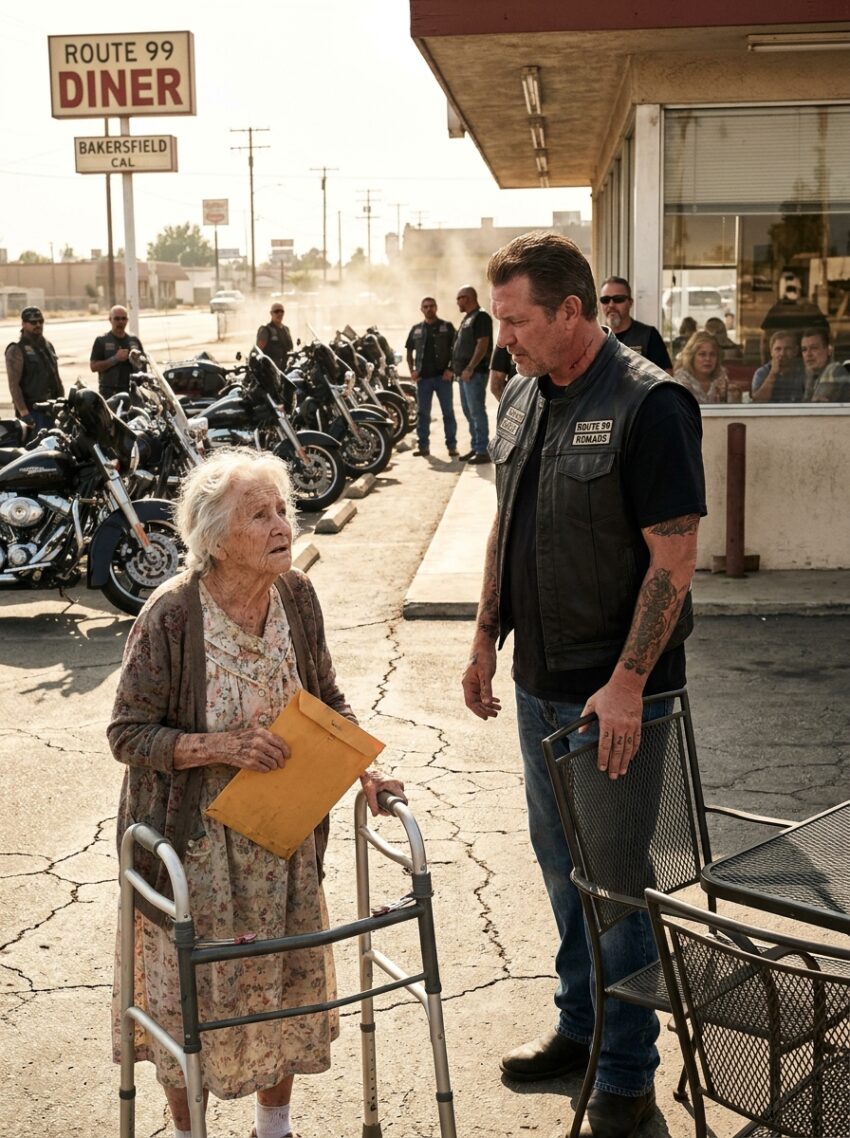
An 82-year-old woman, betrayed by her greedy grandson, asked a group of Hells Angels bikers to pose as her son. What followed stunned the entire town—twenty bikers stood by her side, choosing loyalty over fear, and by sunset, justice was served as she found a true family no money could ever buy.
The first thing people noticed about Eleanor Whitaker—if they noticed her at all—was how carefully she moved, as though every step required negotiation with time itself. She was eighty-two, though she disliked the number because it sounded heavier than she felt inside, and on that particular Tuesday in late August, the heat in Bakersfield pressed down like a hand that refused to let go. The asphalt outside the diner shimmered, the air thick with dust and the faint scent of burnt oil, and inside the Route 99 Diner, the broken air conditioner rattled like it was arguing with its own existence.
Eleanor sat in the far booth, the one with the cracked vinyl seat that sighed whenever she shifted her weight. Her iced tea had long since turned watery, the ice melted into something lukewarm and forgettable, but she hadn’t touched it in nearly an hour. Her attention kept drifting back to the envelope resting in her lap, its edges softened from being opened and folded too many times in too short a span. It wasn’t just paper—it was a countdown.
Her grandson, Caleb Mercer, had always been clever in the way that made people trust him too quickly. Even as a boy, he knew how to tilt his head just enough, how to soften his voice at the right moment, how to make promises feel like guarantees. After her daughter passed, he became Eleanor’s only remaining family, and for a while, she let herself believe that was enough. But somewhere along the years, something had shifted. The visits became shorter, the calls less frequent, and then, almost overnight, he returned with urgency—papers, signatures, concerned looks that felt rehearsed.
The documents now in her lap said things she still couldn’t quite accept: cognitive decline, inability to manage personal affairs, petition for conservatorship. Beneath the legal language was a simpler truth—he wanted her gone. The farmhouse, sitting on acres of land that had quietly become valuable, was the real target. Developers had circled for years. Caleb had finally decided to open the door for them.
She checked the time again. 2:12 p.m.
He would arrive at four, with lawyers and someone she’d never met but who would claim to assess her mental state. Everything would happen quickly. Efficiently. Clean, in the way that erased resistance.
Eleanor exhaled slowly, her fingers tightening around the envelope.
She had called the police. They said it was a civil matter. She had called legal aid. They said they could schedule something in three weeks. She had even called an old neighbor who used to fix tractors with her husband, but he had passed the previous winter.
There was no one left to call.
And then the sound came.
It started low, like distant thunder rolling beneath the ground, and then it grew—layer upon layer of engines, heavy and deliberate. The diner windows trembled slightly, the silverware on nearby tables giving a faint metallic rattle as heads turned toward the parking lot.
Motorcycles.
Not one or two, but a formation—tight, controlled, unmistakable.
Eleanor didn’t need to step outside to know what they were. Everyone in Bakersfield recognized that sound. The leather. The patches. The reputation that walked in before they did.
A group of bikers—twenty, maybe more—rolled into the lot and parked in a line so precise it almost looked choreographed. Conversations inside the diner dropped into uneasy silence. A waitress paused mid-step, tray hovering, as if she had forgotten what she was doing.
Eleanor watched through the window, something in her chest tightening, not with fear exactly, but with a kind of desperate calculation. She had lived long enough to know that help rarely arrived in the form you expected. Sometimes, it didn’t look like help at all.
She checked the time again.
2:15 p.m.
Less than two hours.
Her hands trembled as she pushed herself up, leaning on her walker. The metal legs scraped lightly against the floor, the sound oddly loud in the hush that had settled over the diner. A few people glanced at her, confusion flickering across their faces, but no one said anything.
Outside, the heat wrapped around her immediately, pressing against her lungs as she stepped into the sunlight. The bikers were dismounting, removing helmets, stretching shoulders, their presence filling the space with something that felt both dangerous and grounded.
At the center stood a man who drew attention without trying. He was tall, broad in a way that suggested years of physical labor rather than vanity, his arms marked with ink that told stories Eleanor couldn’t read. A scar ran from just below his ear down along his neck, pale against sun-weathered skin.
He noticed her before she reached them.
Of course he did.
People like him didn’t miss much.
Eleanor stopped a few feet away, her grip tightening on the walker as she forced herself to meet his eyes. They were not what she expected—steady, yes, but not cold. There was something else there. Something that paused instead of pushed.
“Can you pretend to be my son today?” she asked.
The words sounded strange even to her, hanging in the hot air like something misplaced.
For a moment, no one spoke.
Then the man tilted his head slightly, studying her, not dismissing her, not laughing, just… considering. He pulled out a chair from one of the outdoor tables and nudged it toward her.
“Sit,” he said, his voice low but clear. “Start from the beginning.”
And so she did.

It wasn’t a clean story. It came out unevenly, pieces of memory and frustration tangled together—her husband, Daniel, who had planted every tree in the orchard by hand; the farmhouse they built room by room; the years that had passed quietly until they hadn’t. She told them about Caleb, about the papers, about the four o’clock deadline that loomed like a closing door.
As she spoke, something shifted among the men. The initial curiosity gave way to stillness, then to something heavier. These were not men unfamiliar with broken loyalty. They recognized it in the way her voice caught when she spoke about her grandson, in the way her hands tightened when she mentioned the word family.
The man with the scar listened without interrupting, his gaze steady the entire time.
When she finished, the silence that followed felt different than before—not uncertain, but resolved.
He nodded once, almost to himself, then glanced over his shoulder.
“Eli,” he called out. “Go find me something with buttons. Clean, if possible.”
A younger man, leaner, with sharp eyes and a quicker step, nodded and jogged toward one of the bikes, digging into a saddlebag.
The older man turned back to Eleanor.
“We’re going to your place,” he said.
She blinked. “You don’t have to—”
He cut her off with a small shake of his head.
“We’re not pretending,” he said, and there was a quiet firmness in his tone that made the words settle differently. “We’re your family now.”
Something in Eleanor’s chest shifted, fragile and unfamiliar. She didn’t trust it entirely—not yet—but she didn’t reject it either.
By the time they reached her farmhouse, the sun had dipped slightly, the light softening just enough to take the edge off the heat. The property looked exactly as she had left it that morning—faded paint, a porch railing that needed repair, weeds creeping where they shouldn’t—but seeing it now, with the low rumble of engines filling the space, made it feel… defended.
Eli returned wearing a flannel shirt that fit him surprisingly well, his usual leather vest tucked away. He stood near the porch, posture straighter, expression composed in a way that suggested he understood the role he was stepping into.
“Good enough?” he asked.
Eleanor studied him for a moment, then nodded.
“It’ll do,” she said softly.
At exactly 4:00 p.m., a sleek black car turned onto the gravel driveway, its tires crunching loudly in the sudden quiet. It stopped a few yards away, and Caleb stepped out, adjusting his jacket, his expression already forming the practiced concern he had likely rehearsed.
That expression faltered the moment he looked up.
Because what he expected—an old woman alone, perhaps confused, certainly vulnerable—was not what stood before him.
Eleanor sat calmly on the porch, a glass of lemonade in her hand, her posture relaxed in a way that felt deliberate. Behind her stood Eli, steady and composed, and lining the driveway, the bikers remained astride their motorcycles, engines idling low, a collective presence that didn’t need to move to be understood.
Caleb froze.
“What is this?” he demanded, his voice sharper than intended. “Grandma, who are these people?”
Eleanor didn’t raise her voice.
“This is my family,” she said.
She gestured slightly toward Eli.
“And this is my son. He’s been helping me manage things.”
Caleb’s eyes flicked between them, confusion giving way to irritation.
“That’s ridiculous,” he snapped, pulling a folder from his car. “I have legal documents—”
He didn’t get any further.
The man with the scar stepped forward, placing himself squarely in Caleb’s path. Up close, his presence was even more imposing, not because of aggression, but because of certainty.
“She said you’re trespassing,” he said evenly. “That means you’re done here.”
Caleb hesitated, his confidence slipping just enough to show the cracks.
“You can’t just—this is a legal matter—”
Eli stepped down from the porch, pulling out his phone and holding it out.
“Call your office,” he said. “Ask about the audit that started fifteen minutes ago.”
Caleb frowned, but something in Eli’s tone made him take the phone. He dialed, his irritation still present but now mixed with unease.
The change came gradually.
At first, it was just a shift in posture. Then his face tightened, color draining slowly as the voice on the other end spoke. His free hand clenched at his side, the folder slipping slightly from his grip.
“What do you mean… missing funds?” he said, his voice quieter now. “That’s not possible.”
Eleanor watched him, not with satisfaction, but with a kind of tired understanding. She had suspected something like this, the sudden urgency, the way he had pushed for signatures without explanation. It wasn’t just greed—it was desperation.
Eli took the phone back gently.
“The conservatorship is over,” he said. “And if you come back, you’ll be dealing with more than paperwork.”
Caleb didn’t argue.
He got back into his car, the door closing harder than necessary, and drove away without another word.
The dust settled slowly in his wake.
For a moment, no one moved.
Then one of the bikers let out a low whistle, and the tension broke, replaced by something lighter, almost relieved.
They stayed.
Not out of obligation, but because leaving immediately felt wrong.
They fixed the porch railing, the rhythmic sound of hammers filling the air. They cleared weeds, hauled debris, brought a kind of energy the place hadn’t seen in years. Eleanor sat and watched, occasionally offering direction, more often just absorbing the presence of people who had chosen to stay when they could have left.
As the sun began to set, painting the sky in shades of amber and violet, the man with the scar approached her again.
“You’ll be okay?” he asked.
Eleanor looked at him, really looked this time, seeing past the ink and the reputation to something steadier underneath.
“I think I will,” she said.
He nodded, then extended his hand. She took it, her grip surprisingly firm.
“You’re not alone anymore,” he said. “We’ll check in. Regularly.”
Eleanor smiled, a real one this time, the kind that softened her entire face.
“I asked for one son,” she said quietly, “and somehow ended up with more than I can count.”
He huffed a small laugh, shaking his head.
“Life does that sometimes.”
When the engines roared back to life, the sound rolled across the valley, echoing off the hills in a way that felt different now—not threatening, but protective.
Eleanor stood on the porch, watching them disappear down the road, the last traces of sunlight catching on chrome and leather.
For the first time in a long while, the silence that followed didn’t feel empty.
It felt like something had finally settled into place.
Lesson of the story:
Sometimes, family is not defined by blood but by the people who choose to stand beside you when it matters most. Loyalty, once broken, cannot be repaired with words alone—but it can be rebuilt through action, through courage, and through unexpected connections that remind us we are never truly alone if we are willing to ask for help.