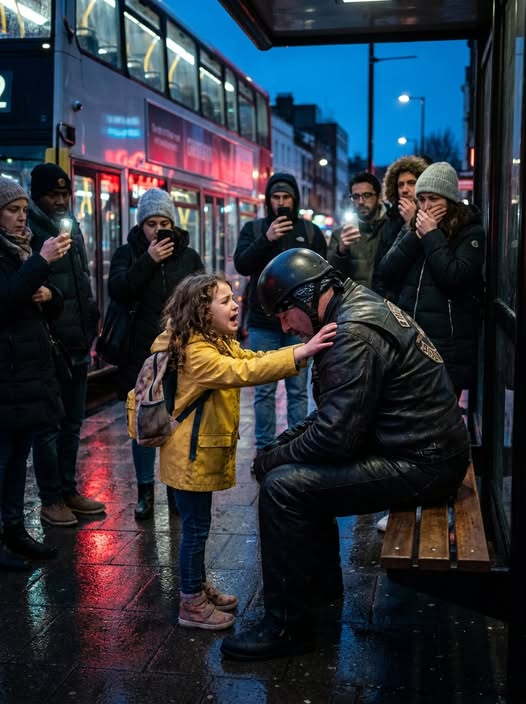
A little girl suddenly struck a biker at a bus stop, shocking everyone nearby who assumed it was an act of defiance, until it became clear her actions were actually a desperate attempt to warn him about something urgent and dangerous.
It was one of those late afternoons that didn’t feel like anything special at first, the kind that slips past you unnoticed unless something interrupts it hard enough to leave a mark. Downtown Denver had already begun its usual descent into the early evening rush, that familiar choreography of buses sighing at the curb, doors folding open and shut, commuters moving in practiced patterns, shoulders brushing without apology, eyes glued to screens as if the world existed somewhere else entirely. The air carried that faint metallic chill that hinted at night coming too quickly, and if you stood still long enough, you could hear the low hum of the city blending into something almost hypnotic.
At the far end of a bus stop bench, half-shadowed by a flickering streetlight that hadn’t decided whether it wanted to stay on yet, sat a man most people noticed only long enough to look away again. His name was Daniel Cross, though no one there knew it at the time, and even if they had, it wouldn’t have changed much about the way they saw him. He looked exactly like the kind of man people had already decided who he was before he ever spoke—broad shoulders that seemed carved more than built, a sleeveless leather vest worn enough to suggest years rather than fashion, tattoos creeping down both arms in faded ink that told stories no one present would bother asking about. His boots were planted flat against the pavement, heavy, unmoving, his helmet resting beside him like an afterthought.
He wasn’t slouched. That was the unsettling part.
He sat upright, still in a way that didn’t feel relaxed but deliberate, as if he had paused mid-motion and never resumed. His head dipped slightly forward, just enough to make his expression unreadable, and his hands rested loosely on his thighs. To anyone passing by, it could have been fatigue, maybe a long day catching up with him, maybe the kind of exhaustion that settles into your bones and refuses to leave.
People noticed. Of course they did. Humans are wired to notice anything that doesn’t quite fit the rhythm of a place.
“Guy looks out of it,” someone muttered as they walked past.
“He’s fine,” another replied quickly, dismissively, because it was easier to assume that than to test it.
And that was the end of it.
Because noticing is not the same as acting, and most of the time, the distance between those two things is filled with hesitation, with doubt, with that quiet voice that tells you you might be wrong, and being wrong in public feels worse than doing nothing at all.
Not far from the bench stood a little girl named Lila Moreno, her small hand wrapped tightly around the strap of a faded purple backpack, the other clutching the sleeve of her grandmother’s coat. She had been waiting there for nearly ten minutes, shifting her weight from one foot to the other, watching buses come and go, people arriving and leaving in waves that never quite settled. Her grandmother, Elena, was talking about something—groceries, or dinner, or the neighbor who always parked too close—but Lila wasn’t listening anymore.
She had noticed the man.
Not in the passing way others had, but in the way children notice things adults have learned to ignore. She watched how he didn’t move when someone brushed past his knee. How he didn’t adjust when the wind pushed lightly against him. How even when a bus pulled in with a loud hiss right in front of him, he didn’t react—not a flinch, not a blink.
That wasn’t normal.
At first, she told herself he was just tired. People got tired. Her teacher sometimes looked like that at the end of the day. Her mom did too when she worked late. But tired people shifted eventually. They blinked. They stretched. They sighed.
This man did none of those things.
Lila felt something tighten in her chest, a small, persistent unease that didn’t have a name yet. She glanced up at her grandmother, who was still talking, still unaware, still wrapped in the safe assumption that everything around them was exactly what it seemed.
“Abuela,” Lila said softly.
Elena didn’t hear her.
Lila looked back at the man.
There was something else now. Something she hadn’t noticed before, or maybe hadn’t understood. His breathing. It was there, but it wasn’t right. It came in shallow, uneven pulls, as if each breath had to fight its way in, like he was forgetting how to do it and then remembering at the last second.
Her grip on the backpack tightened.
“Abuela,” she tried again, louder this time.
“Yes, mija?” Elena finally responded, glancing down.
“That man…” Lila began, but then she hesitated, because even as she said it, she could hear how it sounded. Adults didn’t like vague concerns. They wanted explanations, reasons, something concrete.
“He looks sick,” she finished.
Elena followed her gaze briefly, her eyes landing on Daniel for no more than a second before moving on. “He’s probably just resting,” she said, gentle but dismissive, the way people are when they don’t want to complicate a simple moment.
But Lila didn’t look away.
She watched as another person brushed past him, bumping his shoulder slightly. No reaction.
Her heart started beating faster.
That wasn’t tired.
That wasn’t normal.

And suddenly, the unease sharpened into something urgent, something that didn’t allow for waiting anymore.
Before her grandmother could say anything else, Lila let go of her sleeve and stepped forward.
At first, no one paid attention. A child moving through a crowded bus stop didn’t stand out. But then she kept going, straight toward the bench, toward the man everyone had already decided not to approach.
“Elena!” her grandmother called, startled, but Lila didn’t stop.
She reached him in seconds, standing just within arm’s reach, her small frame dwarfed by his stillness.
“Hey,” she said.
No response.
Her throat tightened.
“Hey!” she tried again, louder.
Still nothing.
And then, driven by something deeper than hesitation, something instinctive and raw, she lifted her hand and struck his shoulder—not hard enough to hurt, but sharp enough to break through whatever silence he was trapped in.
The sound cracked through the air, loud enough to cut across the noise of engines and conversation.
Everything stopped.
“What the hell—?” someone exclaimed.
“Did she just hit him?” another voice rose, incredulous.
A man stepped forward immediately, his tone sharp with judgment. “Hey! You don’t do that!”
But Lila didn’t look at him. She didn’t look at anyone else.
She stared at Daniel, her chest rising and falling too quickly now, her eyes wide not with defiance but with fear.
“Wake up,” she whispered.
The words were lost to most of the crowd, swallowed by the lingering noise, but their intent was clear in her expression.
Elena rushed forward, grabbing her arm. “Lila! What are you doing?!” she demanded, pulling her back.
“No—wait—” Lila protested, trying to twist free.
The crowd had already decided what they were seeing. A misbehaving child. A reckless act. A situation that needed correction.
Phones came up. Whispers spread. The usual chorus of public judgment, quick and confident.
But then Lila broke free again.
She ran back toward him, faster this time, urgency overriding everything else.
“Stop her!” someone shouted.
Too late.
She stood right in front of him again, closer now, her voice louder, sharper, cutting through the confusion.
“He’s not waking up!”
That changed things.
Not immediately, not all at once, but enough to make people hesitate, to look again instead of looking away.
“What do you mean?” someone asked.
Lila pointed, her hand trembling. “He didn’t move. When the bus came. When people bumped him. He’s not… he’s not okay.”
Now people really looked.
The man who had spoken earlier stepped closer, his expression shifting from annoyance to concern. He crouched slightly, leaning in.
“Sir?” he called.
Nothing.
The stillness that had seemed harmless moments ago now felt wrong in a way that was impossible to ignore.
Lila’s voice cracked. “He’s breathing weird.”
That was the turning point.
Because once someone says it out loud, once the possibility becomes real, it spreads quickly.
“What do you mean weird?”
“Like… like he can’t,” she said, struggling to explain something she didn’t fully understand but knew was wrong.
The man reached out, placing a hand on Daniel’s shoulder, shaking him gently. “Sir? Can you hear me?”
No response.
“Call 911!” someone shouted.
“I already am!”
The energy shifted completely now, from judgment to urgency, from distance to involvement.
Daniel’s fingers twitched.
It was faint, barely noticeable, but Lila saw it immediately.
“Look!” she said, hope flickering through her fear. “He hears you!”
The man leaned closer. “Stay with us, okay? Stay with us.”
Sirens began to cut through the distance, growing louder, closer, carrying with them the promise of help that always seems both too slow and too fast at the same time.
By the time paramedics arrived, moving with that controlled efficiency that comes from seeing too much too often, the crowd had parted, leaving a clear path.
“What happened?” one of them asked.
The man glanced at Lila. “She noticed. Before any of us.”
They worked quickly, assessing, stabilizing, oxygen mask in place, voices calm but urgent.
As they lifted Daniel onto the stretcher, his hand moved again, weaker this time, reaching without direction.
Lila stepped forward instinctively.
For a brief moment, time seemed to slow as her small hand met his.
Just a touch.
Just enough.
Then the doors closed, the sirens faded, and the bus stop returned to something resembling normal—but not quite the same.
Because something had shifted.
Something people would carry with them, whether they realized it or not.
Two days later, the sound of engines returned—not chaotic, but controlled, deliberate, a low rumble that turned heads long before the motorcycles came into view.
Dozens of them.
They pulled up in formation, stopping near the same bus stop where it had all happened.
An older rider stepped forward, his presence steady, measured. His name was Victor Hale, though again, names mattered less than what he carried with him.
He approached Lila and her grandmother.
“You the one who hit him?” he asked gently.
Lila nodded, suddenly unsure.
Victor’s expression softened. “Good,” he said. “Because he’s alive.”
Elena covered her mouth, emotion rising too quickly to contain.
“Heart condition,” Victor continued. “Came out of nowhere. If he’d been sitting there much longer…”
He didn’t finish the sentence.
He didn’t need to.
“He told us about you,” he added.
Lila blinked. “He did?”
Victor nodded. “Said a kid refused to let him disappear.”
From his vest, he pulled out a worn envelope, handing it over carefully.
“First step,” he said.
Inside was a key. An address. Something more than a gesture, though not fully explained.
“He wanted you to have it,” Victor said. “Said your family could use it more than he ever did.”
The engines started again, low and steady, and one by one, they left.
No spectacle. No noise beyond what they arrived with.
Just presence.
And absence.
And the quiet understanding that sometimes, the things that look wrong to everyone else are the only things that save a life.
Lesson from the Story
What we often label as inappropriate, impulsive, or even wrong can sometimes be the clearest expression of awareness in a moment where hesitation costs more than action. Adults tend to filter reality through doubt and social rules, while children act on instinct, unburdened by the fear of being judged. This story reminds us that awareness is not enough—we must be willing to act on it, even when it feels uncomfortable or risks misunderstanding. Because sometimes, the line between chaos and rescue is crossed by the person brave enough to trust what they see, not what others assume.