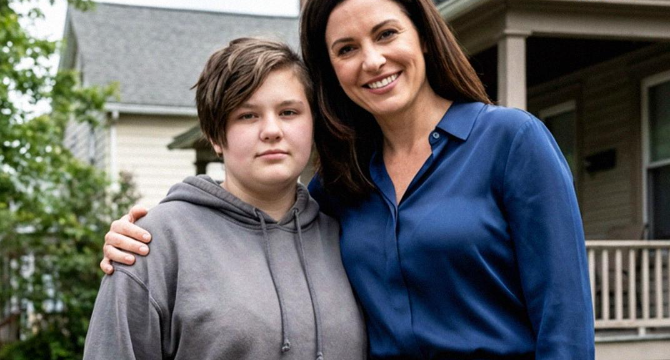
I loved my daughter more than anything I had ever known.
I knew her moods by the way she closed a door, her habits by the sounds she made in the next room, and the small things that could make her laugh when she’d had a bad day.
But for years, there was one thought I hated myself for having: she did not look like me, and she did not look like my husband either.
People have a million ways to make you feel silly for noticing such things.
“Kids change.” “Genes are funny.” “Maybe she’s like some great-aunt.” “She’s just her own person.”
So I nodded, laughed, and acted grateful for the wisdom, then went home and stared at my child while she colored at the kitchen table.
I wondered why she felt like mine in every way that mattered and yet, somewhere deep in my bones, also felt like a question I was too afraid to ask.
Her name was Riley.
At least, that was the name I gave her. The name on her school forms, on her birthday cakes, and on the little wooden sign I painted for her bedroom door when she was four and obsessed with purple glitter and horses.
I raised her mostly alone. My ex-husband, Ryan, left when she was two.
Actually, “left” is a polite word. He drifted first, and then he started coming home late. One day, he stood in our kitchen, looking at the fridge instead of me, and said, “I can’t do this anymore.”
I remember laughing because I thought he meant the marriage.
Then I said, “Fine. We can end the marriage. But you don’t get to stop being her father.”
He rubbed his face and said, “I know.”
He did not know.
He paid support when he felt like it and visited when it suited him. He made promises to a toddler and then a child and then a girl, and every time she stood at the window waiting for his car, I hated him more.
So it became just the two of us.
When she got older, the questions got louder in my head. Her eyes were a different shade, and her laugh sounded unfamiliar. Even her habits felt strange. I stacked books in neat piles; she left them open and upside down like she had just stepped out of them.
I loved quiet; she filled silence with humming, tapping, and little songs under her breath. I was careful with people. She trusted too quickly, loved too openly, and forgave too much.
Sometimes I would look at her and think, Whose smile is that?
Then I would hate myself.
Because I was her mother. I had rocked her through fevers and cut crusts off sandwiches for ten years.
I had worked double shifts and skipped new shoes and smiled through panic over rent so she could do dance class for exactly one semester before deciding she hated dance and loved robotics.
I had earned the right to call her mine.
So I did.
Then came the hospital visit. It was ordinary. Life almost never announces that it is about to split in half.
Riley had been tired for a few weeks. Pale and bruising more easily. Nothing dramatic, just enough for me to call our pediatrician, who told me to bring her in for blood work “just to rule things out.”
Riley rolled her eyes in the waiting room.
“This is so annoying,” she muttered. “I feel fine.”
“You just told me this morning your legs felt weird.”
“But I feel okay now.”
I smiled. “Very convincing.”
She smiled back, and for a moment, I felt silly for worrying.
The doctor came in later with a face that made my stomach drop.
He sat down across from me and looked at Riley first with careful concern.
“Can you give your mom and me a minute?” he asked gently.
Riley stood up immediately. “I’ll go get some fresh air.”
The door closed behind her.
I turned to him. “What is it?”
He looked at the chart, then at me. “Some of her markers don’t line up with her medical history.”
I frowned. “What does that mean?”
“It may mean nothing urgent. But I want to repeat some tests. Also…” He paused. “Was she adopted?”
I stared at him.
“No.”
He folded his hands. “I don’t want to alarm you. But for accuracy, I would like to order a comparative DNA test.”
The room went so quiet I could hear a printer somewhere down the hall.
I said, very slowly, “Why would you need that?”
“Because based on her blood type and your records, there is an inconsistency.”
My mouth went dry. “You’re saying she’s not mine?”
“I’m saying we need more information.”
I heard myself ask practical things after that. Insurance, timing, where the sample would go, and when results might come back. I gave my phone number twice because my hands were shaking the first time.
Then I walked out holding Riley’s backpack while she stood at the doorway and said, “Can we get fries?”
I looked at her face. Her familiar face. The one I had kissed a thousand times.
“Yeah,” I said. “We can get fries.”
That night after she went to bed, I stood in her doorway and watched her sleep. The little night-light made half her face gold.
That night, I couldn’t sleep. I just lay there wondering if the suspicion I had buried for years, the one everyone else had always dismissed, had been right all along.
Around ten the next morning, my phone rang. I grabbed it so fast I almost dropped it. It was an unknown number.
My heart started pounding. I answered on the first ring.
“Hello?”
For a second, there was only breathing.
Then a woman said softly, “Please don’t hang up. We need to talk about your daughter.”
Every part of me went cold.
“Who is this?”
“My name is Nora.”
I almost ended the call right there. “How did you get my number?”
There was a shaky inhale on the other end. “From the hospital. I had a DNA test done last month. They called me yesterday because there may be another family involved.”
I sat down so suddenly that I missed the chair and hit the edge of the table with my hip.
“What are you talking about?”
Her voice cracked. “I think our daughters were switched.”
I laughed. I did not mean to. It burst out of me like something broken.
“That’s insane.”
“I know.”
“No, you don’t get to call me and say something like that. Who even are you?”
She said her last name.
I froze.
It was my last name.
Not because we were related. Because before Ryan left, I had his name.
And the hospital still had me listed under it from Riley’s birth records. Nora had the same married surname. Our daughters were born on the same day, in the same hospital, and we had the same last name.
I gripped the phone harder. “No.”
“I didn’t believe it either,” she whispered. “Not until they called me.”
I shut my eyes. “Why were you getting a DNA test?”
There was silence, and then she said, “Because my daughter needed a procedure, and our bloodwork didn’t make sense either.”
I could hear her crying, trying not to let me hear it.
“We need to meet,” she said. “Or at least wait for your results and then decide. But please don’t think I’m lying. I would never do this to someone for no reason.”
I don’t remember ending the call.
I remember sitting there while the refrigerator hummed, the clock above the stove ticked too loudly, and my mind kept repeating one sentence.
Our daughters may have been switched, and there was nothing I could do at the moment but wait for the DNA results.
A few days later, the hospital called me and asked me to check my email.
Upon opening it, I read the text three times before the words fully sank in: I was not the biological mother of the daughter I had raised.
I pressed my hand over my mouth and decided that it was time to meet Nora.
I met her that afternoon in a coffee shop halfway across town. I knew her the second she walked in, though I had never seen her before. She had Riley’s eyes. My daughter’s eyes.
She stopped when she saw me and gasped.
For one awful second, we just stared.
Then she whispered, “Oh my God.”
I stood up too quickly and knocked my chair back. Neither of us apologized as we were past manners.
She sat across from me, trembling. Up close, I could see she had not slept. I probably looked the same.
“Her name is Flora,” Nora said.
I almost flinched.
“My daughter,” she clarified, then let out a broken laugh. “I don’t even know what words to use anymore.”
I nodded because I didn’t either.
She pulled out her phone with shaking fingers. “Can I show you a picture?”
I couldn’t speak, so I nodded again.
It was a girl in a soccer uniform, grass stains on both knees, grinning at the camera with one front tooth slightly crooked.
I felt the world tilt. She looked like me.
Nora looked at me with tears running down her face. “I saw your daughter’s school picture on the hospital paperwork.”
I knew before she finished.
“She looks like my husband,” Nora whispered. “Or my ex-husband. She has his ears. His chin. His expression when she’s annoyed.”
I laughed once, then covered my face.
Neither of us had done anything wrong, and still we sat there looking at each other like survivors of the same fire.
We spent two hours trading facts like detectives trying to prove our own lives.
The delivery date, room number, nurse names, and recovery wing. Tiny details only a mother would remember.
At one point, Nora whispered, “I used to wonder why Flora hated cilantro. Everyone in my family loved it despite its taste.”
I stared at her.
Then I said, “Riley loves it. She puts it on everything.”
We both started crying again.
The hospital investigation moved fast once both DNA tests matched.
An administrator sat with us in a conference room and used words like “unprecedented event,” “deepest regret,” and “historical records review.” I wanted to throw the pitcher of water at the wall.
“What happened?” I said. “Not your legal wording. What happened?”
They had checked archived records. With two infants having the same birthday, same last name, and same maternity floor, a charting error had occurred.
A bassinet tag was also misread during a transfer, with one nurse signing off for another in a rush. Then nobody caught it because both babies were healthy, both were discharged within hours, and everyone trusted the labels.
Mistakes that, now, twelve years later, had hit us in the face.
A difficult conversation also awaited me as I wondered, what will we do?
When I got home that evening, Riley was on the couch with a blanket around her legs, watching some baking show.
She muted the TV as soon as she saw my face.
“Mom.”
I sat across from her. I had rehearsed ten versions of this conversation in the car, and none survived.
She said quietly, “You’re scaring me.”
I folded my hands because if I reached for her too soon, I thought I might fall apart.
“The hospital made a mistake when you were born.”
She blinked. “What kind of mistake?”
I forced the words out. “They sent two babies home with the wrong families.”
She stared at me.
Then she laughed, “You’re not serious.”
“I am.”
Her face changed so fast it felt violent to watch.
“What are you saying?” she whispered.
I was crying by then. “I am saying I am your mother in every way that counts. Every way I know how to name. But biologically…”
I had to stop and breathe. “Biologically, another woman gave birth to you.”
Riley stood up so fast the blanket slid to the floor.
“No. No.”
I stood too. “Riley-“
“Then whose kid am I?”
The question hit like a slap because there was no safe answer.
“A woman named Nora,” I said. “And there’s another girl. Flora. She is…”
My throat locked. “She is mine,” I finished.
Riley backed away from me.
I will never forget that look. It wasn’t hate, it was fear.
“Are you sending me away?”
That was the moment my whole body broke open.
I crossed the room in two steps. “No. Never. Never.”
She was crying now too, hard and angry.
“Then why are you telling me this? Why would you tell me this if nothing is changing?”
“Because it is the truth. And because you have a right to know who you are.”
She shook her head violently. “I know who I am.”
I took her face in my hands. “Yes. You do. And none of this erases that.”
She stood there breathing like she had run a race.
Then she whispered, “Do you still want me?”
I made a sound I cannot describe. I pulled her into me and held on with everything I had.
“Listen to me,” I said into her hair. “I wanted you when I thought you were mine by blood. I wanted you when I learned you weren’t. I want you when you’re difficult, when you’re funny, when you slam cabinets, when you leave wet towels on the floor, when you forget your lunch, and even when you roll your eyes at me. I want you every day for the rest of my life.”
She clung to me then, just like she used to after nightmares.
A week later, Nora and I met again, this time with the girls.
No one knew where to put their hands or their eyes.
We chose a park because it felt more freeing than a living room.
Flora came first, walking beside Nora with her jaw set in that teenage way that says, I do not want to be here.
Riley stood next to me, arms crossed so tightly she looked cold.
When the girls saw each other, they both froze.
Flora looked at me for a long time and then at Riley.
Riley looked at Nora, then back at the ground.
Finally, Flora said, “This is messed up.”
I almost laughed from relief because it was so painfully true.
Nora nodded. “Yes.”
Riley asked, very quietly, “Do we have to talk right away?”
“No,” I said.
Flora shoved her hands into her hoodie pocket. “Good.”
So we sat on a bench and let silence do some of the work.
Later, while Nora and I pretended to discuss practical things, I heard Flora say to Riley, “Do you like makeup?”
Riley frowned. “Yes, but my mother says I’m still too young to have makeup on.”
Flora nodded. “Same.”
That was the first tiny bridge.
The months after that were ugly, tender, and confusing.
There were therapists, lawyers, and meetings with the hospital. There were apologies that could not fix anything.
But the real decisions happened away from conference tables.
They happened when Riley crawled into my bed after midnight and whispered, “Can I sleep here like when I was little?”
They happened when Nora texted me, “Flora asked if you also hate pineapple on pizza.”
They happened when the girls started messaging each other memes before they admitted they actually liked each other.
One evening, Nora sat across from me at her kitchen table while the girls were upstairs painting each other’s nails and arguing over music.
Nora wrapped both hands around a mug and said, “What are we supposed to do?”
I looked toward the ceiling, listening to their muffled voices.
“I don’t know,” I said honestly.
She nodded, tears filling again. “I keep having this awful thought that if I love Riley, I’m betraying Flora. And if I hold onto Flora, I’m stealing from you.”
I leaned back in the chair. “I know.”
She looked wrecked. “Do you hate me?”
I thought about it.
“No,” I said. “I hate what happened. I hate that we both lost something we didn’t even know we could lose twice. But I don’t hate you.”
She then started crying. “I don’t want to take her from you,” I said.
Her head snapped up. “What?”
“I don’t want to rip Riley out of the life she knows. Or Flora either.”
Nora just stared.
I said, “They are twelve and not newborns. We can’t undo the first twelve years by pretending biology is the only thing that counts.”
She covered her mouth.
“I want to know my daughter,” I said. “I want her to know me, but I am not going to heal my grief by creating hers.”
Nora let out one shaking breath. “I’ve been so afraid to say that.”
“I know.”
We sat there a long time, two mothers bound together by the worst mistake others made, saying out loud the thing that felt impossible.
In the end, we agreed the girls would stay with the families who raised them.
Not because blood didn’t matter. It did.
Not because the truth didn’t matter. It did.
But because love, routine, history, inside jokes, bedtime rituals, school friends, favorite mugs, the smell of a home, and the hand you reach for when you wake up crying matter too. Maybe more.
We told the girls together.
Riley cried first. Flora didn’t cry until later, when she asked Nora if this meant “some stranger” was going to start acting like her mom.
I said, “Only if you want me to.”
She looked at me carefully and replied, “Okay. Not yet.”
That hurt, and it was fair.
So we moved slowly.
Dinners once a week and then every weekend. There were awkward birthdays and careful holidays. There were moments that felt almost normal and then suddenly not normal at all.
The girls began to call each other “birthday twin” as a joke, then as something softer.
Meanwhile, the hospital settled fast, even before our lawsuit was finished being drafted. They wanted the story buried. They paid for therapy, legal fees, educational trusts, and every polished version of remorse money can buy.
None of it changed the fact that two mothers went to sleep one night with one life and woke up years later inside another.
People ask, very gently, the question they are really dying to ask.
So which one is your real daughter?
I have an answer now.
Both.
Riley is the child I raised. The one who still yells from her room, “Mom, where’s my charger?” as if chargers migrate south for the winter.
Flora is the child my body made. The one whose smile startled me because it looked like my mother’s. The one who let me hug her for the first time without going stiff, then pretended it didn’t matter.
There is no clean ending to a story like this.
Just choices made by people trying not to do further harm.
Last month, all four of us went out to dinner for the girls’ fifteenth birthday. Same cake, two names, and one very confused waiter.
At one point, Riley held up her phone and said, “Okay, everyone, smile like we’re normal.”
Flora snorted. “We’re not normal.”
Nora raised her glass. “Normal is overrated.”
We laughed when I said. “I’ll drink to that.”
That laughter healed something.
Not all of our trauma, but maybe most of it.
I understand that what happened at the hospital turned my life upside down, but it also showed me something I was too shattered to know before.
Motherhood is bigger than biology, and our children deserve the truth even when the truth arrives late, bruised, and impossible.
We could not undo the mistake.
So we chose connection instead.
We chose honesty.
We chose the girls.
And every day since then, imperfectly, painfully, happily, and with more grace than I thought any of us had left, we keep choosing them again.