I am 34, and until a few weeks ago, I thought I had a decent handle on fear.
Not the big kind. Not the kind that comes with sirens or hospital calls in the middle of the night. I mean the ordinary kind that comes with raising a child on your own instincts, hoping you are doing enough and not missing something important.
My son, Sam, is eight, and he has always had a vivid imagination. He turns shadows into dragons, creaks into secret messages, and rainy nights into adventure stories.
I used to love that about him.
Then he started saying something that made my skin crawl.
“Mom… someone watches me at night.”
The first time he said it, I was folding laundry on the couch while he stood in the hallway in his dinosaur pajamas, rubbing one eye. He looked half asleep, his hair sticking up in the back, and I gave him the kind of smile mothers give when they think a problem can be solved with gentleness.
“What do you mean, sweetheart?”
He shifted from one foot to the other. “At night. When it’s dark.”
I thought it was just his imagination.
Night fears, shadows, the usual things kids go through. So I tucked him back into bed, kissed his forehead, and left the hall light on a little brighter than usual.
But he kept repeating it.
Every single night.
At bedtime, in the morning over cereal, while I tied his shoelaces before school. It was never dramatic. That almost made it worse. Sam did not say it like he wanted attention. He said it like he was telling me a fact.
By the fourth night, I stopped brushing it off so easily.
I sat on the edge of his bed and asked him to tell me exactly what he meant. The blue race car blanket was pulled up to his chin, and his small face looked serious in the glow of his night-light.
He swallowed hard and said, “I can feel it.”
My stomach tightened. “Feel what?”
“That someone stood in my room when the lights were off.”
The words came back to me later, over and over, because of how certain he sounded. Not confused. Not dreamy. Certain.
Closet. Under the bed. Windows locked. Doors secured.
Nothing.
I even made a show of it the second night, moving carefully so he could see me being thorough. I opened the closet wide enough to show him the hanging shirts swaying slightly from my hand.
I got down on my knees and looked under the bed, where I found two missing socks, a comic book, and a stale cracker. I checked the window latch twice. I tested the bedroom door and the back door. Everything was exactly as it should be.
Still, Sam slept with his fists clenched under his chin.
I even tried sleeping in his room one night.
Nothing happened.
I lay awake on a spare pillow beside his bed, listening to the old hum of the air conditioner and the occasional groan of the house settling.
Every sound seemed louder because I was waiting for something to explain his fear. But the night passed quietly. No footsteps. No whisper of a door. No strange movement in the dark.
In the morning, I expected him to be relieved.
I thought he would laugh it off, embarrassed maybe, and we would move on.
Instead, he stood at the kitchen table while I packed his lunch and said in a whisper, “He only comes when you’re not here.”
I turned to look at him fully then. His face was pale, and his eyes were fixed on the floor.
That’s when I stopped dismissing it.
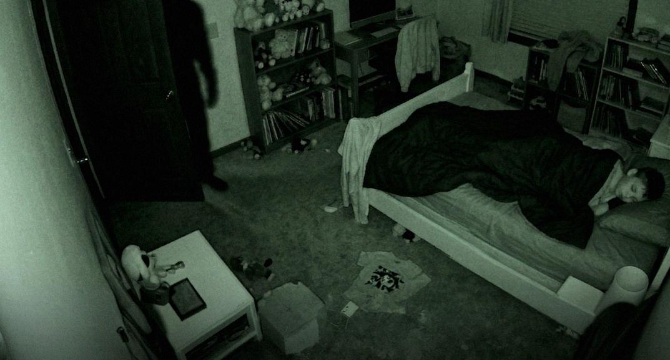
The next day, I installed a small hidden camera in his room.
I didn’t tell him.
I didn’t want to scare him more. I told myself I was doing it for peace of mind, that once I watched a full night of empty footage, I would finally be able to reassure both of us.
That night, I barely slept.
I lay in my bed staring at the ceiling, jumping at every noise in the house, every shifting pipe, and every passing car outside. A part of me felt ridiculous. Another part of me could not shake the image of Sam lying awake in his bed, eyes open in the dark, waiting for something I could not see.
The next morning, as soon as he left for school, I sat down and opened the recording.
My hands were shaking.
At first, there was nothing.
Just my son sleeping.
Then, around 3:17 a.m., the door slowly creaked open.
My heart stopped.
And then, a dark silhouette stepped into the room.
The silhouette moved slowly, almost carefully, and I forgot how to breathe.
I froze in front of the screen, my fingers digging into the edge of the laptop. The figure stepped farther into Sam’s room, and the faint light from the hallway caught the side of his face.
Darren.
My ex-husband. Sam’s father. Thirty-five years old, broad-shouldered, familiar down to the way he tilted his head when he was thinking.
For one wild second, I thought I had to be wrong. I leaned closer, staring until my eyes burned, hoping the image would change into someone else. But it did not. It was Darren. He stood beside our son’s bed in the dark, completely silent, just looking at him.
A chill ran through me so hard that my teeth clicked together.
On the screen, Darren stayed there for several long seconds.
Then he crouched slightly, as if he wanted to get closer without waking Sam. He reached out, not quite touching him, then pulled his hand back.
A moment later, he turned and slipped out.
The door stayed open behind him.
I replayed it three times, each viewing making me feel worse, not better. My fear had not been invented. Sam had been telling the truth. Someone had been watching him at night.
His own father.
I grabbed my phone and called Darren immediately. He picked up on the fourth ring, his voice rough with sleep or maybe irritation.
“Lara?”
I did not bother with hello. “You were in Sam’s room last night.”
Silence.
Then he exhaled. “You put a camera in there.”
My whole body went rigid. “You had no right to be in my house.”
“I still had my key,” he said, like that explained anything.
I stood up so fast my chair scraped the floor. “Darren, what kind of answer is that? Our son has been terrified for weeks. He kept telling me someone was watching him at night, and it was you.”
He was quiet again. When he spoke, his tone had lost its edge. “I never meant to scare him.”
My throat tightened with anger.
“Then what did you mean to do?”
“I just wanted to see him.”
That answer broke something open inside me. “You could have asked.”
“I knew what you’d say.”
“Yes,” I snapped. “I would have said no to you sneaking into his room in the middle of the night. Obviously.”
He made a tired, frustrated sound. “Lara, please. Don’t turn this into something twisted.”
I laughed once, and it came out shaking.
“Twisted? Darren, an eight-year-old boy, was afraid to sleep because his father was creeping into his bedroom after midnight.”
He did not argue with that. Instead, his voice softened in a way that almost made it worse. “I missed him.”
I closed my eyes. Missing someone was not a free pass to ignore every boundary. “You do not get to love him in a way that frightens him.”
That finally landed. I heard him inhale sharply.
“I only came in after I knew he was asleep. I told myself I was not hurting anything. I just wanted to see him. I wanted to stand there for a minute and remind myself I was still his dad.”
I sank back into the chair, suddenly exhausted.
Darren and I had been separated for over a year, and the divorce had been final for six months. He had grown distant before it ended, unreliable with plans, emotionally slippery, always promising to do better later.
Sam adored him anyway. Later, he stopped coming. A canceled weekend here, a forgotten school event there, a birthday dinner shortened by a work excuse that did not even sound real.
And now this.
“You should have rung the bell,” I said, my voice lower now. “You should have called. You should have acted like a father, not a shadow.”
“I know,” he murmured.
I pressed a hand over my eyes.
I was still furious, but beneath the anger was another feeling I hated admitting. Sadness. Darren sounded ashamed. Not manipulative, not defensive. Ashamed.
“When did you plan to stop?” I asked.
“I don’t know.”
That honest answer hurt more than a lie would have.
“You are bringing me your key today. And you are not coming near this house again unless I know about it.”
He did not fight me.
“Okay.”
“And you’re going to talk to Sam,” I added. “Not to excuse it. Not to make it about your feelings. You are going to tell him the truth in a way an eight-year-old can understand, and you are going to apologize.”
His voice cracked just enough for me to notice. “If he wants to see me.”
I looked back at the paused video of Darren standing in the doorway like a ghost from our old life. “That depends on what you do next.”
That evening, after I picked Sam up from school, I sat with him on the couch. He leaned into me, warm and small, still young enough to trust that I could fix the world if I knew where it was broken.
I stroked his hair and said gently, “Sam, I know who was in your room.”
He went still.
“Who?”
I chose my words carefully. “It was Dad.”
His face changed in an instant. Fear first, then confusion. “Dad?”
I nodded. “He should not have done that. It was wrong, and I’ve handled it. You were right to tell me.”
His eyes filled with tears. “I thought maybe I was making it up.”
That nearly undid me. I pulled him close and kissed the top of his head. “No, baby. You were brave, and you told the truth.”
A few days later, Darren came over while I stayed in the kitchen and let Sam decide whether he wanted to talk. He did. I could not hear every word, but I heard enough.
Darren apologized. Really apologized. No excuses. No self-pity.
Just the truth, plain and painful.
That night, Sam slept with his bedroom door open and the hall light on. I checked on him twice before I went to bed. He was sprawled across the mattress, breathing evenly, his face peaceful in a way I had not seen in weeks.
For the first time in a long time, I understood something difficult about love. It is not enough to feel it. Love without care, without respect, and without boundaries can become frightening, even when it is not meant to.
Sam taught me that. He trusted his fear. I trusted him.
And in the end, that is what protected us both.