My nephew Jeremy had been pushing boundaries for as long as anyone could remember.
He was ten years old and had spent most of his life testing every limit in every room he entered. Rules meant nothing to him. He talked back to adults he had just met. Other people’s belongings were props in a story where he was always the main character.
My sister Kelsey had a name for it.
I had another name for it, but I tried to keep that to myself.
Whenever someone in the family tried to correct Jeremy, Kelsey would immediately step in with the same breezy line.
“You’re interfering with his development.”
She said it when Jeremy dumped a plate of pasta into our cousin’s lap at Thanksgiving because he wanted to sit at the adult table.
She said it when he knocked over a display at a hardware store and walked away without looking back.
Eventually, the rest of the family stopped saying anything. It was easier to ignore Jeremy’s behavior than deal with Kelsey’s lectures afterward.
One afternoon I told her quietly, “Kelsey, your son is going to seriously hurt someone one day.”
She laughed.
“You sound like Mom,” she said, like that was some kind of insult.
The moment that really defined everything happened at our grandmother’s eightieth birthday party.
My mom had ordered a beautiful three-layer vanilla cake from the local bakery. She’d spent two weeks choosing the design: white fondant, yellow roses, and Grandma’s name written in gold icing.
Jeremy wanted chocolate.
He said it loudly. Twice.
When nobody rushed to replace the cake, he grabbed the serving spatula and shoved the entire top tier off the stand.
The cake hit the wall and slid slowly down Grandma’s floral wallpaper in a sticky yellow streak.
My grandmother looked at the mess and said nothing.
Ten minutes later, when my mom tried to give a birthday toast, Jeremy talked over her using language a ten-year-old should never even know, much less aim at his own grandmother.
Then he demanded the chair my pregnant cousin was sitting in and glared at her until she stood up.
Kelsey watched the entire scene with the same relaxed smile she always had.
“He’s just having a hard day,” she told me.
I looked at the cake smeared across the wallpaper.
“Sure, Kelsey,” I said.
Four months ago, I bought my dream car.
A brand-new dark green CR-V.
I had spent four years saving for it, moving money into a separate account every single payday. When I finally drove it off the lot, I sat in the dealership parking lot for five minutes just breathing in that new-car smell.
My mom suggested celebrating with a small family gathering at my apartment.
I agreed immediately.
Then I remembered that “small gathering” included Kelsey and Jeremy.
Before anyone arrived, I pulled Kelsey aside.
“I just need one thing from you tonight,” I said. “Please keep Jeremy away from the car.”
Kelsey smiled like I was being ridiculous.
“How could such a good boy possibly do anything bad, Kristen?”
And the strange thing was—Jeremy behaved perfectly that evening.
Almost too perfectly.
He sat quietly in the corner of the living room with his hands folded in his lap. He said “please” and “thank you.” He didn’t touch anything that didn’t belong to him.
But every few minutes he glanced toward the driveway window with a small, private smile.
I should have trusted my instincts.
I carried a stack of plates into the kitchen when suddenly the car alarm started screaming.
Then came another sound.
A dull, heavy thud.
I ran outside.
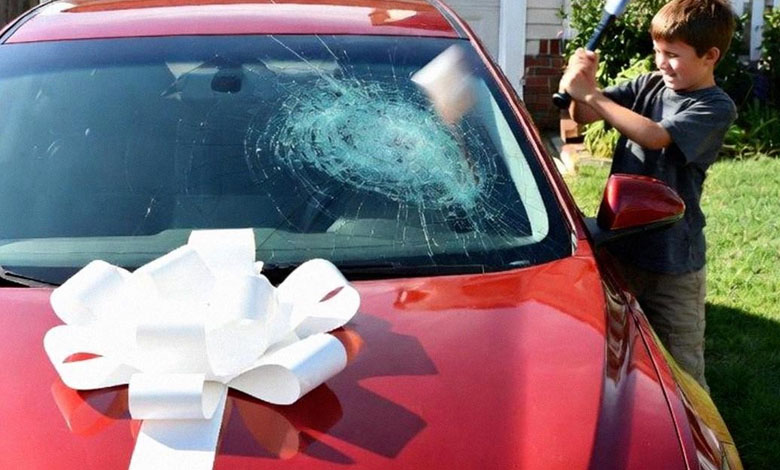
Jeremy stood in the driveway with a wooden baseball bat, swinging it into the hood of my car.
The windshield was already shattered into a spiderweb of cracks.
My sister stood on the porch watching.
Laughing.
“What a cool design!” she said. “This car actually looks better now!”
I froze at the bottom of the steps.
“Oh my God, Jeremy! Put the bat down!” I shouted. “Why are you doing this?”
Jeremy looked up at me calmly.
“Mom said to teach you a lesson, Aunt Kristen.”
I turned slowly toward Kelsey.
She lifted her hands like I was the one overreacting.
“He’s just exploring the world,” she said. “You can buy another car. This helps him develop his sense of agency.”
“I worked four years for that car.”
She shrugged.
“Maybe next time you won’t show off so much when your sister and nephew are stuck driving around in a junker.”
So that was it.
Jealousy.
She had used her own son to act it out.
I stood there for a moment.
Then I said one word.
“Okay.”
I walked back inside.
Everyone had heard the alarm. My mom looked sick. My cousins were already heading toward the door.
I held up my hand.
“Don’t yell,” I said calmly. “Just come outside.”
The driveway went silent when everyone saw the car.
I took out my phone.
I walked slowly around the CR-V and photographed everything.
The shattered windshield.
The dented hood.
The deep marks in the doors.
Then I said, “Jeremy, come stand next to the car.”
Jeremy thought this was fantastic.
He walked over grinning, holding the bat like he’d just hit a home run.
I photographed that too.
Kelsey laughed from the porch.
“You’re being dramatic. It’s just a car.”
I didn’t respond.
I went inside, opened my laptop, and started making calls.
Within an hour I had two repair estimates.
Both were so high that even my mother went pale.
Kelsey didn’t look worried at all.
I printed the estimates and slid them across the table.
“Jeremy didn’t do this alone,” I said calmly. “You told him to. That makes you responsible.”
Kelsey pushed the papers back toward me.
“You have a good job. Replace it.”
I pushed them back again.
“No,” I said. “You will.”
She called me vindictive.
Then she grabbed Jeremy and stormed out.
After everyone left, my mom sat quietly at the table.
“You know Kelsey doesn’t have that kind of money,” she said.
“I know.”
“So what are you going to do?”
“Whatever it takes.”
The next morning I left an envelope in Kelsey’s mailbox.
Inside were the repair estimates and a payment plan.
Three installments.
Very reasonable.
She called me that afternoon laughing.
“I’m not paying this. This is insane.”
“Okay,” I said.
And I hung up.
Because I already had plan B.
Six weeks earlier Kelsey had asked me for a huge favor.
She had found a house she loved, but her credit score wasn’t good enough to qualify for the mortgage alone.
She needed a co-signer.
She asked me.
And at the time, I had agreed.
The morning after she laughed at me, I called the bank and removed my name from the loan application.
Then I called three relatives who had quietly agreed to help with the down payment.
I told them exactly what had happened to my car.
Nothing more.
Within a week the house deal collapsed.
The relatives withdrew their help.
And Kelsey no longer qualified.
The following Saturday she showed up at my apartment.
She wasn’t smiling anymore.
Her eyes were swollen and red.
“You ruined my life over a car,” she said.
I stepped aside and let her come in.
Jeremy stood behind her, unusually quiet.
I pulled up the photos of my car and slid the phone toward them.
“You laughed while your son destroyed something I worked years for,” I said calmly. “Now he gets to learn what responsibility looks like.”
Jeremy stared at the pictures.
Then he looked at his mother.
“Are we actually supposed to pay for all that?” he asked. “You said it was just for fun.”
For the first time, Kelsey had no answer.
“You have one choice,” I said. “Fix my car or deal with the consequences.”
It took three weeks.
Kelsey owned a small camping trailer she and Jeremy used every summer.
She sold it.
Jeremy stood in the driveway watching the trailer get hitched to someone else’s truck.
The money paid for the repairs.
Ten days later my CR-V came back looking exactly like it had the day I bought it.
Two weeks after that, I picked Jeremy up from school because Kelsey was sick.
He climbed into the passenger seat and quietly ran his finger along the edge of the windshield.
“You can’t even tell,” he said.
“They replaced the whole thing,” I replied.
He was silent for a while.
“I didn’t know cars cost that much.”
“That’s why people respect things that belong to others,” I said.
He nodded slowly.
Then, somewhere along the highway, he spoke again.
“I’m sorry, Aunt Kristen. About the car.”
He said it to the window, the way a ten-year-old gives his first real apology when he’s not quite sure how it works yet.
“Thank you, Jeremy,” I said.
When I dropped him off, Kelsey stood on the porch watching us.
I drove away knowing something important had finally happened.
Jeremy learned that actions have consequences.
And Kelsey finally discovered something too.
Shielding someone from consequences isn’t gentle parenting.
Sometimes the gentlest lesson is also the one that costs the most.