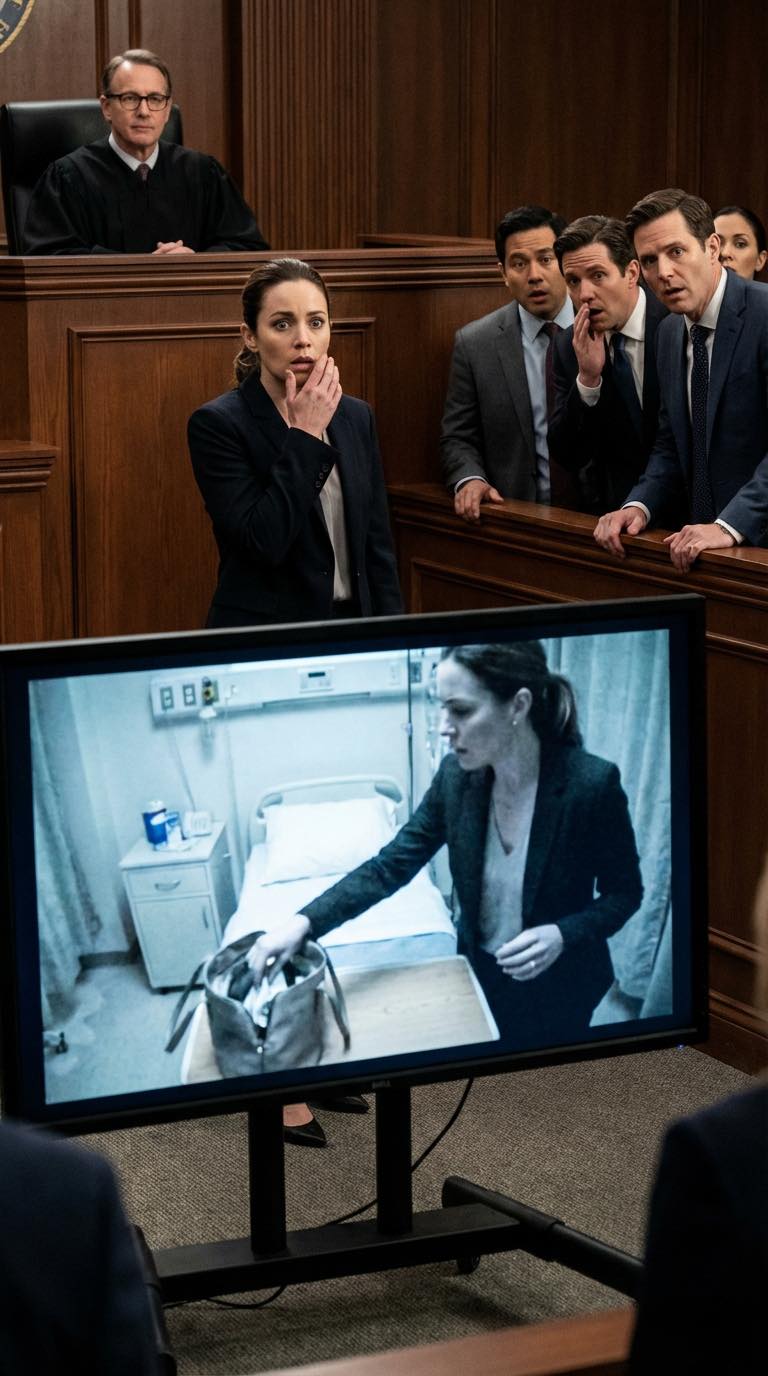
“Now it’s my turn to enjoy luxury,” my sister-in-law bragged after taking my credit card while I was in the hospital. What she didn’t realize was that security cameras had recorded everything she did.
If you had asked me, even a month before everything unraveled, what the worst thing that could possibly happen to me was, I would have said something dramatic but predictable—losing a client, maybe, or the business collapsing under pressure, or even, on a particularly anxious day, something happening to my family. I wouldn’t have imagined that the moment that would fracture my sense of normality wouldn’t come from the accident that nearly killed me, but from something far more deliberate, far more calculated, and in some ways, far more personal.
Because accidents are chaotic. They don’t choose you.
But betrayal does.
My name is Elara Vance, and until recently, my life in Seattle had followed a rhythm that, while occasionally exhausting, felt stable enough to trust. I co-owned a boutique financial risk consulting firm with two partners who had become more like old friends than colleagues, and although the work demanded long hours and a certain level of constant vigilance, I liked what I did. There’s something quietly satisfying about understanding systems, about knowing where money moves and why, about spotting patterns before they become problems. My husband, Rowan, worked in operations for a regional freight company, the kind of job that required him to be practical, steady, and occasionally unavailable at odd hours, but we had built a life around that unpredictability. Our home was rarely quiet—two kids, a dog that barked at shadows, and the constant ebb and flow of Rowan’s extended family meant there was always someone coming or going, always some kind of noise filling the space.
And then there was his younger sister.
Her name was Maris Hale, though if you asked ten different people who knew her, you’d probably get ten slightly different descriptions. Some would call her charming, others ambitious, and a few—if they were being honest—would admit that there was something just a little off about the way she moved through the world, as if everything and everyone around her existed on a kind of sliding scale of usefulness. I never disliked her outright, not in a way I could easily justify, but there was always a tension there, something subtle and persistent that made me careful around her without fully understanding why.
She had expensive taste, that much was obvious, but not the patience that usually accompanies the ability to afford it. She liked things that signaled status—designer handbags, limited-edition shoes, jewelry that caught the light just enough to draw attention—but her career path, which shifted every year or so, never quite supported those preferences. Still, she was family, and family, as I would come to understand in a much harsher way than I ever expected, has a way of blurring boundaries that should probably remain very clear.
Three weeks before everything fell apart, I was driving home from a late client meeting. It had been raining steadily for hours, the kind of rain that turns city streets into slick mirrors, reflecting headlights and traffic signals in a way that makes distance harder to judge. I remember thinking, as I waited at a red light, that I should have left earlier, that I was more tired than I realized.