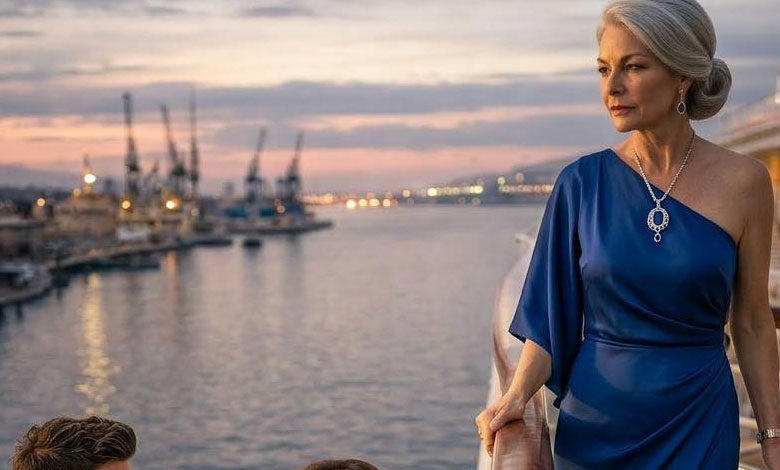
After bu.rying my husband, I told no one about the ticket I had bought for a year-long cruise. A week later, my son told me, “Now that Dad is d.ead, you’ll take care of our new pets every time we travel.”
When Julián died of a sudden heart attack, everyone in Valencia assumed the same thing.
That Carmen Ortega would remain exactly where she had always been.
Available.
Useful.
The quiet widow who accepts casseroles, hugs, and sympathetic looks while gradually turning into the family’s permanent emergency contact. The woman who answers calls, solves problems, and fills empty spaces without ever asking what she wants.
I played the role perfectly during the funeral week.
I thanked neighbors. I accepted condolences. I stood beside my children—Daniel and Lucía—while they spoke about their father and about “staying strong as a family.” People kept touching my arm and saying the same empty phrases: You’re not alone. Your children will take care of you.
What no one knew was that three months before Julián died, I had bought a ticket.
A year-long cruise.
Mediterranean ports. Asia. Latin America.
I had booked it quietly, almost guiltily, after a long night when I realized something uncomfortable: that for decades my life had revolved around taking care of everyone except myself.
It wasn’t an impulsive decision.
It was the result of a lifetime of postponing my own existence.
The week after the burial confirmed exactly why I had made it.
Daniel visited twice.
The first time he arrived with inheritance documents, his urgency cold and practical. He talked about paperwork, bank accounts, the apartment title—everything except grief.
The second time he came with his wife Marta.
And two pet carriers.
Inside them were two small dogs, nervous and yapping, the kind of animals people buy when they imagine themselves becoming responsible adults.
Except Daniel and Marta had no intention of becoming responsible for them.
The girls—my granddaughters—barely looked at the animals.
Daniel waited until I was pouring coffee in the kitchen before explaining their real plan.
“Now that Dad isn’t here,” he said casually, “you can keep them every time we travel. After all, you’re alone, and it’ll be good for you to have company.”
He said it the way someone announces a convenient arrangement.
Not once did he ask.
Marta smiled beside him and added, “And it’ll keep you busy.”
Busy.
The word landed like a slap.
I felt a sharp, clean anger—so pure it almost felt like oxygen filling my lungs after years of shallow breathing.
They were already dividing up my future.
Assigning me tasks.
Designing my loneliness for me.
I smiled instead of arguing.
I bent down and stroked one of the carriers.
“Every time you travel?” I asked.
Daniel shrugged confidently.
“Of course. You’ve always been the one who solves everything.”
He said it proudly, as if it were praise.
But it wasn’t praise.
It was a life sentence.
That night I opened the drawer where I kept my passport.
The cruise reservation was there. Printed. Folded neatly beside the ticket and travel documents.
Departure: Barcelona. Friday. 6:10 a.m.
Thirty-six hours away.
My phone rang.
Daniel.
I answered.
“Mum,” he said, “don’t make any strange plans. On Friday we’ll leave you the keys and the dogs.”
Something inside me settled into place with perfect clarity.
I barely slept that night.
Not because I was uncertain, but because for the first time in years I knew exactly what I was going to do.
At seven the next morning I called my sister Elena.
“I’m leaving tomorrow,” I told her.
There was silence on the other end.
Then a soft laugh—half disbelief, half joy.
“Finally, Carmen,” she said.
“Finally.”
She came over that morning and helped me organize practical matters. Bills. Documents. Property papers. Contact numbers. Everything went into neat folders.
I wasn’t disappearing.
I was leaving responsibly.
At one point I made another phone call.
A dog boarding facility just outside the city.
They had two spaces available.
I booked them for one month under Daniel’s name and printed the reservation confirmation.
At noon Daniel called again.
He talked about the resort in Tenerife where they were flying for vacation. About how exhausted they were. About how desperately they needed to “disconnect.”
Then he added, almost as an afterthought:
“We’ll leave you food for the dogs and a list with their schedule.”
That sentence made something twist in my stomach.
Not once had he asked.
Not once had he wondered whether I had plans.
I ended the call with a vague “we’ll see” that he didn’t even notice.
In the afternoon I packed a medium suitcase.
Light dresses.
Medication.
Two novels.
A notebook.
And the blue scarf I wore the day I first met Julián, decades earlier.
I wasn’t leaving out of resentment for him. Even during the good years, though, I had slowly disappeared inside the roles life assigned to me—wife, mother, organizer, problem-solver.
Standing in the bedroom mirror, I studied myself carefully.
My hair carried silver now. My face held the calm lines of experience. But there was still beauty there, quiet and steady.
And I realized something simple.
I did not need permission to live my own life.
At eleven that night, after I had already booked a taxi for 3:30 a.m., Daniel sent me a message.
“Mum, remember the girls were really excited about you taking care of the dogs. Don’t let us down.”
I read it three times.
It didn’t say we love you.
It didn’t say thank you.
It didn’t ask how are you coping after Dad died?
It said: don’t let us down.
I opened my laptop and wrote a letter.
Not an apology.
Just the truth.
I left it on the dining table beside the boarding reservation and a single house key.
Then I turned off every light in the house and sat quietly in the darkness, waiting for dawn.
The taxi arrived at 3:38 a.m.
Valencia was warm and humid even before sunrise. I rolled my suitcase quietly down the hallway and paused at the door.
For years that hallway had been filled with other people’s belongings—school backpacks, forgotten jackets, stacks of mail addressed to everyone except me.
Before leaving, I looked at it one last time.
Then I locked the door and dropped the key into the inside mailbox.
On the drive to Barcelona I expected guilt.
Instead, I felt something stranger.
Relief.
By 7:15 a.m. I was already on board the ship, sitting beside a huge window overlooking the harbor. I ordered coffee and watched the city slowly wake.
My phone started vibrating endlessly.
Daniel.
Lucía.
Marta.
Daniel again.
The screen filled with missed calls and messages.
I ignored them for a while.
Eventually curiosity won.
The first message was a photo of the dogs sitting in the back seat of Daniel’s car.
“Where are you?”
The second:
“Mum, this isn’t funny.”
The third:
“The girls are crying.”
And the fourth—the most honest of them all:
“How could you do this to us?”
I called him.
Daniel answered immediately, furious.
“You left us stranded. We’re at your house. What are we supposed to do?”
I waited until he finished shouting.
Then I said calmly, “The same thing I’ve done my entire life, son. Figure it out.”
Silence.
I explained that the boarding facility reservation was on the table. Paid for one month. I reminded him not to touch my personal documents.
And I told him something I had never said out loud before.
“I’m not canceling this trip. From now on, any help I give will be voluntary, not automatic.”
His voice hardened instantly.
“You’re going on a cruise now? Dad barely died.”
I looked out at the sea.
“Precisely now,” I replied. “Because I’m still alive.”
He hung up.
Half an hour later Lucía sent a message.
It wasn’t kind, but it was softer.
“You could have warned us.”
I answered honestly.
“I’ve been warning you for twenty years in other ways. No one listened.”
She never replied.
When the ship finally began pulling away from the harbor, I stood by the railing and watched the city slowly shrink behind us.
The feeling inside me was complicated.
Grief.
Fear.
Freedom.
Julián was gone. That loss was real.
But it was also real that my life had not ended with his.
The wind smelled of salt and distance. The sea stretched open and wide ahead of me.
I didn’t know if my children would understand what I had done. Maybe they would in a few months. Maybe in a few years. Maybe never completely.
But for the first time in decades, that question no longer controlled my choices.
Sometimes the most shocking thing a woman can do isn’t leaving.
It’s refusing to remain useful on demand.
And if you were Carmen—standing at that harbor with your suitcase and your passport—would you have boarded the ship?
Or would you have stayed behind, once again explaining a life no one had ever truly listened to?