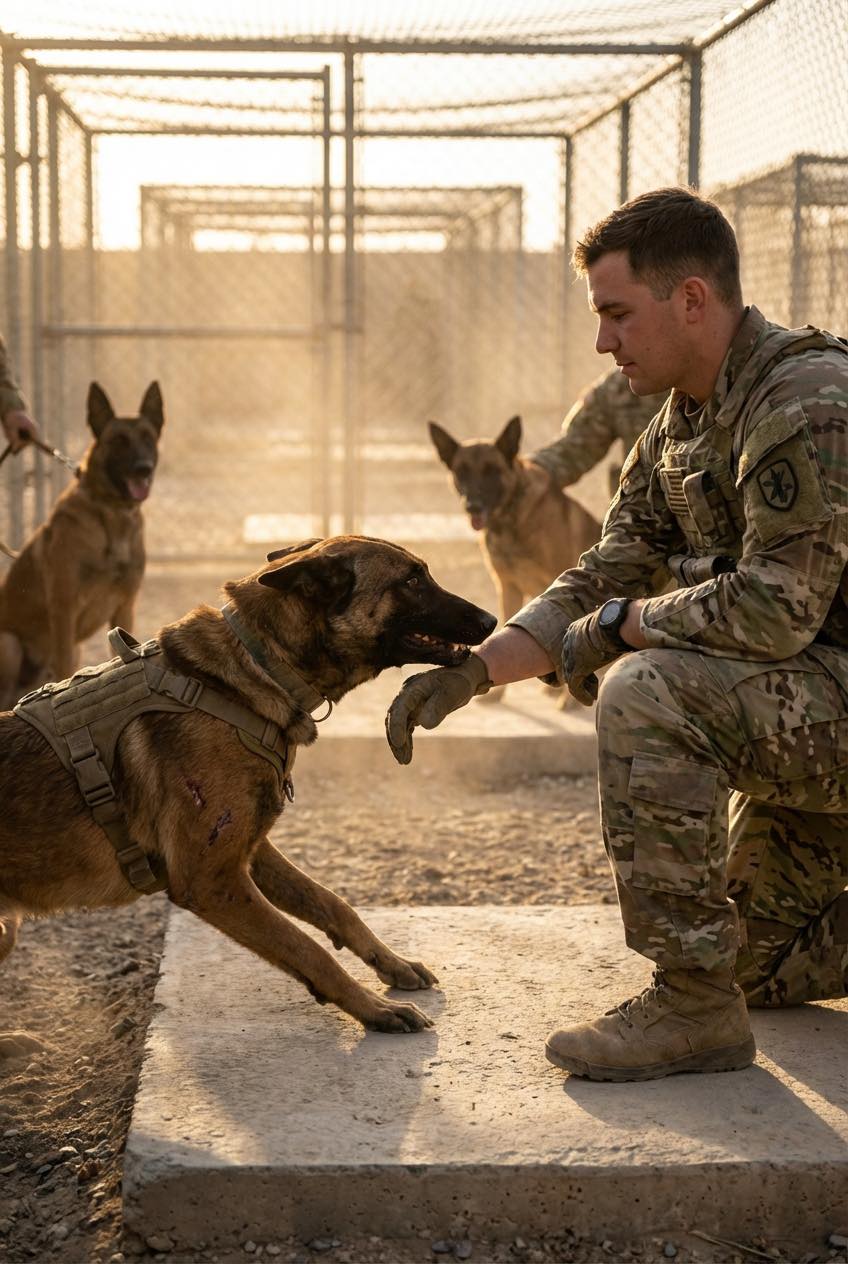
A battle-scarred Belgian Malinois suddenly lunged, stopping just inches from her wrist, creating a moment of pure tension—until she spoke a single calm command that instantly shifted the dog’s behavior and transformed the entire situation.
The steel door slammed behind me with a hollow clang that rolled across the concrete like thunder trapped inside a drum. The echo lingered longer than it should have, bouncing off the kennel walls and settling into the kind of silence that feels deliberate, as if even the building itself had decided to watch what would happen next.
Not one curious glance followed by the others.
Perfect synchronization.
Anyone who has spent enough years around working dogs knows what that means: they were already on edge before I stepped inside.
My pulse ticked somewhere in the nineties—old habit had me counting without thinking—but my breathing stayed slow and controlled, the way you learn after years of trying not to make a tense situation worse simply by existing.
The dogs watched me the way soldiers watch a dark doorway.
Focused. Suspicious. Ready.
My name is Sergeant First Class Laura Bennett, and by the time I walked into that pen at Iron Canyon Naval Annex, most of the special operations personnel stationed there had already decided they didn’t like me very much.
Some called me “the welfare officer.”
Others were less polite.
A few used the word babysitter like it was a joke that never stopped being funny.
And the men standing outside the chain-link fence now—boots planted, arms folded, expressions somewhere between curiosity and amusement—were waiting to see whether the joke would end badly.
A Welcome That Wasn’t One
Five days earlier I had driven through the outer security gate with a sun-bleached duffel bag in the passenger seat and a scuffed leather case on the floorboard.
The leather case smelled faintly of dog harness oil and old training fields.
It had belonged to my first partner.
A Malinois named Ranger who had saved my life once and nearly lost his own doing it.
I kept the case because it reminded me what these dogs really were—not equipment, not extensions of a unit’s ego, but living teammates who made a decision every day to trust the humans holding their leash.
https://googleads.g.doubleclick.net/pagead/ads?gdpr=0&us_privacy=1—&gpp_sid=-1&client=ca-pub-5527153484150509&output=html&h=280&adk=1507152944&adf=3444502417&pi=t.aa~a.4286844980~i.52~rp.4&w=728&fwrn=4&fwrnh=100&lmt=1773488396&rafmt=1&armr=3&sem=mc&pwprc=4205333079&ad_type=text_image&format=728×280&url=https%3A%2F%2Fgootopix.com%2F%3Fp%3D22823%26fbclid%3DIwY2xjawQiKFNleHRuA2FlbQIxMABicmlkETFzVWw5UTVJWDIxTmVTYmt0c3J0YwZhcHBfaWQQMjIyMDM5MTc4ODIwMDg5MgABHjvwJboJx3fMOSJuK83fR4zWLnsPhRn7LDROAJQcmD0TwCfRQN3A4jd5bQZC_aem_qTRTJR3_F9jtHzs0MYe_-A&fwr=0&pra=3&rh=182&rw=728&rpe=1&resp_fmts=3&aieuf=1&aicrs=1&fa=27&uach=WyJXaW5kb3dzIiwiMTAuMC4wIiwieDg2IiwiIiwiMTQ1LjAuNzYzMi4xNjAiLG51bGwsMCxudWxsLCI2NCIsW1siTm90OkEtQnJhbmQiLCI5OS4wLjAuMCJdLFsiR29vZ2xlIENocm9tZSIsIjE0NS4wLjc2MzIuMTYwIl0sWyJDaHJvbWl1bSIsIjE0NS4wLjc2MzIuMTYwIl1dLDBd&abgtt=6&dt=1773488394089&bpp=1&bdt=3964&idt=1&shv=r20260312&mjsv=m202603110101&ptt=9&saldr=aa&abxe=1&cookie=ID%3Dec606d9d3b5736ae%3AT%3D1771001885%3ART%3D1773488392%3AS%3DALNI_MbhX-Vg_s5QHKveOaa63XYDxwnGqg&gpic=UID%3D000012f855a45f2e%3AT%3D1771001885%3ART%3D1773488392%3AS%3DALNI_MZ3rjm92DPUohjUJO6tCwwWrXSB6g&eo_id_str=ID%3Dd7777ccacb3433cd%3AT%3D1771001885%3ART%3D1773488392%3AS%3DAA-Afjbcc7Da9v-lddarfU9a1cpH&prev_fmts=0x0%2C1200x280%2C728x280%2C728x280&nras=5&correlator=2749236661754&frm=20&pv=1&u_tz=300&u_his=1&u_h=768&u_w=1366&u_ah=728&u_aw=1366&u_cd=32&u_sd=1&dmc=8&adx=122&ady=3351&biw=1351&bih=641&scr_x=0&scr_y=854&eid=31097123%2C95378425%2C95383701%2C95384194%2C95385283%2C95385301%2C31097231&oid=2&pvsid=3627925920776148&tmod=949786127&uas=3&nvt=1&ref=https%3A%2F%2Fl.facebook.com%2F&fc=1408&brdim=0%2C0%2C0%2C0%2C1366%2C0%2C1366%2C728%2C1366%2C641&vis=1&rsz=%7C%7Cs%7C&abl=NS&fu=128&bc=31&bz=1&num_ads=1&ifi=5&uci=a!5&btvi=3&fsb=1&dtd=2221
Iron Canyon was supposed to be one of the best canine units in the region.
That’s what the paperwork said anyway.
Their operational success rate was impressive. Their deployment records looked flawless. The reports that came across my desk described an elite program run by handlers who treated their dogs like extensions of themselves.
But paperwork has a way of smoothing the edges off reality.
When I stepped out of the truck that first morning, the wind carried the distant sound of kennel barking across the compound, sharp and frantic in a way that made the back of my neck tighten before I even reached the building.
The man waiting for me outside the kennel block introduced himself as Commander Nathan Cross.
Tall. Fit. Perfect posture.
The kind of officer who looked like he belonged on a recruitment poster.
His handshake was firm but brief, the kind that says we’ll be polite but don’t expect warmth.
https://googleads.g.doubleclick.net/pagead/ads?gdpr=0&us_privacy=1—&gpp_sid=-1&client=ca-pub-5527153484150509&output=html&h=280&adk=1507152944&adf=1105187611&pi=t.aa~a.4286844980~i.70~rp.4&w=728&fwrn=4&fwrnh=100&lmt=1773488475&rafmt=1&armr=3&sem=mc&pwprc=4205333079&ad_type=text_image&format=728×280&url=https%3A%2F%2Fgootopix.com%2F%3Fp%3D22823%26fbclid%3DIwY2xjawQiKFNleHRuA2FlbQIxMABicmlkETFzVWw5UTVJWDIxTmVTYmt0c3J0YwZhcHBfaWQQMjIyMDM5MTc4ODIwMDg5MgABHjvwJboJx3fMOSJuK83fR4zWLnsPhRn7LDROAJQcmD0TwCfRQN3A4jd5bQZC_aem_qTRTJR3_F9jtHzs0MYe_-A&fwr=0&pra=3&rh=182&rw=728&rpe=1&resp_fmts=3&aieuf=1&aicrs=1&fa=27&uach=WyJXaW5kb3dzIiwiMTAuMC4wIiwieDg2IiwiIiwiMTQ1LjAuNzYzMi4xNjAiLG51bGwsMCxudWxsLCI2NCIsW1siTm90OkEtQnJhbmQiLCI5OS4wLjAuMCJdLFsiR29vZ2xlIENocm9tZSIsIjE0NS4wLjc2MzIuMTYwIl0sWyJDaHJvbWl1bSIsIjE0NS4wLjc2MzIuMTYwIl1dLDBd&abgtt=6&dt=1773488394098&bpp=1&bdt=3972&idt=1&shv=r20260312&mjsv=m202603110101&ptt=9&saldr=aa&abxe=1&cookie=ID%3Dec606d9d3b5736ae%3AT%3D1771001885%3ART%3D1773488392%3AS%3DALNI_MbhX-Vg_s5QHKveOaa63XYDxwnGqg&gpic=UID%3D000012f855a45f2e%3AT%3D1771001885%3ART%3D1773488392%3AS%3DALNI_MZ3rjm92DPUohjUJO6tCwwWrXSB6g&eo_id_str=ID%3Dd7777ccacb3433cd%3AT%3D1771001885%3ART%3D1773488392%3AS%3DAA-Afjbcc7Da9v-lddarfU9a1cpH&prev_fmts=0x0%2C1200x280%2C728x280%2C728x280%2C728x280&nras=6&correlator=2749236661754&frm=20&pv=1&u_tz=300&u_his=3&u_h=768&u_w=1366&u_ah=728&u_aw=1366&u_cd=32&u_sd=1&dmc=8&adx=122&ady=4285&biw=1351&bih=641&scr_x=0&scr_y=1722&eid=31097123%2C95378425%2C95383701%2C95384194%2C95385283%2C95385301%2C31097231&oid=2&pvsid=3627925920776148&tmod=949786127&uas=3&nvt=1&ref=https%3A%2F%2Fl.facebook.com%2F&fc=1408&brdim=0%2C0%2C0%2C0%2C1366%2C0%2C1366%2C728%2C1366%2C641&vis=1&rsz=%7C%7Cs%7C&abl=NS&fu=128&bc=31&bz=1&num_ads=1&ifi=6&uci=a!6&btvi=4&fsb=1&dtd=81565
“Sergeant Bennett,” he said. “We weren’t expecting an inspection for another six months.”
“Joint command requested one early,” I replied.
He smiled slightly.
Not a friendly smile.
More like the kind a chess player gives when they think they already know the next few moves.
“Well,” he said. “You’re welcome to look at whatever you want.”
The words were technically cooperative.
The tone underneath them was not.

The Kennel That Passed Inspection
On paper, everything looked perfect.
Ventilation systems met regulations.
The kennel runs were the correct dimensions.
Training records were up to date.
Medical files existed for every dog.
If you glanced at the checklists, Iron Canyon would pass any inspection with ease.
But dogs don’t live on paperwork.
They live in details.
And details were everywhere.
Water bowls placed just far enough back in the runs that a pacing dog couldn’t easily reach them.
Rest platforms positioned directly under midday sun.
Runs that were technically clean but completely empty—no scent objects, no chew items, nothing that asked a dog’s brain to engage with its environment.
The dogs themselves told the real story.
Some paced nonstop.
Others barked at every passing footstep.
One or two simply watched quietly with the kind of stillness that comes from too much time spent waiting for something unpredictable.
Working dogs are supposed to be alert.
But there’s a difference between alert and wired.
And these dogs were wired tight.
The Handlers
Two handlers stood out during the first walk-through.
One was a quiet Petty Officer named Luis Ortega, who scratched the ears of a sable female Malinois when he thought nobody was looking.
The other was a younger operator named Samir Patel, who refilled water bowls a little higher than the standard line so the dogs didn’t have to stretch awkwardly to drink.
Most of the others treated the kennel like a storage room for gear that happened to breathe.
They spoke about their dogs with pride, yes—but the language was technical, mechanical.
“Fast bite.”
“Good detection range.”
“Solid grip.”
The way mechanics talk about tools.
When I asked about enrichment schedules or decompression time, the responses ranged from polite confusion to open irritation.
One senior handler laughed outright.
“These dogs don’t need toys,” he said. “They need work.”
I wrote everything down.
Not because I expected instant change.
But because documentation has weight.
You can ignore a complaint.
It’s harder to ignore a timeline.
The Dog That Collapsed
The turning point came during a training drill on day three.
The temperature was pushing ninety-four degrees.
Humidity thick enough to taste.
The dogs were running simulated building searches while handlers rotated through scenarios.
One Malinois—a young male named Viper—started showing early signs of heat stress.
Nothing dramatic yet.
Just the subtle things you learn to recognize if you spend enough years reading dogs instead of orders.
Panting too fast.
Ears slightly back.
Focus slipping.
I walked over to the handler.
“Pull him,” I said quietly.
The handler—Chief Petty Officer Grant Wallace—didn’t even glance at me.
“He’s fine.”
“His respiration rate’s climbing,” I said. “He needs water and shade.”
Wallace smirked.
“Sergeant, this isn’t a pet obedience class.”
I felt every pair of eyes in the training yard slide toward us.
“Pull the dog,” I repeated.
Wallace ignored me.
Two minutes later Viper collapsed.
The silence that followed lasted exactly three seconds.
Then the blame started.
The Rumors
Bases have ecosystems.
Information moves through them the way currents move through water.
By that evening, the story had changed.
According to the version circulating in the hallways, I had “interfered with training.”
Apparently my concern had “distracted the handler.”
https://googleads.g.doubleclick.net/pagead/ads?gdpr=0&us_privacy=1—&gpp_sid=-1&client=ca-pub-5527153484150509&output=html&h=280&adk=1507152944&adf=840592849&pi=t.aa~a.4286844980~i.224~rp.4&w=728&fwrn=4&fwrnh=100&lmt=1773488521&rafmt=1&armr=3&sem=mc&pwprc=4205333079&ad_type=text_image&format=728×280&url=https%3A%2F%2Fgootopix.com%2F%3Fp%3D22823%26fbclid%3DIwY2xjawQiKFNleHRuA2FlbQIxMABicmlkETFzVWw5UTVJWDIxTmVTYmt0c3J0YwZhcHBfaWQQMjIyMDM5MTc4ODIwMDg5MgABHjvwJboJx3fMOSJuK83fR4zWLnsPhRn7LDROAJQcmD0TwCfRQN3A4jd5bQZC_aem_qTRTJR3_F9jtHzs0MYe_-A&fwr=0&pra=3&rh=182&rw=728&rpe=1&resp_fmts=3&aieuf=1&aicrs=1&fa=27&uach=WyJXaW5kb3dzIiwiMTAuMC4wIiwieDg2IiwiIiwiMTQ1LjAuNzYzMi4xNjAiLG51bGwsMCxudWxsLCI2NCIsW1siTm90OkEtQnJhbmQiLCI5OS4wLjAuMCJdLFsiR29vZ2xlIENocm9tZSIsIjE0NS4wLjc2MzIuMTYwIl0sWyJDaHJvbWl1bSIsIjE0NS4wLjc2MzIuMTYwIl1dLDBd&abgtt=6&dt=1773488394113&bpp=1&bdt=3987&idt=1&shv=r20260312&mjsv=m202603110101&ptt=9&saldr=aa&abxe=1&cookie=ID%3Dec606d9d3b5736ae%3AT%3D1771001885%3ART%3D1773488392%3AS%3DALNI_MbhX-Vg_s5QHKveOaa63XYDxwnGqg&gpic=UID%3D000012f855a45f2e%3AT%3D1771001885%3ART%3D1773488392%3AS%3DALNI_MZ3rjm92DPUohjUJO6tCwwWrXSB6g&eo_id_str=ID%3Dd7777ccacb3433cd%3AT%3D1771001885%3ART%3D1773488392%3AS%3DAA-Afjbcc7Da9v-lddarfU9a1cpH&prev_fmts=0x0%2C1200x280%2C728x280%2C728x280%2C728x280%2C728x280%2C728x280&nras=8&correlator=2749236661754&frm=20&pv=1&u_tz=300&u_his=3&u_h=768&u_w=1366&u_ah=728&u_aw=1366&u_cd=32&u_sd=1&dmc=8&adx=122&ady=9965&biw=1351&bih=641&scr_x=0&scr_y=7404&eid=31097123%2C95378425%2C95383701%2C95384194%2C95385283%2C95385301%2C31097231&oid=2&pvsid=3627925920776148&tmod=949786127&uas=3&nvt=1&ref=https%3A%2F%2Fl.facebook.com%2F&fc=1408&brdim=0%2C0%2C0%2C0%2C1366%2C0%2C1366%2C728%2C1366%2C641&vis=1&rsz=%7C%7Cs%7C&abl=NS&fu=128&bc=31&bz=1&num_ads=1&ifi=8&uci=a!8&btvi=6&fsb=1&dtd=M
Someone even suggested that my presence had “stressed the dog.”
https://googleads.g.doubleclick.net/pagead/ads?gdpr=0&us_privacy=1—&gpp_sid=-1&client=ca-pub-5527153484150509&output=html&h=280&adk=1507152944&adf=2870529156&pi=t.aa~a.4286844980~i.226~rp.4&w=728&fwrn=4&fwrnh=100&lmt=1773488521&rafmt=1&armr=3&sem=mc&pwprc=4205333079&ad_type=text_image&format=728×280&url=https%3A%2F%2Fgootopix.com%2F%3Fp%3D22823%26fbclid%3DIwY2xjawQiKFNleHRuA2FlbQIxMABicmlkETFzVWw5UTVJWDIxTmVTYmt0c3J0YwZhcHBfaWQQMjIyMDM5MTc4ODIwMDg5MgABHjvwJboJx3fMOSJuK83fR4zWLnsPhRn7LDROAJQcmD0TwCfRQN3A4jd5bQZC_aem_qTRTJR3_F9jtHzs0MYe_-A&fwr=0&pra=3&rh=182&rw=728&rpe=1&resp_fmts=3&aieuf=1&aicrs=1&fa=27&uach=WyJXaW5kb3dzIiwiMTAuMC4wIiwieDg2IiwiIiwiMTQ1LjAuNzYzMi4xNjAiLG51bGwsMCxudWxsLCI2NCIsW1siTm90OkEtQnJhbmQiLCI5OS4wLjAuMCJdLFsiR29vZ2xlIENocm9tZSIsIjE0NS4wLjc2MzIuMTYwIl0sWyJDaHJvbWl1bSIsIjE0NS4wLjc2MzIuMTYwIl1dLDBd&abgtt=6&dt=1773488394117&bpp=1&bdt=3991&idt=1&shv=r20260312&mjsv=m202603110101&ptt=9&saldr=aa&abxe=1&cookie=ID%3Dec606d9d3b5736ae%3AT%3D1771001885%3ART%3D1773488392%3AS%3DALNI_MbhX-Vg_s5QHKveOaa63XYDxwnGqg&gpic=UID%3D000012f855a45f2e%3AT%3D1771001885%3ART%3D1773488392%3AS%3DALNI_MZ3rjm92DPUohjUJO6tCwwWrXSB6g&eo_id_str=ID%3Dd7777ccacb3433cd%3AT%3D1771001885%3ART%3D1773488392%3AS%3DAA-Afjbcc7Da9v-lddarfU9a1cpH&prev_fmts=0x0%2C1200x280%2C728x280%2C728x280%2C728x280%2C728x280%2C728x280%2C728x280&nras=9&correlator=2749236661754&frm=20&pv=1&u_tz=300&u_his=3&u_h=768&u_w=1366&u_ah=728&u_aw=1366&u_cd=32&u_sd=1&dmc=8&adx=122&ady=10019&biw=1351&bih=641&scr_x=0&scr_y=7614&eid=31097123%2C95378425%2C95383701%2C95384194%2C95385283%2C95385301%2C31097231&oid=2&pvsid=3627925920776148&tmod=949786127&uas=3&nvt=1&ref=https%3A%2F%2Fl.facebook.com%2F&fc=1408&brdim=0%2C0%2C0%2C0%2C1366%2C0%2C1366%2C728%2C1366%2C641&vis=1&rsz=%7C%7Cs%7C&abl=NS&fu=128&bc=31&bz=1&num_ads=1&ifi=9&uci=a!9&btvi=7&fsb=1&dtd=M
It would have been funny if it hadn’t been predictable.
When institutions feel threatened, they close ranks.
But I kept documenting.
Photos.
Time stamps.
Vet reports.
Copies of kennel layouts.
Every small detail.
And the more documentation I collected, the colder the atmosphere became.
The Invitation
On the fifth day, Commander Cross approached me after morning briefings.
“We’ve noticed you’re concerned about behavioral stress in the dogs,” he said.
“That’s correct.”
He nodded toward the kennel building.
“Why don’t we run a behavioral evaluation this afternoon? Give you a chance to see how our dogs respond under pressure.”
It sounded cooperative.
Reasonable.
Professional.
But something about the way the handlers exchanged glances made the back of my mind tighten.
Still, declining the offer would look worse.
So I agreed.
The Pen
Which is how I ended up standing inside a concrete aggression pen with three Malinois and a group of silent operators watching from outside the fence.
No cameras.
No recording equipment.
Just dogs.
The youngest dog stood on my left.
Lean, restless, bouncing slightly on his front paws as nervous energy crackled through him.
The dog on the right had a faint limp in his rear leg.
Old injury, maybe untreated.
His breathing carried a low growl that sounded less like aggression and more like anxiety trying to wear armor.
And then there was the one in the center.
He was larger than the others.
Broad chest.
Dark coat scarred across the muzzle.
His eyes held the quiet calculation of a dog that had learned something difficult about humans.
He didn’t bark.
He didn’t rush.
He simply watched me.
Waiting.
Somewhere behind the fence, someone chuckled.
Then the chuckle stopped when I didn’t react.
Reading the Dogs
I turned slightly sideways.
Not submissive.
Just smaller.
Hands relaxed at my sides.
Palms visible.
Direct eye contact can feel like a challenge to a tense dog, so I softened my focus somewhere past their shoulders.
Years of training had taught me one simple truth.
Dogs read energy faster than commands.
If I showed tension, they would amplify it.
So I spoke.
Not commands.
Just quiet rhythm.
A tone dogs recognize long before they understand words.
The younger dog flicked his ears.
The limping dog slowed his pacing.
The big one stepped closer.
His nose worked the air, pulling in my scent.
I lowered myself slowly to one knee.
Outside the fence someone shouted.
“Show them who’s boss!”
I ignored it.
Dominance isn’t leadership.
Especially with a frightened dog.
A Name
The big dog stopped three feet away.
His shoulders trembled with tension.
His eyes locked onto mine.
And for a moment I remembered another Malinois standing in desert dust years ago, blood on his flank, refusing to leave my side until medics dragged him away.
Without thinking, I whispered a name.
“Atlas.”
The dog blinked.
Not recognition.
Just curiosity.
But curiosity is the first crack in fear.
The younger dog sat down.
The limping one leaned lightly against the fence as if relieved that something had shifted in the air.
Atlas took another step forward.
The Lunge
Then he moved.
It happened so fast the younger dog jumped sideways.
Atlas surged forward in a blur of muscle and motion.
Teeth flashed inches from my wrist.
Hot breath washed across my skin.
If I had pulled away—even an inch—it would have triggered the bite.
But something in his eyes stopped short of commitment.
So I did the only thing that made sense.
I exhaled.
And spoke one calm word.
“Easy.”
Atlas froze.
Not like a robot obeying a command.
More like someone remembering they had another choice.
His ears twitched.
His head tilted slightly.
Then he stepped back.
The Silence
Outside the fence the men had gone quiet.
Really quiet.
The younger dog lay down.
The limping dog shuffled closer to my knee.
Atlas lowered his head slowly until his scarred muzzle brushed against my open palm.
Not submission.
Just contact.
The kind that says I’m willing to try trusting you.
I stood up slowly.
Using only tone and posture, I guided all three dogs into calm sitting positions.
Then I turned toward the men outside the fence.
“Locking an evaluator inside a pen with three stressed dogs and no cameras,” I said evenly, “is a protocol violation.”
No one laughed.
“Where are the cameras?” I asked.
No one answered.
Commander Cross stared at the dogs like they had just rewritten a rule he believed in.
Finally he nodded toward the gate.
“Open it.”
The latch clicked.
I walked out with Atlas beside me like we had been partners for years.
The Investigation
Two days later an inquiry team arrived.
A Navy captain.
A JAG officer.
And a veterinarian from the Army Veterinary Corps.
We walked the kennel runs together.
They asked quiet questions.
Why were water bowls placed out of reach?
Why had the limping dog never received treatment?
Why did the aggression pen lack cameras when every other training area had them?
No one had good answers.
Change
The findings hit harder than anyone expected.
Several handlers were reassigned.
Training protocols were rewritten.
Kennel design changed.
Water bowls moved.
Shade installed.
Enrichment schedules introduced.
The dogs changed first.
Their coats improved.
The pacing stopped.
The constant barking softened into something calmer.
Handlers changed slower.
But when performance metrics improved, even pride had to acknowledge the results.
The Final Drill
Three weeks later we ran a nighttime corridor exercise.
Atlas moved silently beside his handler.
When the simulated threat appeared, he reacted perfectly—pinning the target long enough for the operator to clear the area.
Afterward, the handler who once mocked my “dog welfare lectures” approached quietly.
“You were right,” he said.
“Treating them like tools made them worse.”
I nodded.
Dogs always know the difference.
The Last Morning
On my final morning at Iron Canyon, I walked the kennel aisle one last time.
The building sounded different now.
Calmer.
I clipped Ranger’s old cracked collar onto the kennel gate as a reminder of what the program was supposed to stand for.
Atlas watched with steady eyes.
And for the first time since I arrived, the base understood something simple.
Respect doesn’t weaken a working dog.
It makes them stronger.
Lesson From the Story
True leadership is not built on dominance, intimidation, or the illusion of control. Whether working with people or animals, trust is the foundation of real performance. When leaders ignore welfare, empathy, and respect, they create fear—and fear eventually destroys effectiveness. But when trust replaces fear, even the most tense and damaged relationships can transform. Strength isn’t proven by forcing obedience; it’s proven by earning trust.