My mother used to say our family was like a table.
“Every leg matters,” she would tell us when we were little, smiling as she set dinner down. “If one leg gives out, the whole thing wobbles.”
Back then, I believed her.
Back then, Rachel, Marissa, and I were just sisters. We fought over clothes, bathroom time, and who got the bigger slice of cake. We rolled our eyes at Mom’s rules, complained about chores, and expected her to be there, the way children always do.
Then I got older and learned the truth that families do not like to admit. Some people show up when love is easy. Others only show up when love benefits them.
My mom, Evelyn, had three daughters. Rachel, the oldest, was ambitious, polished, and impatient with anything that slowed her down.
Marissa, the middle sister, was softer, at least on the surface. She cried easily, apologized quickly, and had a way of sounding sincere right before she asked for money.
And then there was me. Claire.
I was the one who stayed nearby after college, came over for Sunday dinners, and answered when Mom called just to say she missed me.
For a long time, I told myself that my sisters were just busy; in case of anything serious, they would show up, too.
The first sign that something was wrong came in a way that felt almost harmless. Mom started forgetting little things.
She would misplace her keys, then laugh it off. She would call me twice in one day to ask the same question, then blame it on stress.
Then came the fatigue. Mom stopped taking her morning walks. She started napping in the afternoon, a habit that made her look strangely small in her favorite armchair.
The day she fainted in the grocery store, the illusion finally snapped.
The nurse called me from the hospital because I was listed as her emergency contact.
When I arrived, Mom looked embarrassed. She held her purse against her lap so she could hide behind it.
“This is ridiculous,” she muttered. “I just stood up too fast.”
“You passed out in the produce aisle,” I said, bending to kiss her forehead.
That night, I made her soup and sat with her on the couch. She rested her head on my shoulder the way I did when I was a child, and I realized something terrifying.
I still needed her. And she might not always be there.
The next day, I called my sisters.
Rachel answered on the third ring.
“Claire, I’m in the middle of something,” she said, already annoyed.
“Mom fainted,” I said. “She was in the hospital.”
A pause.
“Is she fine?” Rachel asked.
“They want her monitored,” I replied. “She needs help. We all need to step in.”
Rachel exhaled sharply. “I have meetings all week. Tell her to rest. I’ll call her later.”
“Rachel,” I said, trying to keep my voice even, “this isn’t a calendar inconvenience.”
“Don’t be dramatic,” she snapped. “You’re always dramatic when it comes to Mom. You hover. You like being needed.”
The words landed like a slap.
“I like her being alive,” I said quietly.
Rachel muttered, “I can’t talk,” and hung up.
Marissa answered more warmly.
“Oh my God,” she said. “Poor Mom. Is she okay?”
“She needs support,” I told her. “Can you come by this week? Maybe take her to an appointment? Give me a break?”
“Of course,” Marissa said quickly. “Absolutely. Just send me the details.”
She sounded sincere as she always did, but she did not come.
Mom’s diagnosis came in pieces.
First, more tests. Then specialist appointments. Finally, one doctor said all that could be done was management.
Mom tried to stay upbeat, but I saw the fear flicker through her. I saw it when she pressed her pendant between her fingers like it was a prayer.
That pendant had always been part of her.
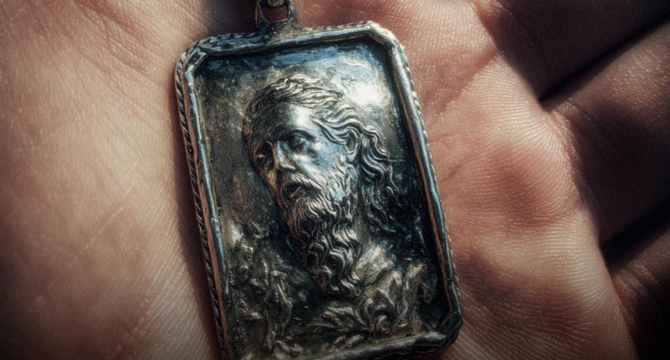
A small oval charm on a thin chain, silver worn smooth from years against her skin. She wore it to weddings, to funerals, to the grocery store, and to bed.
As her health declined, I became the one who lived in the in-between spaces of her life.
One night, her voice trembling with exhaustion, she said, “I don’t want to be a burden.”
“You are not a burden,” I replied, even though my body felt heavy and my brain felt stretched thin.
She squeezed my hand.
“You’ve always been my steady one,” she whispered.
I swallowed the lump in my throat. “Someone has to be.”
Her eyes held mine for a moment longer than usual, like she wanted to say something else but chose not to.
When Mom died, it was quiet. She said no dramatic last words.
She slipped away early one morning with my hand in hers, her skin cool, her breathing shallow, and her eyes closing like she was finally resting.
Afterward, I sat beside her for a long time, unable to move. The house felt like it had lost its center.
Rachel and Marissa arrived later, crying loudly in the doorway as if their grief needed an audience.
The funeral was crowded.
People praised Mom, said she was generous and the glue of our family.
I stood next to the casket and nodded politely, feeling hollow inside.
A week later, we sat in George’s office for the will.
Rachel was composed, wearing black like it was business attire. Marissa dabbed her eyes dramatically.
George read the documents in a calm voice, as if he were listing items in a catalog.
“The house to Rachel.”
Rachel exhaled like she had won something.
“The savings to Marissa.”
Marissa’s shoulders relaxed, relief plain on her face.
Then George opened a small velvet box and slid it toward me.
“And to Claire… her personal pendant.”
The silence was immediate.
Marissa stared. “That is a joke.”
Rachel laughed, short and sharp. “Wait. That’s all she left her?”
George adjusted his glasses. “It is what is stated in the will.”
Marissa turned to me, openly amused. “You stayed with her every night and got jewelry.”
Rachel leaned back in her chair. “Well. I guess all that hard work did not pay.”
My throat tightened, but my voice stayed steady. “It was hers.”
Marissa shrugged. “So was the house.”
Rachel tilted her head, eyes narrowing. “Mom always favored you. And she still left you nothing. That should tell you something.”
It took everything in me not to lunge across the table.
Instead, I opened the velvet box, lifted the pendant, and held it in my palm. It was warm from the room, but I could still picture it against Mom’s skin.
“I got what mattered to me,” I said quietly.
Rachel scoffed. “Sure you did.”
Marissa laughed again. “Maybe you can sell it if you get desperate.”
George cleared his throat. “If we are done…”
Rachel stood quickly. “Yes, we’re done.”
Outside, I stood in the parking lot holding the pendant in my fist until the chain pressed into my skin.
The months after Mom’s death were not just grief; they were warfare.
Rachel moved into the house, claiming she needed to “sort things out.” Marissa demanded access to Mom’s belongings, insisting she wanted sentimental items. Rachel accused her of trying to steal. Marissa accused her of being selfish.
Eventually, Rachel kicked Marissa and me out of the house.
I moved into a small apartment and built a quiet life where nobody yelled at me over money that wasn’t mine.
The pendant stayed with me through all of it.
My sisters’ disagreements and arguments did not stop. They called me constantly, not to ask how I was, but to recruit me to their side.
“Tell Rachel she can’t do that,” Marissa demanded.
“Tell Marissa to back off,” Rachel insisted.
I tried to stay out of it, but they dragged me in anyway.
One afternoon, I showed up to retrieve a box of my childhood photos and found Marissa standing in the living room, voice raised, Rachel glaring at her from the hallway.
“You sold Mom’s dining table?” Marissa shouted.
Rachel shrugged. “It was old. I didn’t want it.”
“She loved that table,” Marissa snapped. “We ate every holiday meal on it.”
“And now she’s not here to care,” Rachel replied coldly. “It was my house. My decision.”
Marissa saw me and pointed. “Tell her she’s wrong, Claire.”
Rachel turned to me. “Don’t start. I’m already dealing with enough.”
I looked between them, exhausted.
“Stop,” I said quietly. Neither listened.
Marissa stepped closer to Rachel. “You always do this. You take everything and act like it’s normal.”
Rachel’s eyes narrowed. “Says the woman who drained Mom’s savings in less than a year.”
Marissa gasped. “Excuse me?”
Rachel laughed without humor. “You think I don’t know? You already bought a new car. A vacation. And you’re still complaining to me about fairness.”
Marissa’s face reddened. “That was Mom’s money. She left it to me.”
“And Mom is gone,” Rachel said. “So spare me the moral speech.”
I felt sick. That night, Rachel texted me: You should come get the rest of your stuff. I’m listing the house.
The house sold within a month, and Rachel moved on.
Marissa spent the savings quickly, as Rachel predicted. She bought new clothes, new furniture, and went on weekends away.
Then the frantic calls began because she wanted to borrow money from me. I did not bother to answer her calls or messages.
Grief was heavy enough without dragging their entitlement behind me.
Some nights, when everything felt too raw, I would hold the pendant and remember the only thing Mom ever asked of me.
Just sit with me. So I did, even in her absence.
Seven years passed the way years do when you’re busy surviving.
I changed jobs. I learned how to budget without resentment and how to say no without guilt. I learned that peace is not something you wait for someone else to grant you. It is something you build and defend.
Rachel became a stranger who sent holiday texts that felt like obligations.
Marissa called, always needing something but I kept my distance.
Then my aunt Sylvia died.
She was my mother’s younger sister, the quiet one who always brought homemade bread and sat in the corner watching everything with thoughtful eyes.
She had never married and never had children. She lived in a house filled with books and plants and the smell of lavender.
Her funeral was smaller than Mom’s. Rachel and Marissa showed up late and left early, acting inconvenienced by grief.
Two weeks later, I received the call.
“Good afternoon,” George said calmly. “May I ask… did you keep your mother’s pendant?”
The question made my chest tighten.
“Of course,” I replied.
“Then I’d like you to come to my office,” he said. “Please bring it.”
I drove there immediately, hands tense on the steering wheel, the pendant heavy in my pocket as if it had turned into something alive.
In his office, George greeted me politely and gestured toward the chair across from his desk.
“Thank you for coming, Claire.”
I sat down. “What happened? Why did you want to see me?”
He didn’t answer right away.
He held out his hand. “May I see the pendant?”
I placed it in his palm.
He turned it carefully, then opened the clasp. His finger traced the inside edge.
“There,” he said, and tilted it toward me. “Do you see the engraving?”
Inside it were tiny numbers, clean and precise. A serial marking so small that I had missed for years because I never opened the pendant.
“I never noticed that,” I whispered.
He placed a folder on the desk and opened it slowly, deliberately, as if giving the moment weight.
“Your mother established a trust before her passing,” he said. “It was designed to transfer assets to a designated trustee.”
A sharp ache rose behind my ribs.
He slid the documents toward me.
At first, the words did not register. Then I saw account numbers. That’s when my brain caught up.
“These are…” My voice cracked.
“Yours,” George said. “Savings and an investment were transferred into the trust years ago. They were held until now. Your aunt Sylvia served as the trustee under your mother’s instructions.
I blinked hard, trying to focus.
George continued, “She was asked to release them after 10 years if you still had the pendant. However, it was to be released immediately in case of her death.”
“Why didn’t Aunt Sylvia tell me?”
“She was instructed not to,” George said. “She was to release these documents only if you arrived with the pendant after 10 years.”
My hands began to tremble as I turned pages.
Then George opened another folder.
“And there is more,” he said.
He placed a separate will on the desk.
“Your aunt Sylvia left her entire estate to you.”
I stared at him. “What?”
“Her home,” he said. “Her accounts and assets. She had no children, and she named you as her sole beneficiary.”
The room felt unreal.
My mother’s careful voice echoed in my head, the one she used when she wanted me to breathe.
You’ve always been my steady one.
I swallowed hard. “My sisters…”
George sighed quietly. “They are not named in your aunt’s will. Nor are they beneficiaries of the trust.”
Tears blurred the page. Not from money.
From the realization that mom had known. She had watched Rachel and Marissa show up only when there was something to gain.
She had watched me show up when there was nothing to gain but time and exhaustion, and she had planned accordingly.
I pressed my fingers against my eyes, trying to stop the tears. George gave me a moment, silent and respectful.
When I finally looked up, my voice was quiet. “So she left me the pendant because it was… a key.”
“Yes,” he said. “And because she trusted you to keep it.”
It took only days for the news to travel. Families do not keep secrets well when money is involved.
Rachel called first.
Her voice was different. Softer and careful.
“Claire,” she said, as if we had spoken yesterday.
Then she cleared her throat. “Listen… we should talk. We’re family.”
I could almost hear the calculation behind the word family.
Marissa called later, crying.
“I was young,” she said. “We were all grieving. We said stupid things. We didn’t mean it.”
“You laughed at me,” I replied calmly. “At Mom’s will. At the pendant.”
Marissa sniffed. “It was just… surprising.”
“It was revealing,” I corrected.
Rachel texted me the next morning: Can we meet? I’d like to apologize properly.
Marissa texted after: Please don’t shut us out. Mom would hate that.
That message was the one that made my jaw tighten.
Mom would hate a lot of things, I thought. But she planned this anyway.
I agreed to meet them, not because I missed them, but because I wanted to say something face-to-face that I had carried too long.
We met at a small café. A neutral ground.
Rachel arrived first, dressed like she was attending an interview. Marissa came in behind her, eyes red, acting fragile.
Rachel smiled cautiously. “Claire.”
Marissa reached for my hand. “I’m sorry.”
I pulled my hand back gently.
Rachel sat down and folded her hands. “We were wrong,” she said. “We didn’t appreciate you. We didn’t appreciate what you did for Mom.”
“You didn’t even notice it,” I replied.
Marissa started crying harder. “That’s not true. I noticed. I just… I didn’t know what to do.”
I looked at her. “You knew how to call when you needed money.”
Marissa flinched.
Rachel leaned in. “Claire, we were all dealing with things.”
“No,” I said quietly. “You were both avoiding hard things. I was dealing with them.”
Rachel’s lips tightened. “So what now? You’re just going to cut us off because of some old resentment?”
“It isn’t old,” I said. “That’s not it. I just wanted to let you two know that we are done. Respect my boundaries and stop calling and texting me.”
Marissa whispered, “We can start over.”
I shook my head slowly. “You can start over with yourselves.”
Rachel’s eyes narrowed. “Is this about the inheritance?”
I held her gaze. “No. It’s about who you were when you thought I got nothing. It’s about the fact that you never offered to share what you got. Not once. Not when Rachel sold the house. Not when Marissa drained the savings. Not when I was rebuilding my life from scratch.”
Marissa’s voice broke. “We were selfish.”
Rachel looked away.
I exhaled slowly. “I don’t hate you,” I said. “But I don’t trust you. And trust isn’t something you demand because you’re related. It’s something you earn.”
Rachel’s voice sharpened. “You’re punishing us.”
“I’m protecting myself,” I replied.
Marissa whispered, “What did Mom say? Did she… did she plan this?”
I looked down at my coffee for a moment, then back at her.
“Mom believed time reveals motives,” I said quietly. “And time did. Look at what you two became.”
Rachel’s face hardened. “So that’s it.”
“That’s it,” I said. I stood, picked up my bag, and left them there, not because I wanted revenge but because I wanted peace.
I moved into my aunt’s house a month later.
It was filled with quiet reminders of the women who raised me in different ways: my mother’s warmth, my aunt’s steadiness, and their shared belief that love was not a performance.
The pendant sits in a small velvet box on my dresser.
I do not wear it every day. But sometimes, when I miss my mother so much my chest aches, I hold it in my palm and feel the weight of what she gave me.
That love is real when it shows up. That loyalty matters even when nobody applauds it. That kindness and patience are not weaknesses, even when people treat them like they are.