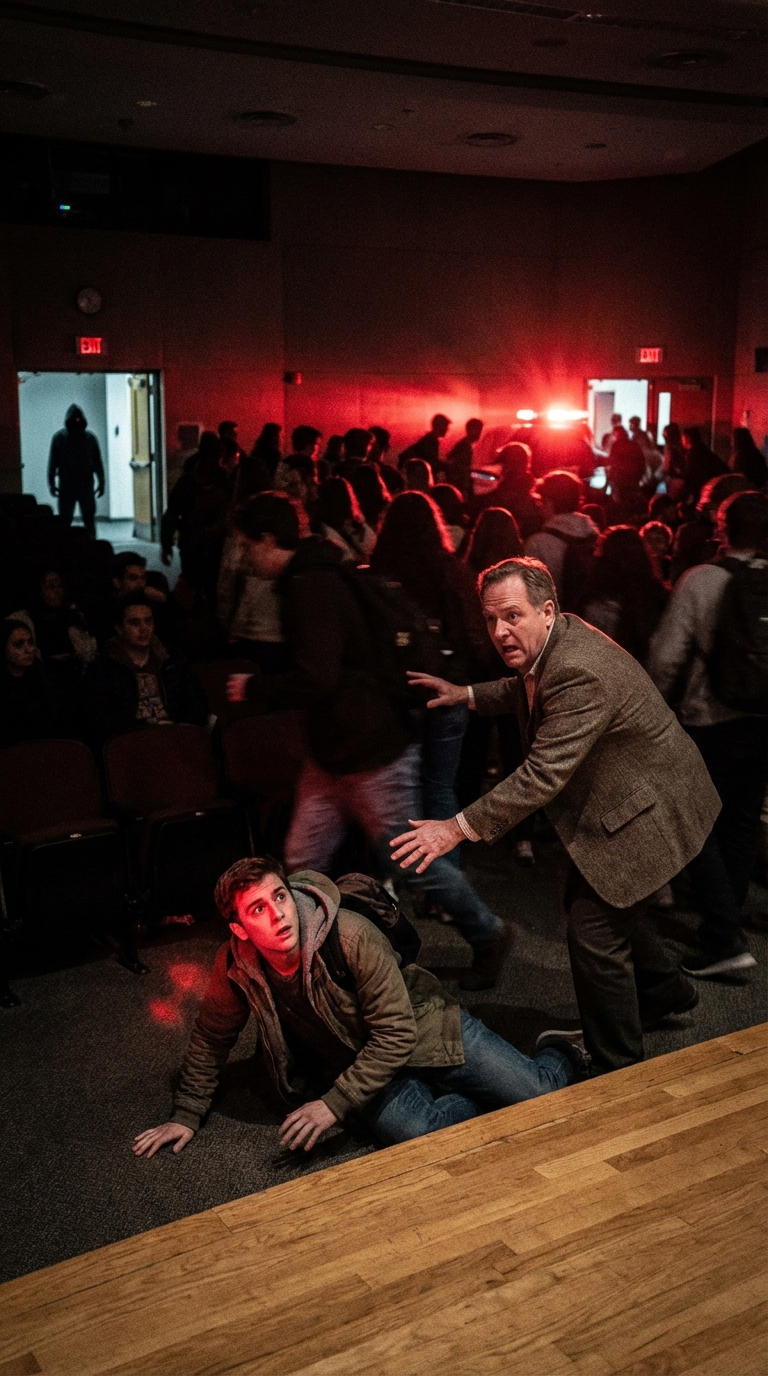
He declined to apologize for presenting a controversial thought experiment—and instead of debate, he was treated like an offender, facing consequences so severe it felt as though he were being punished as a criminal.
Professor Adrian Vale had the kind of voice that never needed to rise in order to command a room; it carried the steady cadence of someone who had long ago understood that conviction, when it is real, does not require volume, and at Redbrook University his seminar on Justice and Moral Conflict was notorious not because it handed down answers but because it left students staring at their own reflections in uncomfortable silence, aware that the neat moral identities they wore in public could unravel under the smallest strain of scrutiny.
On a gray October afternoon, rain streaking the tall windows of Easton Hall, Vale sketched two parallel lines across the whiteboard, then a switch, then a small box meant to represent a train that had already lost its brakes. “Imagine,” he said, marker squeaking faintly, “that a trolley is barreling down this track. Five maintenance workers are ahead. You can pull this lever and divert it onto a side track, where one worker stands. If you do nothing, five die. If you act, one dies. Do you pull the lever?”
The question landed with a kind of theatrical simplicity that made several students smile in relief; hands rose quickly, almost eagerly, as if morality were a math problem they’d been trained to solve, and most of the room agreed that yes, of course, you pull the lever, because five lives outweigh one, because arithmetic feels clean and virtue feels heroic when it fits inside a single decisive gesture.
Vale let them settle into that comfort before he erased part of the drawing and replaced it with a bridge arcing over the track. “Now,” he continued, almost gently, “you are standing here. Beside you is a large man leaning over the railing. If you push him, his body will stop the trolley. The five workers live. He dies. Do you push him?”
The air changed; it was subtle but unmistakable, like a pressure drop before a storm. Chairs shifted. Someone let out a tight laugh that did not mask discomfort so much as advertise it. A few students glanced at one another, as if searching for permission to feel what they were feeling.
In the third row sat Lucas Hale, who had arrived at Redbrook on a patchwork of scholarships and a stack of loans heavy enough to shape his future in advance; he was sharp, occasionally impatient, and possessed of the kind of analytical instinct that sometimes outran his caution. He leaned forward, elbows on his desk. “It’s not the same,” he said. “In the first case, you’re redirecting harm. In the second, you’re using him. You’re deciding that his body is a tool.”
Vale nodded, pleased not with the answer but with the distinction. “So perhaps consequences are not the only currency here. Perhaps there is also the question of what we owe one another, independent of outcomes.”
He clicked to the next slide, which displayed a sepia-toned sketch of a lifeboat adrift at sea. “Consider,” he said, “a nineteenth-century maritime case: four sailors stranded after a wreck, weeks without food, one cabin boy gravely ill and near death. Two of the sailors kill the boy and eat him to survive. They argue necessity. Were they murderers, or merely desperate?”