My name is Phoebe. I’m 30 years old, and the past few years have been anything but kind.
That’s not me being dramatic. That’s just the truth.
After my parents passed away, they left behind nothing but debt. Loans, unpaid bills, and collectors calling daily.
I remember standing in the kitchen of their old house, staring at a stack of envelopes thick enough to choke on.
I kept thinking there had to be some mistake.
Parents were supposed to leave you memories, maybe an old watch, a piece of jewelry, a recipe card stained with sauce. Not red notices stamped with FINAL WARNING.
Within six months, I was selling their furniture to pay off what I could. The rest followed me like a shadow.
My husband walked out not long after.
Nick said he “couldn’t handle the pressure.” That’s the exact phrase he used. He stood near the door with his duffel bag, refusing to look at me.
“It’s too much, Phoebe,” he muttered. “The calls, the stress, the constant worry. I can’t take it.”
“We’re a family,” I told him. “We handle it together.”
“I’m sorry. I can’t do it anymore.”
And just like that, he was gone.
Now it’s just my six-year-old son and me.
Austin is the only reason I get up every morning. He has Nick’s dark hair but my eyes. Sometimes when he smiles, I feel like my ribs might crack from the pressure of holding myself together.
I work two jobs to keep us afloat. Mornings at a diner off Route 8, evenings cleaning offices downtown. Between shifts, I race to pick Austin up from school, help with homework, heat up whatever dinner I can afford, and pretend everything is normal.
Last weekend, I stopped by a flea market just to clear my head.
I did not have money to waste.
But I needed air. I needed noise that was not my own thoughts.
The flea market sprawled across an old parking lot, tables lined with chipped dishes, faded books, tangled cords, and things people once loved enough to buy but not enough to keep.
That’s when I saw it.
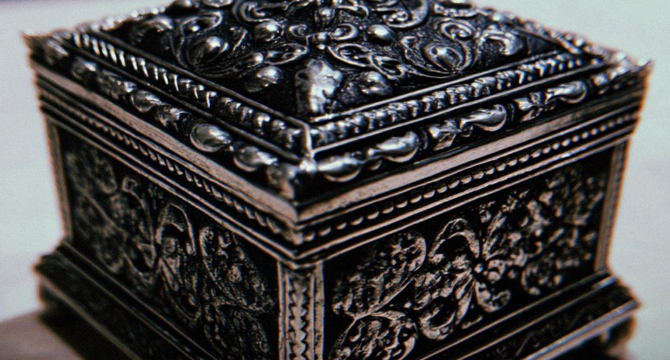
A small metal box with intricate carvings.
It sat at the edge of a vendor’s folding table, half-hidden behind a stack of old magazines. The carvings were detailed and strange, almost floral but not quite. The metal looked darkened with age.
It was old, heavy, and unusual.
I picked it up, surprised by the weight.
“Three dollars,” the seller said. “Found it in the attic of a house I bought. Hard to open, though.”
He was a thin man in his late 40s, with sunburned cheeks and dirt under his fingernails.
“You never tried?” I asked.
He laughed. “Poor folks lived there. Doubt there are diamonds inside.”
I don’t know why that bothered me. The casual way he said it. Poor folks. As if that explained everything.
I turned the box over in my hands.
The carvings caught the light in certain places. There was something stubborn about it. Something sealed.
“I’ll take it,” I said before I could change my mind.
He slid it into a plastic grocery bag and handed it to me.
I bought it anyway.
When I got home, Austin was building a tower out of cereal boxes.
“What’s that?” he asked, pointing.
“Treasure,” I teased.
His eyes widened. “Really?”
“Maybe,” I said, smiling for the first time that day.
I placed it on a shelf at home and forgot about it.
Life moved on. There were double shifts to survive, laundry stacking higher each day, and a permission slip I nearly missed signing. The box became background noise in an apartment already heavy with stress.
A week later, someone knocked on my door.
It was early evening. Austin was in the living room, drawing dinosaurs, humming softly to himself. I wiped my hands on a dish towel and opened the door.
A well-dressed man stood there, tense.
He looked out of place in our building. Tailored gray suit, polished shoes, hair carefully combed. He kept glancing down the hallway as if someone might be watching.
“Do you still have the box?” he asked immediately.
My stomach dropped.
“I’m sorry?” I said carefully.
“The metal box. From the flea market last Saturday.”
Every nerve in my body went alert.
“Yes.”
He exhaled, almost in relief. “I’ll give you fifty thousand dollars.”
My heart stopped.
I actually felt it. That sharp, hollow pause in my chest. Fifty thousand dollars was not just money. It was freedom. It was paying off debt. It was breathing without fear.
“Why?” I asked.
“That’s not important,” he replied quickly. “What matters is that I need it back.”
Need.
Not want.
Behind me, Austin laughed at something on his paper. The sound grounded me.
“I don’t have it,” I lied. “My sister borrowed it. I could get it back in two days.”
The lie slipped out before I had time to weigh it.
The man’s jaw tightened. “Two days?”
“Yes.”
He studied my face, searching for cracks. Then he nodded once. “I’ll return.”
He did not ask for my number. He did not introduce himself. He simply turned and walked down the hall.
I closed the door slowly, my hands shaking.
Austin looked up. “Who was that?”
“No one,” I said too quickly. “Just someone looking for the wrong apartment.”
That night, after my son fell asleep, I sat in front of the box.
I pulled it down from the shelf and placed it on the kitchen table.
The overhead light flickered slightly, casting shadows into the carvings.
Fifty thousand dollars.
What kind of box was worth that?
For six hours, I tried to open it.
Prying. Twisting. Pressing every detail.
I slid a butter knife along the seams. I pushed at every raised swirl and pattern. I turned it upside down, shook it gently, and held it to my ear. Nothing.
At one point, I nearly gave up.
Maybe it was empty. Or maybe it was just an antique collector’s obsession. I could stop this right now, give it back, and take the money without ever knowing what was inside.
But something about the way the man had said “I need it back” would not let me rest.
The sky outside began to pale. My fingers were sore. My eyes burned.
Near dawn, exhausted, I pushed one small carved element.
It was barely noticeable. A tiny leaf-shaped engraving near the bottom edge.
Something clicked.
The sound was soft but unmistakable.
The box opened.
For a moment, I just stared at it.
Inside, there was no velvet lining. No glittering treasure. No stack of cash. Instead, I saw a bundle of yellowed papers tied together with a thin, faded ribbon. Beneath them lay something wrapped carefully in cloth.
My hands trembled as I lifted the papers first.
They were letters.
Dozens of them.
All handwritten.
The ink had faded to a soft brown, but the words were still clear. The first line I saw made my breath catch.
“To my beloved Eleanor, if you are reading this, then I have failed to tell you the truth while I was alive.”
I sank into the kitchen chair.
The letters were dated back to the 1970s. Each one was signed by a man named Thomas. As I flipped through them, I realized they were confessions. Apologies. Explanations.
Thomas had worked as an accountant for a wealthy family.
Over time, he discovered that the family patriarch had hidden large amounts of money through illegal dealings. Instead of exposing him, Thomas had helped cover it up. In return, he had been promised financial security for his own family.
The promise never came.
When the authorities began investigating, the wealthy family distanced themselves from him. Thomas took the fall. He wrote in one letter that he hid documents proving their crimes inside this very box before he was arrested.
“I was weak,” one letter read. “I chose comfort over integrity, and now you pay the price. If our son ever finds this, tell him I loved him more than my own cowardice.”
My chest tightened.
Beneath the letters, I unwrapped the cloth.
Inside were old documents. Property records. Bank transfers. Signed statements. Even to my untrained eye, they looked serious. Official.
Proof.
The well-dressed man’s face flashed in my mind.
“I need it back.”
Not want.
Need.
My kitchen suddenly felt smaller.
At 7 a.m., Austin padded in, rubbing his eyes. “Mommy?”
I quickly gathered everything and slid it back into the box.
“Morning, sweetheart,” I said, forcing a smile.
He climbed into my lap. “You didn’t sleep.”
“I’m okay,” I whispered, kissing his hair.
But I was not okay.
All day at the diner, I could barely focus.
Plates clattered around me. Coffee orders blurred together. Fifty thousand dollars echoed in my head. That money could erase my parents’ debt. It could mean one job instead of two. More time with Austin. A small college fund.
But if those papers were what I thought they were, then this was bigger than me.
That evening, as promised, there was another knock.
I told Austin to stay in his room.
When I opened the door, the man stood there again. Calm. Controlled.
“Well?” he asked.
I held the box tightly against my chest. “Why do you want it?”
His eyes hardened. “That is not your concern.”
“It is my concern,” I replied quietly. “You offered me fifty thousand dollars.”
He exhaled slowly. “Those papers inside belong to my family.”
So he knew.
“Your family?” I asked.
“Yes. My grandfather was the man falsely accused. Those documents were stolen. They could damage people who are still alive.”
“Damage them how?” I pressed.
His jaw flexed. “Reputations. Businesses. You do not understand the consequences.”
I thought about the letters. About Thomas writing that he chose comfort over integrity.
“Maybe I understand more than you think,” I said.
His tone sharpened. “Name your price.”
The way he said it made my stomach twist.
“It’s not about the money,” I replied.
He studied me for a long moment, then tried a different approach. “You look like a smart woman. You have a child. Take the money. Walk away. Let the past stay buried.”
My pulse pounded in my ears.
He was right about one thing. I did have a child.
And what kind of example would I be if I sold the truth?
“I can’t,” I said finally.
His expression darkened. “You are making a mistake.”
“Maybe,” I admitted. “But it won’t be the same mistake your grandfather made.”
For a second, something flickered in his eyes. Anger. Or maybe shame.
“You have no idea what you’re stepping into,” he muttered.
“Maybe not,” I answered. “But I’m stepping into it honestly.”
He stood there, rigid and silent.
Then he gave a short nod.
“This is not over,” he said quietly before turning away.
I closed the door, my legs weak.
The next morning, I called a lawyer whose number I found through a legal aid clinic. By the end of the week, the documents were in safe hands. An investigation reopened. Names that had been untouchable decades ago began appearing in headlines.
It was messy. It was frightening.
But it was right.
The man never returned.
Weeks later, I received a call from the lawyer. Because the documents had led to recovered assets and exposed fraud, there would be a financial settlement. A reward for coming forward.
It was not fifty thousand dollars.
It was more.
More than I ever expected. It paid off every debt my parents had left behind, allowed me to reduce my hours at the diner, and, for the first time in years, let me breathe without fear pressing against my chest.
The night I paid the last bill, I sat at the kitchen table and cried.
“Mommy, are you sad?”
“No,” I whispered, holding him tight. “I’m proud.”
He smiled up at me. “Of what?”
“Of choosing to do the right thing.”
Life has not suddenly become perfect. I am still 30, a single mother navigating each day as it comes, doing my best with what I have.
But I am not drowning anymore.
Sometimes I replay that day at the flea market, the three dollars in my hand, and the moment I nearly gave the box away without ever opening it.
If I had, I would have walked away with money in my pocket and a quiet ache I would not have known how to name.
Instead, I walked away with both the truth and the reward.
And for the first time since my parents died and Nick walked away, I feel steady.
Not because of the money.
But because when it truly mattered, I chose integrity over comfort.