The afternoon had the particular drowsiness that comes with a successful family gathering—the kind where everyone leaves satisfied, bellies full of grilled burgers and potato salad, conversations lingering in that easy space where family feels uncomplicated. I was sitting on my childhood bed in my parents’ house in Columbus, Ohio, scrolling through photos on my phone while the sounds of cleanup and goodbyes drifted up the stairwell.
The smell of charcoal and smoke clung to my hair. My mother’s laughter echoed from downstairs—that particular laugh she only made when surrounded by family, when she felt anchored by proximity to people who knew her before she became who she was.
I was planning my evening, mentally organizing which bills I could shuffle around to move more money into the “Future House” fund I’d been building for three years. At twenty-seven, I worked as a software engineer, made decent money, and had spent the last five years carefully, methodically saving for the day when I could buy something that was entirely mine.
I opened my banking app out of pure habit, the kind of checking that’s become as automatic as breathing for people who’ve worked hard for what they have.
The number made no sense.
Where there should have been eighty-three thousand dollars, there was a balance that might cover a week of groceries and a tank of gas. For a full second I thought it was a technical glitch—banking apps sometimes crash, sometimes display incorrect information, sometimes remind you that technology is held together with hope and habit.
I refreshed the page.
Same number.
My stomach dropped so fast I had to grip the edge of the bed to keep from sliding off. My hands started shaking. I grabbed my laptop from my bag, fingers clumsy as I logged into the full banking website, clicking through recent transactions with a sense of terrible dread building with each page.

One transfer. All of it. To an account that belonged to my father.
Eighty-three thousand dollars moved from my account to his. In a single transaction. No explanation. No discussion. No ask.
The Moment Everything Changed
I walked downstairs on legs that did not feel attached to my body. The hallway seemed longer than it had that morning. The smell of the barbecue—which had been pleasant when I was sitting upstairs—now felt suffocating, like smoke that wouldn’t clear.
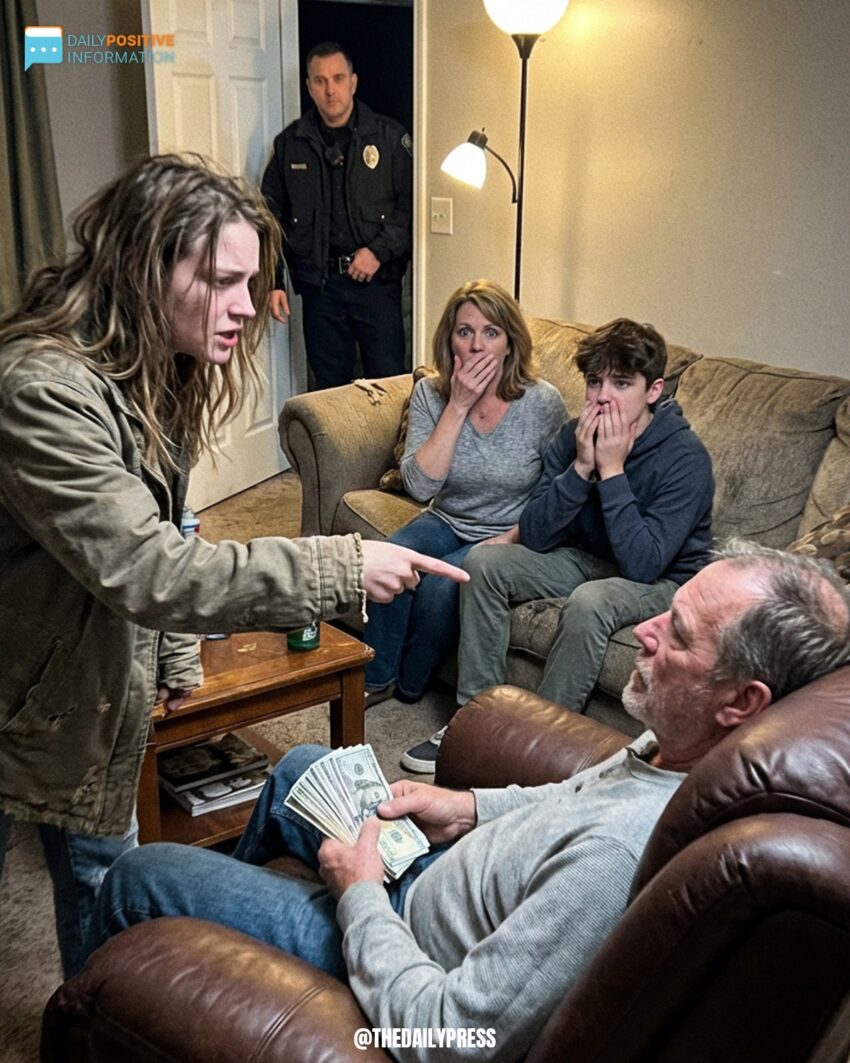
My father was in the living room with my mother, my younger brother Nate, and an uncle who was still nursing a beer despite it being nearly dinner time. The television blasted some game show with aggressive cheerfulness, everyone loose and happy from food and wine and the specific comfort that comes from family you see twice a year.
I walked between my father and the television, my body blocking his view of the screen.
“Dad,” I said, and my voice came out thin and strange, like it belonged to someone else. “Why is my savings account empty?”
He didn’t even mute the TV. He just glanced sideways at me like I was a minor inconvenience blocking his view of a game show.
“Because we needed it more,” he said, the tone casual, matter-of-fact. “Mortgage payment didn’t come through. Your mother’s medical bills are worse than we thought. That roof I keep talking about fixing—it’s actually leaking into the walls now. You’re single, no kids. You’ll make it back. You make good money.”
I felt something inside me crack.
“That’s my money,” I said, my voice louder now, steadier. “Every extra shift. Every freelance project I took on nights and weekends. Every vacation I didn’t take because I was trying to save. You had no right to touch that.”
My mother’s hands fluttered up like nervous birds. “Emily, honey, calm down,” she said, using that particular voice she reserved for moments when she wanted to dismiss something important as emotional overreaction. “It’s all in the family. Your father has always managed the accounts. You know that’s how things work in this house.”
“That was when I was sixteen,” I shot back, my voice rising. “I’m twenty-seven years old. I’m an adult. I left his name on that account because I trusted you. Both of you. That wasn’t permission to steal from me.”
Nate laughed from the couch, that particular laugh of someone who thinks this is all a misunderstanding that will resolve itself. “Wow, Emmy, chill. You act like he robbed a stranger or something. It’s Dad. You act like he didn’t put a roof over your head for eighteen years.”
My vision blurred. For a heartbeat I seriously considered just walking out of that house and never coming back. But something in me—something stubborn and angry and done being treated like my labor was automatically the family property—kept me rooted in place.
I reached for my tote bag on the side table. The leather felt cool and steady under my hand, an anchor in a moment where everything felt like it was tilting sideways.
I looked my father directly in the eye. My voice came out low but absolutely clear.
“Then you won’t mind what’s coming next,” I said.
They all chuckled—actual laughter—like I’d told some dramatic joke. Like a twenty-seven-year-old woman was not standing in their living room discovering that her entire future had been treated like a family emergency fund.
In the middle of their laughter, a loud bang shook the front of the house, rattling the picture frames on the mantle. The door opened—not gently, but firmly—and two uniformed police officers stepped into the living room, followed by a woman in a navy blazer with a folder tucked under her arm.
My mother gasped. My father’s face went completely white.
Nate’s beer bottle paused halfway to his mouth.
And I felt, for the first time since discovering that balance, like I could breathe.
The Discovery That Led To Action
What my family didn’t know was that I’d already been to my credit union three weeks earlier.
I’d noticed a small overdraft fee that didn’t make sense and stopped by during my lunch break, mostly out of curiosity. The teller—a kind woman in her sixties named Patricia who’d always been friendly during my visits—pulled up my profile and frowned while scanning the screen.
“Did you recently increase the limit on your home-equity line of credit?” she asked.
“I don’t own a home,” I’d said, confused.
That simple sentence set off a cascade of conversations that moved up the chain. Patricia got the branch manager. The branch manager got a fraud specialist. And suddenly I was sitting at a desk in a back office learning that my childhood account—the one my parents opened for me at sixteen—had never been fully converted into my sole ownership.
My father’s name still sat next to mine on the paperwork.
His name made everything possible. Small transfers that seemed like rounding errors. A personal loan with my name as primary applicant and my father as co-signer—except I’d never signed anything. Their mortgage refinance using my credit score and my name. All of it carried my signature in smooth, practiced loops I’d never written.
I left the bank that afternoon with a folder of statements and a referral to Rachel Moore, a financial crimes attorney whose office was eight miles away. Rachel had taken one look at the documents and said five words that changed everything:
“You need to file a police report today.”
“Today?” I’d asked. “Can’t I just talk to them first?”
Rachel shook her head. “If you confront them first, they’ll have time to move money, delete records, cover their tracks. The evidence will disappear. You file the report, we send a formal letter, and they have ten days to respond. Then we decide whether to pursue charges.”
So I filed. Detective Marcus Alvarez from the economic crimes unit had taken my statement with the kind of compassion that comes from understanding this happens more often than people realize. He walked me through my options: a repayment agreement with everything properly documented, or a formal investigation that would involve police and prosecutors.
We started with the letter. Rachel drafted something that was polite but absolute, explaining the situation and giving my parents ten days to respond with a repayment plan.
They didn’t respond. Instead, my mother texted me a photo of a new patio set with the caption: “Finally, things are looking up! Thank God for answered prayers.”
That text was when I knew I wasn’t backing down.
The Bang That Changed Everything
The woman in the navy blazer was Attorney Rachel Moore, and she looked nothing like the nervous associate I’d met three weeks earlier in her small office near downtown. Here, in my parents’ doorway, she moved with practiced confidence, flashing her credentials like she belonged there and everyone else needed to understand that immediately.
“Robert Carter?” one of the officers asked, though his tone suggested he already knew the answer.
My father finally muted the television. The sudden silence felt louder than any sound. He looked from the uniforms to me, his eyes searching for some explanation that would make this not what it clearly was.
“Yeah,” he said slowly. “I’m Robert Carter. What’s this about?”
“This is about unauthorized transfer of funds from your daughter’s accounts,” Rachel replied, opening her folder with a practiced gesture. “And several loans opened using her Social Security number without her consent. We’re here with a warrant to review financial records and any devices related to that activity.”
The color drained from my mother’s face. “There must be some mistake,” she whispered, her voice small in a way I’d never heard before.
I wished there was a mistake. I really did. I spent the three weeks between the letter and this moment hoping that somehow I’d misunderstood the documents, that my father had some explanation that would make this make sense, that my family wouldn’t turn out to be the kind of family that steals from their children to prop up their own comfort.
But here we were.
The Consequences Of Crossing Lines
The next four months were the strangest education in how systems work.
I learned about financial fraud. I learned about the difference between civil and criminal remedies. I learned that sometimes family court and criminal court run parallel tracks and sometimes they intersect. I learned my father’s lawyer’s name (it was Gregory, and he looked exhausted from the moment we met) and I learned the specific way judges’ faces look when they’re hearing stories they’ve heard a thousand times before.
My father hadn’t wanted to come to that first meeting with Rachel. My mother had begged me to drop the whole thing, texting me Bible verses about forgiveness and family loyalty. Nate had stopped calling after the initial shock wore off.
But my father had to come. The warrant required it.
The police had executed the search on a Thursday afternoon, walking through my parents’ house with careful documentation of every financial device they seized. It wasn’t dramatic like it is in movies. It was methodical and sad and very, very real.
I watched from my friend Maya’s car across the street, not because I wanted to see it, but because my attorney thought it would be important testimony that I was there, that I hadn’t suddenly reconsidered after the officers arrived.
My mother looked out the front window once and made eye contact with me. Her expression was something between hurt and betrayal. I looked away.
The plea agreement came a month later. My father would admit to taking the money. He would admit to opening loans in my name. In exchange, he would repay what he could (they calculated a payment schedule that would take him eight years), attend financial management classes, and serve three years probation.
If he violated any term, the suspended jail time would become real.
It wasn’t the kind of dramatic justice you see in movies where the guilty party goes to prison and learns their lesson. It was messier and more complicated and somehow both more satisfying and less satisfying than that.
“Last chance to back out,” Rachel said as I stood in the courthouse hallway the morning of the hearing, holding a styrofoam cup of coffee that tasted like courthouse and nervousness. “And I’m not saying that to encourage it. I’m saying that because I want you to understand this is your choice.”
I looked at the document in my other hand—all those pages of legal language, all that evidence, all that pain and anger and violation reduced to paragraphs about obligations and restitution.
“I’m not backing out,” I said. “I want this done.”
When Confrontation Becomes Accountability
I saw my father once between the arrest and the hearing.
He’d asked to meet at a diner on the far side of the city, a place neutral enough that neither of us would feel like we were trespassing. Rachel advised against it. She said anything he said could be used to try to characterize me as retaliatory or motivated by revenge rather than justice.
But I went anyway. Because thirty years of being someone’s daughter does not shut off overnight, even when that someone has done something that changes how you understand your entire childhood.
He was already sitting in a booth when I arrived, his coffee cup full but untouched, a plate of eggs he clearly wasn’t eating pushed to the side. He looked smaller somehow, or maybe I was seeing him more clearly for the first time.
“Thank you for coming,” he said when I slid into the opposite bench.
I didn’t say “you’re welcome” because I wasn’t sure I was. I just waited.
He talked about medical bills, about the mortgage payment that had come due, about layoffs at the plant where he worked. He talked about how he’d “always taken care of the money” in the house and how he’d “meant” to pay it back, like intention was the same as action.
“You’re a software engineer,” he’d said, his voice carrying something that sounded like resentment. “You’ll be fine. You’ll make more money. Your old man just needed a little help.”
“You took eighty-three thousand dollars,” I said quietly. “You signed my name. You opened accounts in my Social Security number. That’s not a little help. That’s a crime.”
His jaw had tightened. His eyes had hardened. And then he’d said the thing that made me understand there was no version of this where he would actually understand what he’d done.
“After everything I did for you, this is what you focus on. This is how you repay thirty years of being your father.”
I stood up. I left before the waitress brought our food. And I didn’t look back.
The Hearing And The Aftermath
The hearing itself lasted less than twenty minutes.
The judge—a woman in her sixties who’d clearly seen enough family financial crimes to write a textbook about them—asked my father if he understood the terms of the plea agreement. He answered yes, barely above a whisper, without looking at me.
When it was my turn, I read a brief statement I’d written with Rachel. I talked about nights spent on hold with banks trying to figure out which fraudulent accounts were mine and which weren’t. I talked about the strange feeling of not being able to trust your own name. I talked about how trust, once broken, doesn’t grow back like money in an account.
“I’m not here for revenge,” I finished, and I meant it. “I’m here because I want my future to belong to me. Not to crisis management. Not to cleaning up someone else’s mistakes. Just to me.”
The judge accepted the plea. Documents were signed. Dates were set. The gavel came down with a sound that felt both final and incomplete.
When my father glanced over his shoulder on the way out, I kept my eyes on the bench in front of me. The bailiff led him out a side door, and I never saw him look back a second time.
Life after that was paperwork and small, stubborn steps.
I froze my credit with all three bureaus and changed every password—not just the ones I thought had been compromised, but every single one. I started getting fraud alerts and acted on every single one. I pulled my credit report and found eight accounts I’d never opened; I spent two weeks on the phone disputing every single one.
I moved into a one-bedroom apartment in downtown Columbus that echoed when I walked across the hardwood floors. For the first time in my life, every single bill, lease, and account carried only my name. The utility bill was mine. The lease was mine. The Wi-Fi connection was mine.
I found a therapist who specialized in financial abuse—yes, that’s a specific type of therapy, and yes, I needed it. Tuesday evenings I sat in a small office talking about how “helping family” had somehow transformed into erasing myself. How the narratives I’d been given about family loyalty had made me vulnerable to exploitation by the people who were supposed to protect me.
My mother still called. First to beg me to drop the case, using language about forgiveness and second chances. Later to offer updates about how Dad was doing, how the neighbors had found out, how embarrassing this all was.
I learned to say, “I’m not discussing money,” and hang up when she pushed.
By month six, the first restitution check arrived. My father had paid the first monthly installment on schedule. It wasn’t nearly enough to undo the damage—it would take eight years at this rate—but it was evidence that the consequences were real and ongoing.
The Life You Build For Yourself
Almost a year after the reunion, I hosted friends from work for takeout and cupcakes in my small apartment. We toasted with cheap champagne to me being debt-free—my student loans paid off from money I’d earned that wasn’t contested or suspect.
When my phone buzzed with a bank alert during the celebration, my stomach clenched on instinct. Old habits die hard when they’re rooted in trauma.
It was the second restitution deposit, right on schedule. Still not enough. Still not complete. But real.
“You okay?” my friend Maya asked, noticing something shift in my expression.
“Yeah,” I said, feeling it settle somewhere deep in my chest. “I think I actually am.”
The apartment was quiet after everyone left. I stood at my kitchen sink washing cupcake plates, looking out at Columbus at night—the city lights, the buildings, the ordinary magic of a life that was entirely mine.
Down the hallway, my neighbor’s door slammed—a loud bang that made me jump. For a moment I was back in my parents’ living room, back in that moment when the door flew open and everything changed.
But this time I didn’t flinch. I just acknowledged the sound and moved on.
Because the first loud bang—the one when the officers arrived at my parents’ house—had blown apart the version of family I’d been raised to protect at all costs, the narrative that said your blood was obligated to exploit you.
This quieter echo marked something else entirely: the life I was building on my own terms, boundaries absolutely clear, future finally, completely mine.
What This Story Teaches Us About Boundaries And Self-Protection
Emily’s story isn’t about a vindictive daughter punishing a struggling father. It’s about understanding that protecting yourself isn’t betrayal—it’s survival.
She didn’t file charges to hurt her family. She filed charges to protect her future. And more importantly, she made the choice not to allow her family’s narrative of “you owe us” to override her own legitimate need for safety and autonomy.
Sometimes the most important boundary we can set is the one that says: your emergency is not my responsibility.
Your Story Matters In This Conversation
If your family has made you feel obligated to sacrifice yourself for their problems. If you’ve realized that “family” was code for “people who exploit you.” If you’ve had to choose between loyalty and self-preservation—you understand Emily’s choice.
We want to hear from you. Share your thoughts in the comments on our Facebook video. Have you ever had to hold family accountable for financial abuse? What made you finally decide that protecting yourself was more important than keeping the peace? What would you tell someone struggling with the decision to press charges against a family member?
If this story resonated with you—if it helped you understand that financial abuse is real and serious, or gave you permission to protect your future even when it means holding family accountable—please share it with your friends and family. The people in our lives need to understand that love and accountability aren’t opposites. That sometimes the most loving thing you can do is refuse to enable someone’s harm.