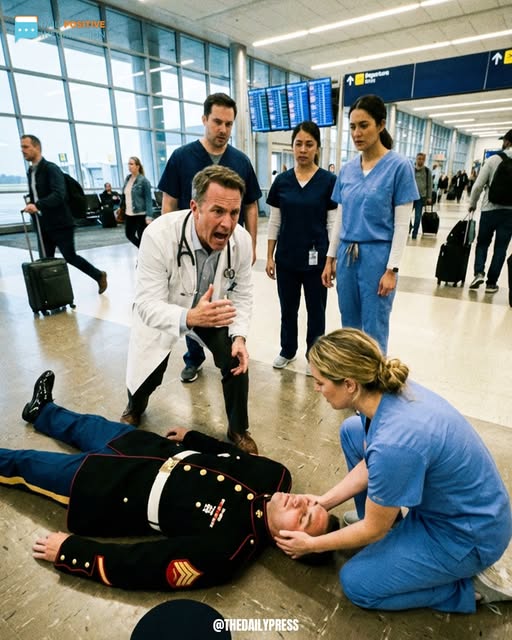
The Dallas–Fort Worth International Airport was loud in that particular way terminals are—rolling suitcases that squeak with every step, overhead announcements competing with airport chatter, the ambient hum of people trying to be anywhere except where they currently stood. It was the kind of noise that swallows individual moments. The kind of place where extraordinary things happen without witnesses.
Until they don’t.
Major General Thomas Reed was walking beside his aide near Gate C-12, holding a paper coffee cup from a small vendor, when his body simply stopped cooperating with his brain. He’d been on his way home to San Antonio after three days of Congressional testimony about military readiness and budgeting—the kind of dry, important work that shaped how wars were fought but never made the evening news.
His knees buckled without warning.
The coffee cup shattered against the polished floor first, spreading a thin brown stain across tile that probably got cleaned seventeen times a day. Then the general followed—his body collapsing in that way that bodies do when the electrical signals stop firing correctly.
For a moment, maybe two seconds, nobody moved.
Then people did what people do in airports: they froze, took phones out, stepped backward like the problem might be contagious. A TSA officer reached for his radio, uncertain what protocol applied when a senior military officer in civilian clothes collapsed in front of two hundred strangers.
A man shouted “Step away!” even though no one had stepped forward.
Another voice snapped something angry about doing something, though nobody could quite articulate what needed doing.
That’s when Emily Carter pushed through.

She wasn’t dressed like someone who’d spent the last eight hours in an intensive care unit at a community hospital in Fort Worth. She looked like someone going home from a night shift—scrubs hidden under a gray hoodie, hair tied back, backpack over one shoulder, the kind of invisible tiredness that settles into bones after twelve hours of other people’s emergencies.
She dropped her backpack without saying a word and knelt beside the fallen man.
No pulse. Breathing irregular and shallow, the kind of breathing that means the heart’s stopping.
She didn’t ask permission. She didn’t look for approval or wait for someone official to arrive. She interlocked her hands and started compressions—hard, fast, perfectly centered on his sternum. Her face didn’t panic. Her eyes didn’t search for support or guidance.
She moved like someone who had done this when there was no backup, when an ambulance wasn’t coming, when the only choice between someone living and someone dying came down to the person kneeling beside them.
“Is anyone trained?” a security officer asked, crouching nearby.
“I am,” Emily said, without looking up from her work. “Call it in. Now.”
Her rhythm never broke. Compressions, sixty a minute, hard enough to crack ribs—which was fine because cracked ribs healed and dead people didn’t. She’d learned that lesson in a dust-covered field hospital where the only rules were the ones written by survival.
Two minutes passed. Three.
Sweat dotted her forehead. A defibrillator arrived, wheeled by a TSA officer who looked like he’d never actually used one outside of training. Emily guided his shaking hands through the steps like she’d walked someone through this a hundred times before—because she had.
Shock delivered. The general’s body convulsed.
Compressions resumed.
Then something shifted. The general’s body jerked—not from the shock, but from something deeper. His chest heaved. A ragged, desperate breath scraped out of his lungs like he was remembering how to be alive.
Emily stopped compressions instantly, rolling him slightly, monitoring his airway, checking his pulse. Her fingers found it—stronger now, present, beating with that irregular but determined rhythm that meant he was coming back.
The crowd exhaled all at once, that collective release of tension that happens when someone doesn’t die in front of you.
General Reed’s eyes fluttered open. Confused at first, scanning the ceiling like he was trying to remember where he was. Then they focused. They locked directly onto Emily’s face.
His voice was weak, barely audible over the resumed noise of the terminal, but his words landed like artillery fire.
“Havoc Six,” he whispered.
Emily’s hands froze.
That call sign wasn’t something you’d find in a military directory. It wasn’t official or ceremonial. It belonged to a specific person, a specific time, a specific operation that had been classified so thoroughly that even mentioning it could get you in significant trouble.
“You’re not dead,” the general continued, his voice strengthening slightly with each word.
Emily’s chest tightened.
Around them, the paramedics had arrived and were taking over—checking vitals, establishing IV access, preparing transport. Nobody else understood what had just been said. Nobody else knew that call sign was supposed to be permanently retired in a casualty report.
But Emily did.
And so did the Marine general who was never supposed to remember her name.
The Name That Shouldn’t Have Survived
The paramedics wanted to rush General Reed straight to the hospital, but he refused the oxygen mask at first, his eyes fixed on Emily with an intensity that made the medical team uncomfortable.
“Her,” he said, his voice cutting through their professional chatter. “Don’t let her leave.”
The lead paramedic—a woman in her fifties with the exhausted competence of someone who’d been doing this for thirty years—hesitated.
“Sir, we really need to transport you. Time is critical with cardiac events,” she said.
“I said don’t let her leave,” the general repeated, and that tone didn’t belong to a patient in need of medical care. That was command voice. The kind of voice that had directed military operations across three continents.
Emily met the paramedic’s eyes, and something passed between them—a silent understanding that this was bigger than protocol.
“I can ride to the hospital,” Emily said. “I don’t mind.”
The paramedic nodded, accepting the explanation without asking for one.
They wheeled General Reed through the terminal toward the airport medical clinic, a small private facility used for VIP passengers and military personnel. TSA quietly cleared the area. The crowd dispersed. Phones were lowered by invisible signals that said this was no longer public interest, this was national security, this was the kind of moment that got handled quietly.
Inside the small medical room, Reed lay on a gurney with monitors beeping steadily, an IV in his arm, an oxygen cannula under his nose. His color was improving, but his eyes never left Emily.
“You didn’t hesitate,” he said, his voice still weak but gaining strength. “Just like Kandahar.”
Emily stood against the far wall, still in her hospital hoodie, still looking like she’d just come from a night shift. Which she had. She’d been running on six hours of sleep and black coffee, coming through the terminal on her way home to her small rented house in Fort Worth, when everything suddenly changed.
“You’re confused, sir,” she said flatly. “You’re recovering from cardiac arrest. Confusion is normal.”
Reed gave a humorless smile. “No. I’m not.”
The room fell quiet except for the steady beeping of the monitors.
“I watched you pull Staff Sergeant Miller out from under a burning MRAP,” Reed continued, his voice steady now. “You kept him alive with one hand while returning fire with the other. You were nineteen years old.”
Emily’s breath caught, and she couldn’t hide it.
“That mission is classified,” she said quietly.
“So was your death,” Reed replied.
That landed differently. That was the moment Emily understood: this wasn’t a coincidence. This was someone from the past she’d spent eight years trying to forget.
“They told me you were killed by an IED two weeks after that operation,” Reed continued, his eyes never leaving her face. “Closed casket ceremony. Citation for valor. Purple Heart. I signed the official letter to your mother myself.”
Emily’s jaw tightened until she felt it might crack.
“My mother never got a body,” she said, voice steady despite the shaking she could feel starting somewhere deep in her core. “Just a flag and a knock on the door from someone in uniform who didn’t know how to explain why they were there.”
“Because you weren’t dead,” Reed said.
“No,” Emily confirmed. “I wasn’t.”
She moved toward the window, looking out at the Dallas skyline—glass towers and endless sprawl, the kind of normal city landscape that had nothing to do with dust and explosives and the sound of people screaming when metal turns into shrapnel.
“My convoy was hit outside Lashkar Gah,” she said, her voice taking on that flat, clinical tone people use when they’re describing traumatic events. It’s easier that way. Easier when you divorce yourself from the emotion and just report facts. “Three vehicles. We lost everyone but me.”
She paused.
“I woke up in a field hospital with shrapnel in my leg and blood that wasn’t mine on my uniform. My CO came in and told me there was a situation. That the operation had… complications. That someone needed to take responsibility.”
“What kind of complications?” Reed asked.
Emily turned back to face him. “The kind that happen when intelligence is bad. When targets are misidentified. When you drop ordnance on a village because the coordinates were wrong and people in power decide they need someone junior and enlisted to take the fall.”
Reed’s expression hardened.
“Criminal Investigation Division showed up before I could even walk properly,” Emily continued. “Offered me two choices. Either disappear quietly—change my name, leave the service, let them bury me in paperwork—or face charges for negligence. For falsifying reports. For things I never did.”
“That’s not legal,” Reed said.
“No,” Emily agreed. “It’s not. But it’s how things work sometimes when you’re junior enlisted and inconveniently alive to contradict the narrative.”
The medical team had discreetly excused themselves, giving them privacy for a conversation that was clearly beyond their clearance level.
“I chose disappearing,” Emily said. “Figured it was better than prison. I changed my name legally. Got out of the service with a general discharge that didn’t say why. Went to nursing school on the GI Bill—under my new identity. Built a life as someone normal. Someone who saves people without shooting anyone.”
“And yet,” Reed said quietly, “you still move like a battlefield medic.”
Emily shrugged. “Muscle memory doesn’t forget. Combat training doesn’t just evaporate because you wear civilian clothes and work in a hospital.”
A Marine colonel entered the room quietly, his eyes flicking between them with the careful assessment of someone trained in reading situations.
“Sir, Pentagon command has been notified of the incident,” the colonel said. “They’re requesting a full report on your condition.”
Reed nodded slowly. “Good. And Colonel, I need you to know that this woman saved my life. Not just at the airport, but eight years ago. And someone in this government made sure no one remembered that.”
The colonel’s expression shifted—processing, understanding, recognizing that this was far above his pay grade.
“I’ll make sure that information is included,” the colonel said carefully.
Before Emily could fully process what was happening, two men in dark suits appeared at the doorway.
No badges. No smiles. No introduction.
Emily recognized the posture immediately—federal, controlled, the kind of people who appeared when conversations were about to become official in ways that changed lives.
One of them looked directly at Emily.
“Ms. Carter,” he said calmly. “We need to talk.”
The Quiet Heroes Don’t Stay Buried
The hospital room suddenly felt smaller with the two federal agents inside it.
They didn’t introduce themselves. They didn’t need to. Emily recognized the bearing immediately—the kind of controlled confidence that came from working for agencies that didn’t have to explain themselves to anybody.
“I’m not under arrest,” Emily said. It wasn’t a question.
“Correct,” the taller agent replied. “But you are of significant interest.”
General Reed pushed himself upright with effort, ignoring the monitors’ protests. “This conversation happens with counsel present, and you both know it.”
The shorter agent smiled thinly. “Sir, with respect, your medical condition—”
“My medical condition,” Reed cut in, his voice carrying the weight of command despite his weakened state, “is stable enough to remember exactly who destroyed a decorated medic’s career to protect bad intelligence and worse judgment.”
That shut them down effectively.
Emily exhaled slowly. “What do you want?”
“To close a file that was never properly closed,” the tall agent said. “Your existence complicates that narrative.”
“Funny,” Emily replied, her voice steady. “I’ve been saying the same thing about you people for eight years.”
Reed studied them both with the gaze of someone who’d spent a lifetime reading people in high-stakes situations. “She saved my life today. If anything happens to her, this conversation goes to every news outlet in America. I guarantee it.”
The agents exchanged a glance—the kind of silent communication that happens between people accustomed to working together.
The shorter one spoke carefully. “Sir, the official record is already written.”
“Then rewrite it,” Reed said. “Or I’ll do it for you.”
They left shortly after—no threats, no promises, no anything. That worried Emily more than open hostility ever could. Silence from federal agencies meant they were calculating options, weighing consequences, considering what damage control looked like.
She didn’t sleep much over the next week.
The Files That Get Reopened
Two weeks after the airport incident, Emily sat on the back steps of her small rental house in Fort Worth, medical textbooks untouched beside her on the weathered wood. The Texas heat was starting to build even in early spring, the kind of warmth that promises brutal summers ahead.
Her phone had been buzzing constantly—unknown numbers, blocked IDs, the kind of calls that meant various parts of the federal government were trying to figure out what to do about her existence.
Then one call came through unblocked.
General Reed’s voice.
“I need to tell you something,” he said without preamble. “And I need you to understand that what I’m about to do will end my career. But I think that ended the moment I let you be erased.”
They met at a quiet VA facility outside Austin after hours. No cameras. No press. Just a general who was walking slowly now, recovering from cardiac arrest, and a woman who’d spent eight years trying to be invisible.
Reed looked aged by more than just his recent medical event. He looked like someone carrying the weight of every decision he’d made.
“I reopened the Afghanistan inquiry,” he told her. “Found altered reports. Deleted drone footage. A threat matrix that was completely fabricated.”
Emily clenched her fists. She’d known some of this. What she hadn’t known was whether anyone in power would care.
“And?” she asked.
“And the officer who signed off on the original operation—who ordered the airstrike that killed everyone but you—is now a private contractor with significant influence in the defense sector,” Reed said. “He’s made a lot of money off the Iraq and Afghanistan wars. A lot of powerful friends.”
“Of course he is.”
Reed nodded. “I’m prepared to testify about what really happened. I’m prepared to say that the operation was based on faulty intelligence, that civilian casualties were covered up, and that you were made a scapegoat for someone else’s negligence.”
Emily looked at him sharply. “That would end your career.”
“My career ended the moment I let this happen,” he said simply. “Let it end for something true, at least.”
The next four months were a blur of legal proceedings, closed-door meetings, and endless questions from people in suits asking her to relive the worst day of her life under oath.
The hearing was technically classified, but word leaked slowly into the media. A military medic declared killed in action. A general willing to testify that the entire operation had been based on corrupted intelligence. A contractor who’d gotten rich off a war built on lies.
The story was too good, too true, too obviously important for people to ignore.
Emily testified under her real name—the name she’d been born with, the name she’d abandoned, the name that was supposed to stay buried in classified files nobody was supposed to access.
For the first time in eight years, she told the full story publicly.
She described the field hospital. The CID agents. The choice between prison and disappearing. She talked about the twelve people who died because someone misread coordinates. She talked about knowing the truth and not being allowed to say it.
The general testified. Contractors who’d worked that operation testified. Intelligence analysts who’d flagged the bad intel testified.
The findings weren’t perfect. Justice rarely is in these situations.
But Emily’s record was corrected.
Combat Medic Emily Carter. Honorably Discharged. Wrongfully Declared Killed in Action.
The officer responsible for the operation resigned quietly from his contractor position. There was no criminal prosecution—there never is, in these circles, because powerful people have lawyers and influence and ways of making things disappear.
But his career was effectively over.
And Emily was no longer invisible.

The Life After Being Found
Emily returned to nursing, this time without hiding.
Sometimes veterans who came through the hospital recognized something in the way she moved—the particular grace under pressure that comes from combat medical training, the way she never hesitated in emergencies, the specific knowledge that lived in her hands.
They never asked her about it directly. But occasionally, someone would say quietly, “Thank you for what you did,” and she’d understand they weren’t talking about the recent shift.
Years later, at a military medical conference in San Antonio, a young nurse in her early twenties stopped her in the hallway.
“I heard what you did,” she said, her voice carrying that particular quality of someone speaking about something almost sacred. “At the airport. Saving that general. And then the whole thing with your case.”
Emily smiled softly. “I did my job.”
The young nurse shook her head. “No. You did more than that. You refused to disappear.”
Emily thought of the battlefield. Of the silence after explosions. Of the names that never make headlines, the stories that stay classified, the heroes that the system tries to erase.
“Quiet heroes don’t wear ranks forever,” she said. “But they don’t disappear either. Not if they’re willing to stand up and be counted.”
The young woman nodded, understanding something that mattered.
What This Story Teaches Us About Truth And Accountability
Emily’s story isn’t about individual heroism in the dramatic sense. It’s about systemic silencing and the courage required to break that silence.
She didn’t become a hero when she saved the general’s life at the airport. She became a hero when she refused to accept the erasure that followed a mistake someone powerful made. She became a hero when she chose to be visible, even when visibility was dangerous.
Sometimes the most important thing we can do is refuse to disappear.
Your Story Matters In This Conversation
If you’ve ever been asked to take responsibility for someone else’s failure. If you’ve been silenced to protect people with power. If you’ve had to rebuild your identity after being told you didn’t deserve the one you’d earned—you understand Emily’s journey.
We want to hear from you. Share your thoughts in the comments on our Facebook video. Have you ever been wrongfully blamed for something? What gave you the courage to fight back? What would you tell someone struggling with similar injustice?
If this story resonated with you—if it helped you understand institutional corruption or gave you permission to fight for the truth even when it costs you—please share it with your friends and family. The people in our lives need to understand that systems are built on silence. That justice requires voices willing to break it.