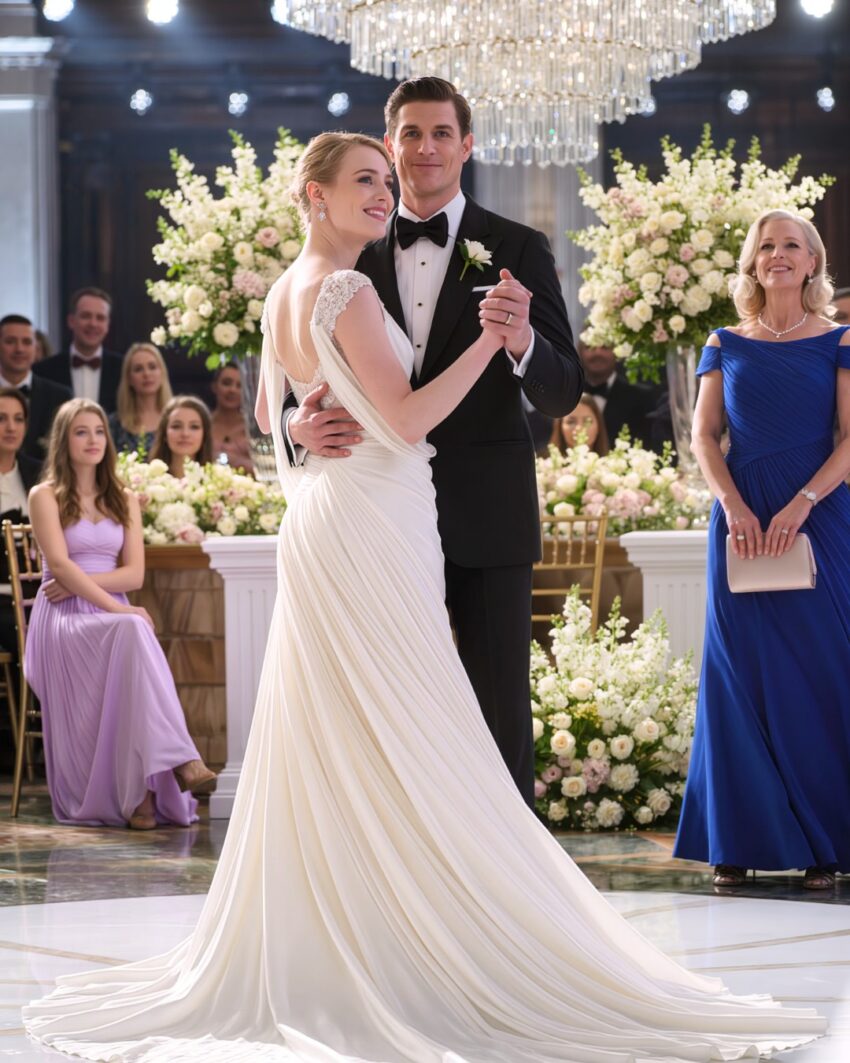
The night I got married, the room smelled like sugar and nerves.
The hotel ballroom had been transformed into something out of a glossy magazine—candles on every table, flowers arching over the head table, fairy lights draped like stars that had decided to come down a little closer for me. The cake stood on its own round table like a marble statue, all white icing and delicate sugar roses, the kind of thing people took pictures of as if it were a guest too.

The band had just shifted into a slow song. I was in that hazy part of the evening where things start to blur together—one polite laugh after another, a constant hand on my arm, glasses touching mine, people telling me I looked stunning, I looked happy, they were so happy for me. It was the sort of happiness that felt crowded, like too many people trying to stand in the same doorway.
Evan’s hand rested at the small of my back, warm and steady. I leaned into him just enough to feel where he ended and I began. We were swaying to the music, the world reduced to the gentle tug of his hand and the fabric of my dress brushing against his trouser leg.
I thought, briefly, that I had made it. That I had finally walked myself out of the story I grew up in and into a better one.
Then my mother stepped into the light.
She glided across the dance floor like it was a stage, her lips already shaped into that practiced smile she reserved for events: big, radiant, almost believable. Her dress glimmered under the chandeliers, her perfume preceding her in a sweet, heavy cloud I’d known for as long as I could remember. Cameras turned toward us the way flowers turn toward the sun.
She slipped an arm around my waist, as if adjusting my posture for a photograph, her fingers light but deliberate.
“Smile, sweetheart,” she murmured through her teeth, the way someone might say Hold still while they pinned something sharp close to your skin.
I turned my face toward the nearest camera because that was what I knew to do—chin up, lips soft, eyes bright. Years of practiced compliance.
And then, still smiling, my mother said it.
“We’re passing the car his parents gave you over to your sister.”
The words were tossed out casually, like a comment about the weather. Her tone was light and breezy, the verbal equivalent of rearranging napkins on a table. To anyone listening, it might have sounded like logistics, a detail already decided, nothing more.
https://googleads.g.doubleclick.net/pagead/ads?gdpr=0&client=ca-pub-3619133031508264&output=html&h=280&adk=4062416028&adf=2288179463&pi=t.aa~a.1720809177~i.28~rp.4&w=850&fwrn=4&fwrnh=100&lmt=1771201701&rafmt=1&armr=3&sem=mc&pwprc=9520209535&ad_type=text_image&format=850×280&url=https%3A%2F%2Fmx.ngheanxanh.com%2Fuyenkok%2Fat-my-wedding-my-mom-smiled-for-the-cameras-and-said-were-giving-the-car-his-parents-gave-you-to-your-sister-everyone-laughed-i-didnt-two-weeks-earlier-i%2F%3Ffbclid%3DIwY2xjawP_QvxleHRuA2FlbQIxMABicmlkETJEMG8zeTV2V0h2OTVrVnpkc3J0YwZhcHBfaWQQMjIyMDM5MTc4ODIwMDg5MgABHqzD7rgxaKXfJ_ImVJxKqlYkjrsnvT3tN5CKHrTS7pTk20ys_BMzJ1Xviv7x_aem_Qq18mDKZ7WjoU618W1UiIw&fwr=0&pra=3&rh=200&rw=850&rpe=1&resp_fmts=3&aieuf=1&aicrs=1&fa=27&uach=WyJXaW5kb3dzIiwiMC4xLjAiLCJ4ODYiLCIiLCIxMDkuMC41NDE0LjEyMCIsbnVsbCwwLG51bGwsIjY0IixbWyJOb3RfQSBCcmFuZCIsIjk5LjAuMC4wIl0sWyJHb29nbGUgQ2hyb21lIiwiMTA5LjAuNTQxNC4xMjAiXSxbIkNocm9taXVtIiwiMTA5LjAuNTQxNC4xMjAiXV0sMF0.&abgtt=6&dt=1771201454542&bpp=2&bdt=630&idt=2&shv=r20260211&mjsv=m202602100101&ptt=9&saldr=aa&abxe=1&cookie=ID%3D047edbb877660eb9%3AT%3D1769733505%3ART%3D1771201325%3AS%3DALNI_MbxLUiZhQ-jXkNFU6dAVksUuZOpsA&gpic=UID%3D000012ece0e4b982%3AT%3D1769733505%3ART%3D1771201325%3AS%3DALNI_Mbbo0t1OcOYWWib3LYu9eIbNU7PIQ&eo_id_str=ID%3D25bebffa57cea215%3AT%3D1769733505%3ART%3D1771201325%3AS%3DAA-AfjY3TbHCnFyRxlxyNSCxA3hZ&prev_fmts=0x0%2C1200x280%2C1200x280%2C728x90%2C1349x600%2C850x280&nras=6&correlator=1328130199664&frm=20&pv=1&u_tz=-480&u_his=2&u_h=768&u_w=1366&u_ah=728&u_aw=1366&u_cd=24&u_sd=1&dmc=4&adx=75&ady=3957&biw=1349&bih=600&scr_x=0&scr_y=1557&eid=95378429%2C95382735&oid=2&pvsid=1389003238660018&tmod=194555166&uas=3&nvt=1&ref=https%3A%2F%2Fl.facebook.com%2F&fc=1408&brdim=0%2C0%2C0%2C0%2C1366%2C0%2C1366%2C728%2C1366%2C600&vis=1&rsz=%7C%7Cs%7C&abl=NS&fu=128&bc=31&bz=1&pgls=CAEaBTYuOS4x&num_ads=1&ifi=7&uci=a!7&btvi=3&fsb=1&dtd=M
But something inside me went cold so quickly it felt like a drop in an elevator.
I stared at her, smile still frozen, cheeks beginning to ache. For a second I thought I must have misheard. The music kept playing. A nearby table erupted in laughter at some joke unrelated to me. The fairy lights twinkled on, indifferent.
My sister Dani stepped into frame like this was her cue. Sequins caught the light along her neckline, throwing little sparks across her collarbones and up toward her grin. She’d always known how to stand where light found her.
She gave a little laugh, shaking her head the way someone does when a friend makes a harmless faux pas.
“Relax, Ev,” she said, her voice dipped in sugar. “It’s just a car.”
To anyone else, it might have been nothing. A harmless family moment. A sister teasing a sister. Typical wedding chaos.
But it was never just the car.
It was the larger shape behind it—the old shadow on the wall that had followed me since childhood—the familiar pattern: what’s yours is negotiable, what’s hers is sacred. And all of it wrapped in the language of love and sacrifice, as if I were selfish for even noticing the exchange.
Evan didn’t say a word. He just went very still beside me. When I turned my head, I caught his expression: calm, alert, eyes narrowed slightly, watching.
He wasn’t shocked. He was…confirming.
And that, more than my mother’s words, told me everything.
People say weddings reveal who loves you, who’s in your corner, who shows up. Mine revealed something else: who had never actually seen me as a person at all.
I grew up in a house where the word “fair” was like fairy dust—pretty in bedtime stories, nonexistent in daylight.
My mother, Grace, loved things neat. Her hair was neat, her kitchen drawers were neat, her emotional life was neat in that nothing messy was allowed to sit on the surface for long. She ironed napkins for holidays and straightened picture frames that were half a degree off. She arranged our family like she arranged her centerpieces: carefully, symmetrically, everything in its proper place.
My place, from early on, was to adjust.
My father, Richard, believed that if no one raised their voice, there was no real problem. He was a man made of deep sighs and folded newspapers. He spoke in mumbled compromises: Let’s not get into this now. Let’s just enjoy dinner. It’s not worth the fight.
And then there was Danielle.
Dani was the delicate one. At least, that’s how my mother introduced her to the world.
“She’s sensitive,” Mom would say, one hand resting lightly on my sister’s shoulder. “She just feels things very deeply.”
https://googleads.g.doubleclick.net/pagead/ads?gdpr=0&client=ca-pub-3619133031508264&output=html&h=280&adk=4062416028&adf=3938564726&pi=t.aa~a.1720809177~i.68~rp.4&w=850&fwrn=4&fwrnh=100&lmt=1771201757&rafmt=1&armr=3&sem=mc&pwprc=9520209535&ad_type=text_image&format=850×280&url=https%3A%2F%2Fmx.ngheanxanh.com%2Fuyenkok%2Fat-my-wedding-my-mom-smiled-for-the-cameras-and-said-were-giving-the-car-his-parents-gave-you-to-your-sister-everyone-laughed-i-didnt-two-weeks-earlier-i%2F%3Ffbclid%3DIwY2xjawP_QvxleHRuA2FlbQIxMABicmlkETJEMG8zeTV2V0h2OTVrVnpkc3J0YwZhcHBfaWQQMjIyMDM5MTc4ODIwMDg5MgABHqzD7rgxaKXfJ_ImVJxKqlYkjrsnvT3tN5CKHrTS7pTk20ys_BMzJ1Xviv7x_aem_Qq18mDKZ7WjoU618W1UiIw&fwr=0&pra=3&rh=200&rw=850&rpe=1&resp_fmts=3&aieuf=1&aicrs=1&fa=27&uach=WyJXaW5kb3dzIiwiMC4xLjAiLCJ4ODYiLCIiLCIxMDkuMC41NDE0LjEyMCIsbnVsbCwwLG51bGwsIjY0IixbWyJOb3RfQSBCcmFuZCIsIjk5LjAuMC4wIl0sWyJHb29nbGUgQ2hyb21lIiwiMTA5LjAuNTQxNC4xMjAiXSxbIkNocm9taXVtIiwiMTA5LjAuNTQxNC4xMjAiXV0sMF0.&abgtt=6&dt=1771201454564&bpp=2&bdt=253&idt=2&shv=r20260211&mjsv=m202602100101&ptt=9&saldr=aa&abxe=1&cookie=ID%3D047edbb877660eb9%3AT%3D1769733505%3ART%3D1771201702%3AS%3DALNI_MbxLUiZhQ-jXkNFU6dAVksUuZOpsA&gpic=UID%3D000012ece0e4b982%3AT%3D1769733505%3ART%3D1771201702%3AS%3DALNI_Mbbo0t1OcOYWWib3LYu9eIbNU7PIQ&eo_id_str=ID%3D25bebffa57cea215%3AT%3D1769733505%3ART%3D1771201702%3AS%3DAA-AfjY3TbHCnFyRxlxyNSCxA3hZ&prev_fmts=0x0%2C1200x280%2C1200x280%2C728x90%2C1349x600%2C850x280%2C850x280&nras=7&correlator=1328130199664&frm=20&pv=1&u_tz=-480&u_his=2&u_h=768&u_w=1366&u_ah=728&u_aw=1366&u_cd=24&u_sd=1&dmc=4&adx=75&ady=5272&biw=1349&bih=600&scr_x=0&scr_y=2873&eid=95378429%2C95382735&oid=2&pvsid=1389003238660018&tmod=194555166&uas=3&nvt=1&ref=https%3A%2F%2Fl.facebook.com%2F&fc=1408&brdim=0%2C0%2C0%2C0%2C1366%2C0%2C1366%2C728%2C1366%2C600&vis=1&rsz=%7C%7Cs%7C&abl=NS&fu=128&bc=31&bz=1&pgls=CAEaBTYuOS4x&num_ads=1&ifi=8&uci=a!8&btvi=4&fsb=1&dtd=M
What she meant was: The world must be padded for her.
When we were seven and nine, Dani and I stood in the doorway of two bedrooms—one big, one small. The bigger room had a generous window, the afternoon light spilling across the hardwood floor like honey. The smaller room had a view of the side of the neighbor’s house and a closet that never quite shut all the way.
“I’m scared of the dark,” Dani whispered, hugging herself, eyes fixed on the smaller room as if it were a mouth waiting to swallow her.
Mom didn’t hesitate. “Eva can take that one,” she said, already stepping into the larger room, pulling the tape measure from around her neck to start planning where the furniture would go.
I swallowed the words on my tongue. I liked the big room. I liked the way the light fell across the floor, and the fact that you could see the maple tree from the window, the one that turned spectacular shades of red in the fall.
But Dani was scared. Dani was fragile. Dani was the one who needed.
And I was the one who adapted.
When I was sixteen, Dani got her first car—a used little hatchback that rattled when you turned the ignition but still meant freedom. Mom and Dad had surprised her with it in the driveway, wrapped in a giant red bow like something from a commercial. There were pictures of her squealing, hands over her mouth, mascara smudged with happy tears. Mom’s eyes shining with pride.
Less than a year later, Dani totaled it.
She had been texting, or changing the music, or sobbing about a breakup. The story changed depending on who she told. What didn’t change was the spin.
“It was just awful weather,” Mom said, shaking her head at the kitchen table, the afternoon the insurance called. “Those roads are terrible when they’re wet. She’s lucky to be alive.”
She said it with such conviction that you’d think the rain itself had climbed into the car and jerked the wheel.
When I was nineteen, I started saving for my own car. No red bow. No surprise. I stocked shelves at a hardware store after classes, stayed late to wash displays no one had asked me to wash, said yes to every extra shift. I went to bed bone-tired and smelling like cleaning chemicals, and I watched the line in my savings account creep up until one day it was enough.
https://googleads.g.doubleclick.net/pagead/ads?gdpr=0&client=ca-pub-3619133031508264&output=html&h=280&adk=4062416028&adf=4020180958&pi=t.aa~a.1720809177~i.94~rp.4&w=850&fwrn=4&fwrnh=100&lmt=1771201778&rafmt=1&armr=3&sem=mc&pwprc=9520209535&ad_type=text_image&format=850×280&url=https%3A%2F%2Fmx.ngheanxanh.com%2Fuyenkok%2Fat-my-wedding-my-mom-smiled-for-the-cameras-and-said-were-giving-the-car-his-parents-gave-you-to-your-sister-everyone-laughed-i-didnt-two-weeks-earlier-i%2F%3Ffbclid%3DIwY2xjawP_QvxleHRuA2FlbQIxMABicmlkETJEMG8zeTV2V0h2OTVrVnpkc3J0YwZhcHBfaWQQMjIyMDM5MTc4ODIwMDg5MgABHqzD7rgxaKXfJ_ImVJxKqlYkjrsnvT3tN5CKHrTS7pTk20ys_BMzJ1Xviv7x_aem_Qq18mDKZ7WjoU618W1UiIw&fwr=0&pra=3&rh=200&rw=850&rpe=1&resp_fmts=3&aieuf=1&aicrs=1&fa=27&uach=WyJXaW5kb3dzIiwiMC4xLjAiLCJ4ODYiLCIiLCIxMDkuMC41NDE0LjEyMCIsbnVsbCwwLG51bGwsIjY0IixbWyJOb3RfQSBCcmFuZCIsIjk5LjAuMC4wIl0sWyJHb29nbGUgQ2hyb21lIiwiMTA5LjAuNTQxNC4xMjAiXSxbIkNocm9taXVtIiwiMTA5LjAuNTQxNC4xMjAiXV0sMF0.&abgtt=6&dt=1771201454582&bpp=3&bdt=272&idt=3&shv=r20260211&mjsv=m202602100101&ptt=9&saldr=aa&abxe=1&cookie=ID%3D047edbb877660eb9%3AT%3D1769733505%3ART%3D1771201702%3AS%3DALNI_MbxLUiZhQ-jXkNFU6dAVksUuZOpsA&gpic=UID%3D000012ece0e4b982%3AT%3D1769733505%3ART%3D1771201702%3AS%3DALNI_Mbbo0t1OcOYWWib3LYu9eIbNU7PIQ&eo_id_str=ID%3D25bebffa57cea215%3AT%3D1769733505%3ART%3D1771201702%3AS%3DAA-AfjY3TbHCnFyRxlxyNSCxA3hZ&prev_fmts=0x0%2C1200x280%2C1200x280%2C728x90%2C1349x600%2C850x280%2C850x280%2C850x280&nras=8&correlator=1328130199664&frm=20&pv=1&u_tz=-480&u_his=2&u_h=768&u_w=1366&u_ah=728&u_aw=1366&u_cd=24&u_sd=1&dmc=4&adx=75&ady=6257&biw=1349&bih=600&scr_x=0&scr_y=3858&eid=95378429%2C95382735&oid=2&pvsid=1389003238660018&tmod=194555166&uas=3&nvt=1&ref=https%3A%2F%2Fl.facebook.com%2F&fc=1408&brdim=0%2C0%2C0%2C0%2C1366%2C0%2C1366%2C728%2C1366%2C600&vis=1&rsz=%7C%7Cs%7C&abl=NS&fu=128&bc=31&bz=1&pgls=CAEaBTYuOS4x&num_ads=1&ifi=9&uci=a!9&btvi=5&fsb=1&dtd=M
My car wasn’t much, just a modest used sedan with too many miles, but it was mine. The day I drove it home, my heart felt too big for my chest.
Mom walked around it in the driveway, arms folded, appraising.
“Good,” she said at last, nodding. “It builds character when you have to work for things.”
She said it like a compliment.
What she meant was: You won’t love it more than your sister.
I didn’t have words for it then, the way love in our house always traveled in one direction. Dani’s needs were urgent– emergencies to be solved. Mine were…opportunities. For me to learn, to give, to prove. I became the family resource without ever agreeing to the job.
If Dani cried, we rearranged plans. If I cried, Mom tilted her head, confused, searching for the life lesson hiding in my tears.
By the time I was twenty-nine, I had carved a life outside their script with the shaky certainty of someone who’s never had anything handed to them.
I was an interior designer by then, the kind who carried tiny fabric samples in her purse and noticed when someone’s throw pillows didn’t match their rug. I was careful with details, with budgets, with people’s feelings. I paid my own bills. I bought my own clothes. I didn’t borrow dresses; I loaned them.
I had a small apartment that I loved fiercely. It was nothing fancy, just two rooms and a balcony, but it smelled like my candles, my coffee, my life. I chose the art on the walls. I chose what came in and what went out.
Or I thought I did.
Then I met Evan.
The first time I saw him, I was standing on a ladder, arguing with a curtain rod.
The boutique I was redesigning had ceilings much higher than the owner had mentioned, and I’d underestimated just how stubborn metal could be when it decided it didn’t want to cooperate. I was muttering under my breath, hair escaping my bun, one arm stretched above my head as I wrestled with a bracket.
“Need a hand?” a voice called from below.
“Nope,” I said automatically, because I never needed help. I was the help.
And then the ladder shifted just enough to make my stomach drop.
A hand closed around the side of it, steadying the whole world.
“Okay,” I amended, catching my balance, my heart pounding in my throat. “Maybe a hand is acceptable.”
I looked down. He was grinning up at me, one eyebrow raised, dark hair tousled, sleeves rolled up to his forearms. There was paint on his knuckles and dust in his hair like he’d been doing his own share of battling stubborn objects that day.
“On one condition,” he said. “You admit you were about to lose that fight.”
“I was not,” I replied, indignant. “I was just…reassessing my strategy.”
He laughed, the sound warm and unselfconscious, and something in my chest eased.
That was Evan.
We started seeing each other in small, ordinary ways. A coffee after I finished at the boutique. An offer to help move a display I insisted I could handle alone. Conversations about music and movies and why people care so much about backsplash tile.
He listened.
That sounds simple, but after years of being the one who listened, the one who fixed, the one who made space, it felt almost disorienting to have someone lean in when I spoke, genuinely curious.
He asked what my favorite room was in the apartment I grew up in.
“The kitchen,” I said, surprising myself. “Even though it wasn’t mine.”
“Why?” he asked.
“Because it was the one place where things got messy and somehow that was allowed. Flour on the counter. Pans piled in the sink at Christmas. It didn’t look like my mother’s magazine anymore. For a little while, everything felt real.”
He nodded like that made perfect sense instead of being deeply revealing.
He told me about his own family. His parents were public-school teachers who took pictures of birds on weekends and still held hands at the grocery store. They weren’t rich, but there was a steadiness in the way he spoke about them that made me feel like he’d grown up on solid ground.
“They’re big on boundaries,” he said once, almost apologetically, as if that might be a flaw. “We weren’t allowed to slam doors, but we were allowed to say we were mad. They’re…particular, I guess, about respecting each other’s stuff, time, space.”
I stared at him. “That sounds like a utopia.”
He laughed. “No, it sounds like family therapy and chore charts stuck to the fridge.”
Still, something in me leaned toward that world like a plant toward light.
The first time I met his parents, we sat around their dining table eating spaghetti from mismatched plates. His mother, Lyn, had a laugh that started in her chest and shook her shoulders. His father, Tom, told me a story about how Evan had once tried to build a treehouse without understanding physics and how he’d kept climbing into it even as it leaned at an alarming angle.
“We let him,” Tom said. “We just stood under it with a mattress, in case.”
“The secret of good parenting,” Lyn added, “is knowing when to be the safety net instead of the puppeteer.”
She said it lightly, like a joke. I thought of my mother’s hands, always on the strings.
I liked them immediately and, worse, I believed them. I believed their world existed.
Months later, sitting at my own small kitchen table with takeout containers between us, Evan fumbled with something in his pocket.
“I know it’s not very romantic,” he said, cheeks slightly pink, “but my mother would never forgive me if I let you choke on your noodles while I did this.”
He slid a small box across the table. It wasn’t velvet. It wasn’t dramatic. It was white and sturdy, like it had practical intentions.
My heart stuttered. I opened it with fingers that suddenly didn’t feel like mine.
Inside was a ring—simple, understated, a thin band and a single diamond that caught the light and tossed it back without showing off.
“I, uh, wanted to say a lot of poetic things,” Evan said quickly, words bumping into each other like puppies, “but honestly, you’re the person I’m calmer with than when I’m alone, and I didn’t know that was possible. So. Do you want to keep…doing life with me? Officially?”
It was the opposite of a grand speech, and it was perfect.
“Yes,” I said, laughing, tears spilling anyway. “Obviously, yes.”
Later, his parents hugged me one by one like they’d been waiting to exhale. My mother, over the phone, sounded pleased in a curated way, like I’d checked off an important life box on schedule.
“It’s about time,” she said. “You’re nearly thirty, Eva. I was starting to think you were married to your job.”
“I like my job,” I said, even as I smiled at the ceiling.
“You’ll like having a husband more,” she replied, as if I were trading in a piece of furniture.
Wedding planning brought my mother into my world more frequently than I’d ever wanted.
There were centerpieces to discuss (mine were too modest), guest lists to negotiate (hers were too long), dresses to try on (“Mermaid cuts are unflattering on your hips, sweetheart, trust me”), and endless questions about seating charts, favors, invitations.
Some of it was normal stress. Everyone told me that. Every bride fights with her mother about something. It’s tradition.
But woven into those ordinary tensions were the old, familiar threads.
“That’s too expensive,” she’d say when I mentioned hiring a photographer I loved. “Danielle still needs help with her rent, you know. We can’t spend all our money on pictures.”
“Dani’s thirty, Mom.”
“She’s going through a rough patch.”
Dani was always going through a rough patch. Rough patches seemed to form wherever she set her foot.
One afternoon, after another argument about the band, I sat at my office desk staring at a spreadsheet and feeling that old sinking sensation. The one that said: You will never be entirely free of this. No matter how carefully you build your life, someone will try to carve pieces off it for her.
“You look like you’re trying to swallow a lemon,” my coworker Maya said, slipping into the chair opposite mine.
I sighed. “Family stuff.”
“Ah.” She leaned back, folding her arms. “Do I need to fetch coffee or a lawyer?”
“Maybe both,” I muttered.
She laughed. “You joke, but I’m only half kidding. Before I worked here, I was a paralegal. Spent three years in a firm that dealt with messy inheritance disputes and people who thought gifts came with invisible strings.”
I looked up. Something in my chest sparked.
“Say more.”
She shrugged. “You’d be surprised how many people lose cars, houses, jewelry, all sorts of things because relatives decide they’re ‘family property.’ Especially when someone gets married. Suddenly everyone thinks they’re entitled to rearrange things in the name of tradition.”
I told her, cautiously at first, about Dani. About bedrooms and cars and offers disguised as generosity. The words came out faster than I expected, as if they’d been waiting just behind my teeth.
Maya listened quietly, her expression shifting from sympathetic to troubled.
“Okay,” she said when I finished. “So you know the pattern. That’s good. Most people don’t realize they’re in one until it steamrolls them.”
“I know it,” I said, staring down at my hands, “but knowing hasn’t stopped it yet.”
“Maybe you just haven’t made it expensive enough to try,” she said lightly.
I blinked. “What?”
She slid her chair closer. “What if you put something in writing? You’re about to receive gifts. The kind that can be titled, registered, insured. You don’t have to let other people decide what happens to them. You can literally say, ‘Anything given in my name isn’t transferable without my consent.’ Make it legal. Make it official. Make meddling a liability instead of a habit.”
The idea sounded extreme and thrilling and terrifying.
“That’s…kind of paranoid, isn’t it?” I asked.
She shook her head. “Paranoid is when your fear doesn’t match reality. Your reality is that your family has a long history of guiding your property into your sister’s hands, and no one sees anything wrong with it. Creating boundaries is just acknowledging data.”
I thought about the ways my mother framed my generosity as a virtue. How saying no felt like confessing to some moral failure.
“I don’t want to start my marriage with a bunch of legal barricades,” I said.
“You’re not building a fortress,” Maya said. “You’re putting a lock on your front door. Trust me, it’s a lot easier to set rules before someone tries to move in their furniture.”
In the end, it was Evan who settled it.
We were in his living room, half buried under swatches of fabric for napkins, scanning our stupidly elaborate wedding checklist. I told him what Maya had suggested, half expecting him to be horrified, or at least uneasy.
He listened, brow furrowed, thumb pressed into the bridge of his nose, thinking.
“Honestly?” he said after a moment. “I think it might be the kindest thing you can do.”
“Kind?” I stared at him. “My mother will think I’m declaring war.”
“She thinks boundaries are war,” he said gently. “She’s trained you to think so too. But you’re not trying to hurt her. You’re trying to protect us. And yourself. You told me once that you always end up giving away things you want to keep because you’re scared of being called selfish.” He reached for my hand. “What if this is how you practice not doing that anymore?”
I’d never thought of paperwork as an act of self-respect.
A week later, Maya sat with me in a quiet corner of a notary’s office, sliding a document across the table. The words were formal, dry, impersonal. They didn’t say anything about little girls and bigger bedrooms or totaled cars and quiet resentment. But I could read those ghosts between the lines.
“Basically,” Maya said, tapping a section with her pen, “this says: if someone tries to transfer, sell, or otherwise ‘reallocate’ a gift given to you without your written permission, it triggers consequences. At minimum, you can contest it. At most, it affects what they can expect from you or your husband in the future. Money, assistance, whatever.”
“It feels so…serious,” I said, staring at the blank where my name would go.
“Because it is,” she replied. “You’re changing the rules of a game they’ve been winning for years. They won’t like it. But you don’t have to keep playing.”
I signed in blue ink.
Evan signed next, his hand steady.
“You’re not being paranoid,” Maya said softly as she stamped it. “You’re being prepared.”
I tucked the document into a thick envelope and slid it into a folder in my home office, my heart pounding. It felt melodramatic, like hiding a secret weapon.
Part of me hoped I would never have to touch it again.
Part of me knew better.
The rehearsal dinner was at a cozy restaurant with exposed brick walls and candles dripping down wine bottles. Evan’s parents arrived carrying a small envelope and an expression I recognized: the look of people who were about to give you something and were excited about your reaction.
After dessert, Tom cleared his throat.
“We know you two have been building this life piece by piece,” he said, looking between us. “We wanted to give you something that…helps that along a bit.”
He slid the envelope across the table toward me. It was heavier than it looked.
I opened it, expecting maybe a check or a gift card.
Inside was a single silver key.
For a second, my brain didn’t register it. Then I saw the little tag attached with a loop of twine: OUR WISH FOR YOUR NEW JOURNEY.
Evan grinned. “They did it,” he said. “They actually did it.”
“What did you do?” I asked, voice faint.
Tom smiled. “We picked up a car for you two. Nothing fancy. It’s used, but it’s solid, low mileage, recently serviced. We had a mechanic we trust go over it twice. It’s in your name, Eva.” He nodded at me. “We figured you two will be doing a lot of driving in the next few years. Apartments, maybe a house, maybe…other cargo.” His eyes softened.
Lyn reached across the table and squeezed my hand. “We wanted you to have something that feels safe,” she said. “No strings. No expectations. Just…wheels under your feet while you figure out where home is.”
It wasn’t about the car. It was about what it represented: they saw me as part of their family, but also as my own person. They trusted me with something practical and significant. They weren’t buying my loyalty or trying to score points. They were saying: we believe in your future.
My throat tightened. “Thank you,” I managed. “Really. Thank you.”
Out of the corner of my eye, I saw my mother watching, her smile perfectly polite. She clapped when everyone else did. She complimented their generosity.
“How thoughtful,” she said, her tone smooth as glass.
But her eyes slid sideways to where Dani sat, twisting her napkin, a familiar crease between her brows.
There it was, the flicker. The mental ledger springing to life. A new resource on the board.
I felt something icy crawl up my spine.
Later that night, when we stepped into our building’s underground garage and saw the car itself—a compact, clean sedan that still smelled faintly like someone else’s air freshener—I ran my hand over the hood and exhaled.
“It’s just a car,” Evan said, hugging me from behind, chin resting on my shoulder.
“I know,” I answered. “That’s the beautiful part.”
And still, somewhere in the back of my mind, my mother’s gaze lingered, calculating.
The morning of the wedding, my apartment turned into a beehive. Bridesmaids, hair stylists, makeup artists, my aunt with an emergency sewing kit, photographers buzzing around like documentarian bees. There were curling irons on every surface, coffee cups multiplying, and someone’s playlist spilling from a Bluetooth speaker.
My dress hung from the curtain rod in the living room like a waiting question.
In the middle of the chaos, Mom stood perfectly composed, lipstick flawless, hair sprayed into submission, calm at the center of the storm. She had appointed herself coordinator, even though we’d hired a planner. Old habits.
“Eva, sweetheart, turn your head,” she said, fingers gentle but firm as she adjusted my veil. “No, not like that. There. Hold still.”
I watched us in the mirror: her in navy silk and pearls, me in white and nervousness.
“You look beautiful,” she said, and for a moment, it sounded almost unguarded. “I’m proud of you.”
My throat tightened unexpectedly. “Thanks, Mom.”
She smoothed the veil over my shoulders, fingers lingering.
“You’ve always been so…giving,” she added, smiling at my reflection. “Don’t lose that. It’s your best quality.”
The words slid in like a compliment with a hidden hook.
I knew what she meant. She meant: don’t start saying no now. Don’t become one of those brides. Don’t start acting like things are yours, not ours.
Her perfume wrapped around us, cloying and sweet, filling my lungs. It smelled like the first day of school, like church, like every big moment she’d narrated for me.
I held her gaze in the mirror and tried to smile like that particular word didn’t sting anymore.
“Don’t worry,” I said lightly. “I haven’t lost anything important.”
She kissed my cheek, leaving the faintest trace of lipstick.
I told myself I was imagining the warning behind her words.
By the time we arrived at the venue, my nerves had braided themselves into a tight coil. The ceremony passed in a blur of candlelight and vowels and Evan’s hand shaking just enough when he slipped the ring onto my finger. There were tears, laughter, applause. I looked out at the crowd and saw my parents beaming like they’d built this moment themselves.
Afterward, the photographer moved us around like pieces on a chessboard, arranging family groupings on the steps outside, under the archway, near the fountain. My cheeks ached from smiling. Evan’s tie loosened slightly as the sun started to dip.
When we finally entered the reception to the band’s upbeat introduction, everyone stood and clapped. It was like walking into a sound wave. We did the obligatory silly little first steps, raised our hands, laughed on cue. I felt like an actress in a movie I’d seen before.
We moved through the motions: first dance, champagne toasts, bouquet toss. People clinked their glasses for us to kiss so often I considered banning silverware.
At some point, between courses, as the band slid into another slow song, Evan and I found ourselves on the dance floor again, swaying. His hand settled at my waist, my fingers resting against his shoulder. For a moment, it was quiet inside me. Just his heartbeat under my palm and the soft drag of my dress on the floor.
Maybe, I thought, this is the turning point. Maybe this is the night we start writing something new.
Then my mother cut through the crowd like a ship through water.
She had her event smile on, bright and polished. Guests turned slightly as she passed, the way people always did, making room for her without realizing. She reached us just as the photographer raised his camera for another candid shot.
She slipped her hand around my arm, leaning in, cheek close to mine, as if we were sharing some piece of gossip.
“There we go,” she said brightly. “Perfect.” Her fingers squeezed lightly. “Smile.”
I did.
The flash went off.
And then, still smiling at the camera, she said, in a tone that held no doubt at all: “By the way, we’re going to give that car his parents bought you to Danielle. She needs it more. You two can get by with one.”
Her words landed in my chest like a fist.
I felt my smile freeze, my jaw quiver beneath it. The music continued. Someone applauded across the room at something unrelated. The clink of silverware on plates sounded suddenly too loud.
For a split second, I wondered if anyone else had heard. The tables closest to us were deep in conversation, faces turned away. The DJ scanned his playlist. A little girl in a flower crown chased bubbles near the dessert table.
Beside me, Evan went still. His hand on my back tightened almost imperceptibly.
Dani materialized at my mother’s shoulder, as if summoned. Her dress sparkled under the fairy lights, catching everyone’s attention without her having to try. She laughed, the sound practiced, airy.
“Relax,” she said, rolling her eyes affectionately. “It’s just a car. You know I’ve had the worst luck with mine.”
Mom nodded. “Exactly. It’s just practical. You and Evan don’t need two, and your sister has been through so much with that piece of junk she drives.”
It wasn’t presented as a question. It was an announcement. A foregone conclusion.
Something hot rose in my throat.
I thought about the night I’d first turned the key in that car’s ignition, the way the engine had started with a low purr, the relief that flooded me knowing there was now a reliable way to get to work, to clients, to friends. The way Evan’s parents had pulled me into their arms and told me they trusted me to use it well.
I thought about Maya’s face when I’d told her about my family. The way she’d said: You already know what they will try.
My mother looked at me, head tilted, anticipation in her eyes. She was waiting for the performance: my gracious smile, my reassuring words, my willingness to turn my own joy into a communal resource.
“Eva?” Dad’s voice came from behind her. He wandered over, drawn by tones he recognized but never quite intervened in. “What’s happening here?”
Mom’s laugh was light, dismissive. “Nothing serious. We’re just working out a little car situation. Helping Dani out.” She patted my arm. “You don’t mind sharing, do you? You’ve always been so practical.”
There it was again. Practical. Giving. Good girl.
Dani shot me a look, eyebrows raised. “You don’t care, right? I mean, you know I’m always short on cash lately. I’ll pay you back somehow. We’re family.”
I heard myself murmur something like “Mm.” It was the sound a person makes while drowning, just before the water closes over their head.
I thought of all the ways I’d “shared” before. The nights I’d stayed up editing Dani’s résumé while she cried about a breakup. The clothes she’d “borrowed” and lost, the jewelry she’d taken without asking and shrugged about later. The money I’d given her when she called me sobbing from some disaster she’d driven herself into.
I’d been told all my life that this was love. That this is what good sisters did.
In that moment, under the fairy lights at my own wedding, with my mother’s fingers digging just a little too hard into my arm, I understood something with startling clarity:
This wasn’t love.
This was access.
I felt my lips curve upward into a smile that didn’t reach my eyes.
“You’re right,” I said softly, my voice steady in a way I didn’t recognize. “I don’t mind sharing.”
My mother’s shoulders relaxed. Dani grinned. The crisis, as far as they could tell, had been averted.
Evan, however, did not relax.
He squeezed my hand, his thumb brushing the inside of my wrist, a question written in that small touch: Are you sure?
I didn’t answer him then, not with words. I just looked at him, letting him see the storm gathering behind my eyes.
The photographer snapped another photo.
Somewhere inside, something old and tired and compliant uncrossed its hands, stood up, and walked away.
The rest of the reception unfolded like a play I was watching from backstage.
Toasts were made. Glasses raised. People danced, laughed, leaned close to gossip. I posed for pictures with cousins I barely knew and clients who’d become friends. I smiled, nodded, said thank you when people told me how beautiful everything looked, how lucky I was.
Through it all, a quiet counting ticked in the back of my mind.
They went into our garage, I thought. They took pictures of the car. They’ve already decided where it belongs. They did it while we were rehearsing our vows.
After a while, the noise in the ballroom started to feel like static. My cheeks hurt. My veil itched. The air seemed too sweet, too thick.
When the last round of dessert had been served and the crowd started thinning, Evan found me near the bar, staring into a glass of champagne I hadn’t touched.
“Come with me,” he murmured.
We slipped out a side door into a narrow hallway, cooler and dimmer than the ballroom. Our footsteps echoed on the tile. Somewhere distant, people laughed, a muffled soundtrack to someone else’s party.
Evan leaned against the wall, tugging at his tie until it hung loose around his neck. He looked at me for a long moment, really looked, taking in the tightness of my shoulders, the way I held my glass like a shield.
“Do you want me to talk to them?” he asked quietly. “About the car. About…everything.”
For a second, the offer was so tempting my knees wobbled. To hand this over to someone else, to let him be the barrier between me and the family that never saw me clearly—it sounded like relief.
But it also sounded like a familiar story: another person stepping in so I didn’t have to stand up.
I shook my head.
“No,” I said. My voice surprised me with its steadiness. “We already did.”
He frowned slightly, then his eyes flicked to my clutch.
Realization dawned.
“You…didn’t,” he said, half in awe, half in disbelief.
“I did,” I replied. “Or we did. Two weeks ago. With Maya.” My fingers brushed the outline of the envelope tucked inside my bag. “I didn’t know if it would ever actually come to this. I hoped it wouldn’t. But…here we are.”
Evan let out a low whistle, then laughed under his breath.
“I should have known,” he said. “You’ve been more relaxed about this wedding than most people I’ve seen. I thought it was just because you’re sane.” His expression softened. “It’s because you prepared for this.”
“I didn’t want to bleed again without a bandage,” I said quietly.
He slipped his hand into mine. “So what now?”
My phone buzzed in my clutch. I ignored it.
“Now,” I said, “we let them step on the tripwire if they’re determined to. We don’t drag them toward it. We don’t push. We just…stop cushioning every fall.”
We stood in silence for a few beats. The distant music shifted into an upbeat number. A burst of laughter seeped under the door.
Evan’s phone vibrated. He pulled it out, glanced at the screen, then flipped it toward me.
It was a picture from one of the guests—someone had forwarded a social media post.
Dani was in our garage, leaning casually against the car Evan’s parents had given us. She’d angled herself just right, one foot lifted, hip popped, smile wide. The caption read: “Finally got a ride that fits me. New chapter, here I come!”
A dozen little heart emojis fluttered underneath. Comments from her friends poured in: “So cute!” “You deserve it babe.” “Yaaaas.”
I stared at the photo, then at the time stamp. It had been posted twenty minutes ago.
“She couldn’t even wait until tomorrow,” Evan said quietly.
I let out a laugh, short and humorless.
“Of course she couldn’t. Posing always comes before permission.”
He slipped his phone back into his pocket.
“We don’t have to go back in there,” he said. “We can leave now. We can tell people we’re tired. We can start our honeymoon early and let them talk themselves in circles.”
I thought about it. The image was so tempting—slipping away with him into the night, leaving the mess behind like an empty plate at a restaurant.
But that’s what I’d always done. Left quietly. Swallowed the hurt. Let the story settle into its familiar shape.
“No,” I said finally. “If I leave now, this becomes another thing they tell themselves. Another story where I was unreasonable, oversensitive, ungrateful.”
I straightened my shoulders.
“This time, they can hear my part of it. Out loud. With witnesses.”
Evan studied my face, then nodded slowly.
“I’m with you,” he said simply.
We smoothed our clothes, adjusted my veil, and walked back toward the ballroom.
The music swelled as the door swung open. The lights were warm and flattering. The guests were halfway through their post-dessert dancing, shoes abandoned under tables, ties loosened, cheeks flushed.
My mother stood near the cake table, laughing too loudly at something my aunt had said. Dani hovered nearby, phone in hand, pretending to scroll while sneaking glances at the door.
When Mom saw us, her face lit up.
“There you are!” she called, patting my father’s arm. “Everyone’s asking where the bride disappeared to.”
“We were handling a few final details,” I replied, letting the words sit between us.
She either didn’t hear the edge in my tone or chose to ignore it.
“Well, don’t be too long,” she said. “We’ll be wrapping up soon, and Danielle still needs a ride home.” Her smile tilted pleasantly in Dani’s direction.
“She has one now,” Evan said lightly.
Mom blinked. “What?”
“A ride,” he repeated. “Didn’t you say she’s taking ours?”
The nearby conversations faltered just enough that the air shifted. A few curious gazes drifted our way.
Dani’s jaw tightened. “Okay, can we not make a scene out of this?” she said, cheeks flushing. “I already posted about it. People know. It’s not a big deal.”
“Not a big deal,” I echoed softly. “You announcing ownership of something that doesn’t belong to you.”
Dad rubbed the back of his neck. “Can we talk about this later? This isn’t the time, Eva.”
“This is exactly the time,” I said. My voice wasn’t loud, but it carried. “You announced the decision here. In front of everyone. I don’t see why the conversation about it needs to happen in the shadows.”
Mom’s smile thinned, the edges brittle.
“You’re overreacting,” she said. “It was a misunderstanding. Of course we were going to ask you. We just assumed—”
Evan reached into my clutch and pulled out the envelope, holding it out to her.
“It might help to read this before you assume anything else,” he said calmly.
Mom stared at the envelope as if it were something vulgar.
“What is this?” she asked, not taking it.
“Documentation,” he said. “About gifts. Ownership. Consent.”
Her gaze snapped to mine, incredulous. “You brought legal papers to your wedding?”
“In case you brought old habits to mine,” I replied.
Dani let out a disbelieving laugh. “Okay, wow. You’re really going to lawyer up over a car? That’s insane, Ev.”
“It’s not about the car,” I said, finally letting the years of swallowed words find their way out. “And if I didn’t bring the papers, I know exactly how this would be spun later. That I never objected. That I agreed. That ‘we all decided together.’ So yes, I brought clarity.”
The music behind us faded as the band, sensing the shift, let the song taper off. The room grew quieter in that particular way large spaces do when everyone is pointedly pretending not to eavesdrop.
Mom snatched the envelope from Evan’s hand and slid the document out. The paper crackled in the air.
Her eyes scanned the lines, moving quickly at first, then slower, then stopping.
Her lips parted.
“What is this?” she repeated, but the question was different now.
“It’s a declaration,” I said. “Legally notarized. It states that any significant gift given to me—especially anything registered in my name—can’t be transferred, sold, or ‘repurposed’ without my written consent. If someone tries, there are consequences. Financial ones.”
Dani stepped closer, peering over her shoulder.
“Oh my God,” she breathed. “You’re serious.”
In the circle around us, people shifted. A murmur ran through the crowd like wind through leaves.
https://googleads.g.doubleclick.net/pagead/ads?gdpr=0&client=ca-pub-3619133031508264&output=html&h=280&slotname=4515924456&adk=2960620333&adf=2044608878&pi=t.ma~as.4515924456&w=850&fwrn=4&fwrnh=100&lmt=1771201827&rafmt=1&format=850×280&url=https%3A%2F%2Fmx.ngheanxanh.com%2Fuyenkok%2Fat-my-wedding-my-mom-smiled-for-the-cameras-and-said-were-giving-the-car-his-parents-gave-you-to-your-sister-everyone-laughed-i-didnt-two-weeks-earlier-i%2F%3Ffbclid%3DIwY2xjawP_QvxleHRuA2FlbQIxMABicmlkETJEMG8zeTV2V0h2OTVrVnpkc3J0YwZhcHBfaWQQMjIyMDM5MTc4ODIwMDg5MgABHqzD7rgxaKXfJ_ImVJxKqlYkjrsnvT3tN5CKHrTS7pTk20ys_BMzJ1Xviv7x_aem_Qq18mDKZ7WjoU618W1UiIw&fwr=0&fwrattr=true&rpe=1&resp_fmts=3&aieuf=1&aicrs=1&uach=WyJXaW5kb3dzIiwiMC4xLjAiLCJ4ODYiLCIiLCIxMDkuMC41NDE0LjEyMCIsbnVsbCwwLG51bGwsIjY0IixbWyJOb3RfQSBCcmFuZCIsIjk5LjAuMC4wIl0sWyJHb29nbGUgQ2hyb21lIiwiMTA5LjAuNTQxNC4xMjAiXSxbIkNocm9taXVtIiwiMTA5LjAuNTQxNC4xMjAiXV0sMF0.&abgtt=6&dt=1771201453663&bpp=2&bdt=-M&idt=328&shv=r20260211&mjsv=m202602100101&ptt=9&saldr=aa&abxe=1&cookie=ID%3D047edbb877660eb9%3AT%3D1769733505%3ART%3D1771201702%3AS%3DALNI_MbxLUiZhQ-jXkNFU6dAVksUuZOpsA&gpic=UID%3D000012ece0e4b982%3AT%3D1769733505%3ART%3D1771201702%3AS%3DALNI_Mbbo0t1OcOYWWib3LYu9eIbNU7PIQ&eo_id_str=ID%3D25bebffa57cea215%3AT%3D1769733505%3ART%3D1771201702%3AS%3DAA-AfjY3TbHCnFyRxlxyNSCxA3hZ&prev_fmts=0x0%2C1200x280%2C1200x280%2C728x90%2C1349x600%2C850x280%2C850x280%2C850x280%2C850x280%2C850x280&nras=8&correlator=1328130199664&frm=20&pv=1&u_tz=-480&u_his=2&u_h=768&u_w=1366&u_ah=728&u_aw=1366&u_cd=24&u_sd=1&dmc=4&adx=75&ady=22471&biw=1349&bih=600&scr_x=0&scr_y=20096&eid=95378429%2C95382735&oid=2&pvsid=1389003238660018&tmod=194555166&uas=3&nvt=1&ref=https%3A%2F%2Fl.facebook.com%2F&fc=1920&brdim=0%2C0%2C0%2C0%2C1366%2C0%2C1366%2C728%2C1366%2C600&vis=1&rsz=%7C%7CeEbr%7C&abl=CS&pfx=0&fu=128&bc=31&bz=1&pgls=CAEaBTYuOS4x&ifi=3&uci=a!3&btvi=7&fsb=1&dtd=M
Dad’s face reddened. “This is petty, Eva,” he said. “It’s just things. You’re going to tear the family apart over…paperwork.”
“Petty,” I repeated. I tasted the word on my tongue. “You think this is petty.”
I looked at my sister. At the phone still in her hand, the notification of likes probably buzzing even now on her post about “her” new car.
“You went into our garage,” I said. “You took photos of a car that isn’t yours and told the world it was. You did that before we’d even had time to leave the reception. And you’re calling me petty for saying ‘no’?”
Dani tossed her hair. “It was symbolic,” she said, voice high. “Everyone knows how close we are. It’s not like I hotwired it and drove away.”
“You didn’t have to,” I replied. “You’ve never had to. The point is you assume my things are negotiable. Up for redistribution. Up for…discussion.”
Mom folded the paper slowly, as if buying time.
“We are your family,” she said. Her voice had lost some of its polish. “We don’t steal from each other. We share. We help. That’s what we do. You’re making it sound sinister.”
“You’re right,” I said quietly. “We should use the right words.”
I took a breath, the kind that feels like it reaches the bottom of your lungs.
“For years, you’ve taken things from me—time, money, belongings, opportunities—and told yourselves it was love. You called it sharing when you decided for me. You called it sacrifice when you put her needs ahead of mine. You praised me for not making a fuss.”
I gestured at the envelope on the table.
“Tonight, I’m not praising myself for that anymore.”
Dani’s eyes shimmered, the first hint of tears. “So you’re going to humiliate us in front of everyone? You couldn’t just talk about this tomorrow?”
“I could have,” I said. “If you had asked tomorrow. If you hadn’t already posed with my car like it was your graduation present and made an announcement at my wedding that the decision had been made.”
“You’re being dramatic,” Mom snapped. Her cheeks were flushed now, her composure fractured. “It was one comment. One photo. Of course we were going to compensate you somehow.”
“The drama,” I said evenly, “is that you thought you had the right to make that comment at all.”
For the first time, silence fell completely. No music. No clinking. Even the hum of conversation diminished to a faint buzz at the edges of the room.
In that silence, I heard my own heart pounding in my ears.
Evan squeezed my hand.
“Mrs. Harper,” he said quietly, his tone still unfailingly polite, “my parents gave that car to Eva. Because they trust her. They put it in her name. They asked no favors in return. When you see something like that and immediately start thinking about how to give it to someone else without asking her first, it…concerns me.”
Mom’s eyes flashed. “You put her up to this,” she said. “You think you’re too good for us because your parents are so… proper.”
Evan shook his head. “I didn’t put her up to anything,” he said. “I just love her enough to stand next to her while she finally says no.”
Dani’s tears spilled over now.
“You’ve changed,” she whispered to me. “You used to have my back. You’re acting like I’m some thief.”
“I’m acting,” I said slowly, “like my life belongs to me.” I looked at her, really looked, past the smeared mascara and the hurt pride. “You’re not a thief, Dani. You’re someone who was taught that taking from me is normal. That’s not entirely your fault. But it is your responsibility now that you’re an adult.”
Her mouth trembled.
“You’re seriously going to choose a car over your sister?” she asked.
“No,” I said. “I’m choosing not to keep losing pieces of myself so you can be comfortable.”
Mom’s jaw clenched.
“You are being cruel,” she hissed. “On your wedding day.”
My voice softened.
“What’s cruel,” I said, “is knowing your child has spent her whole life giving until it hurts and still demanding more because the other one never learned to hold her own weight.”
The words came out quieter than I expected, but they hit the air like something solid.
I saw it then—a flicker of something almost like recognition in my mother’s eyes. A crack in the façade. It was gone a second later, covered in indignation, but it had been there.
Dad swallowed, his throat working.
“Can’t we just put this behind us?” he asked. “Keep the peace?”
I turned to him.
“Dad,” I said. “Peace isn’t me shutting up while other people do whatever they want with my life. That’s quiet. Quiet isn’t the same as peace.”
He looked down.
For a long moment, no one spoke. The fairy lights seemed to hum.
Finally, I reached for the envelope on the table and tapped it.
“You can keep this copy,” I said to my parents. “So there’s no confusion later. If you ever have a question about what belongs to whom, you can read it. If you doubt my memory, you can check. But tonight, consider this the line.”
“And if we don’t?” Mom asked. Her voice had gone low, dangerous.
“Then you can choose to keep behaving the way you always have,” I answered. “And I will choose how much access you have to my life. My time. My home. My future children, if we have them. That’s not a threat. It’s just…cause and effect.”
Dani scoffed. “You’d keep your kids away from their grandmother because of a car?”
I met her eyes without flinching.
“I’d keep them away from anyone who teaches them that love means giving away everything that matters to you to keep someone else comfortable,” I said. “Even if that person shares their DNA.”
Somewhere in the back, someone let out a quiet “damn.”
I didn’t turn to see who.
My mother’s shoulders dropped, ever so slightly. For the first time in my life, she looked genuinely unsure of her next move.
“Eva,” she started. “Please. Don’t do this. Not like this.”
“You did it,” I said softly. “You chose the time and the place when you announced to an entire room that something given to me was actually yours to distribute.” I gestured around us. “I’m just refusing to nod and smile this time.”
I could feel the room holding its breath.
Evan leaned over and murmured to the bandleader, who’d been hovering anxiously near the speakers.
“Could you play something?” he asked. “Soft. Anything.”
The band exchanged glances, then began a gentle, unfamiliar melody. It trickled into the silence like water into dry ground.
Evan turned back to me, his eyes filled with something that looked like fierce tenderness.
“Dance with me?” he asked.
My legs felt like rubber. My hands trembled.
“Yes,” I said.
He led me back onto the floor. The guests parted slowly, creating a ring around us. Some of them pretended to laugh and chat, eyes darting sidelong. Others watched openly, curiosity unmasked.
As we moved, I caught glimpses in the mirrored panels along the walls.
In one, my mother stood rigid, the document still in her hand, her expression vacant in a way I had never seen. In another, Dani rubbed at her face with the corner of a napkin, smearing her makeup further. My father sank into a chair, shoulders slumped, staring at his hands.
It was like watching a painting slowly crack.
Evan’s hand was solid at my waist, his other clasping mine. His thumb brushed over my knuckles, grounding me.
“Breathe,” he whispered. “You’re okay.”
“I know,” I said. And for the first time, I actually did.
We finished the dance. There was no applause, just scattered polite noises. The music shifted to something a little louder, pulling attention away, giving people an excuse to move, to chatter, to pretend nothing monumental had just happened.
I walked back to my parents. They hadn’t moved much.
“Help is when you ask what someone needs and wait for their answer,” I said quietly. “Love is when you respect it. It’s not barging into their life and rearranging things because you think you know best.”
Mom opened her mouth, then closed it again.
“I thought…” she started, and then trailed off. Her eyes were wet. She blinked quickly, furious at herself.
I didn’t wait for the end of that sentence. I’d spent three decades living in the spaces her unfinished thoughts occupied.
I set my empty champagne glass down next to the envelope on the table, the sound a small, decisive click.
Then I turned and walked toward the exit, Evan at my side, through the parting crowd and into the cooler air of the corridor.
No one stopped us.
No one clapped.
Behind us, the music swelled, trying to fill the cracks.
Outside, under the string lights leading toward the parking lot, the night air felt shockingly real. Cool. Slightly damp. It smelled like cut grass and exhaust, not roses and frosting.
I exhaled so hard my shoulders shook.
“Hey,” Evan said gently. “Hey.” He touched my cheek, wiping away a tear I hadn’t realized had escaped. “Talk to me.”
“I’m okay,” I said, and this time the words were not a performance. They were a report. “I just…I think I finally stopped apologizing for existing.”
He gave a soft laugh. “On brand for a wedding. New life and all that.”
Cars were pulling out, taillights glowing red in the dark. People waved at us from windows, called congratulations. Some avoided eye contact altogether.
We reached our car. Our car. The one my mother had tried to casually redistribute like leftover cake.
I ran my hand along the door, feeling the cool metal under my palm. It grounded me.
Evan opened the passenger door for me with a little bow.
“Milady,” he said. “Shall we flee the kingdom?”
I smiled and slid in, gathering my dress around me. He rounded the car and climbed in behind the wheel.
The engine turned over with a soft hum.
We pulled out of the lot, leaving the glowing hotel behind us. In the rearview mirror, the building’s facade shrank, the fairy lights reduced to a cluster of distant stars.
For a while, we drove in silence. The city unfolded around us, streetlights casting pools of orange on the pavement, the occasional bar spilling laughter onto the sidewalk.
I reached up and unpinned my veil. The comb caught in my hair.
“Need help?” Evan asked.
“No,” I said, then snorted. “Actually, yes.”
He laughed and pulled over on a quiet side street. He carefully untangled the comb from my hair, fingers gentle.
“Close your eyes,” he said. “There. Got it.”
I opened my eyes and looked at the veil in my lap. A delicate cascade of tulle and lace, a symbol of something I wasn’t sure I believed in the same way anymore.
Impulsively, I rolled down the window.
“What are you doing?” Evan asked, amused.
“Letting go of a movie moment I never wanted,” I said.
I held the veil out. The night air rushed in, cool against my flushed cheeks. For a second, the veil fluttered, caught on the wind.
Then it slipped from my fingers and floated up, pale against the dark sky, before disappearing behind us.
Evan laughed. “That was dramatic.”
“I thought I was being dramatic,” I said.
“Difference is, that was about you,” he replied, signaling back onto the road. “Not about performances for everyone else.”
We drove the rest of the way home with the windows cracked, the cool air washing over us. Every mile felt like distance—measured not in asphalt but in old patterns I was leaving behind.
By the time we pulled into the driveway of our small house, my shoulders had dropped, my jaw unclenched.
We sat in the parked car for a moment, the engine ticking as it cooled.
“You did something big tonight,” Evan said softly. “Bigger than this wedding.”
“I know,” I replied.
“Are you scared?”
“Yes,” I admitted. “And relieved. And a little sad. It feels like… like a curtain finally dropped, and now I can see the props and the ropes and the people running the show behind it.”
He reached for my hand.
“We’ll figure out what to do with them in daylight,” he said. “Tonight, can we just…go inside and be two people who got married and survived your family?”
I laughed, the sound shaky but real.
“Yes,” I said. “That sounds perfect.”
Inside, the house still smelled faintly of the coffee we’d abandoned that morning in our rush. The living room was exactly as we’d left it: slightly messy, honest, ours.
I kicked off my shoes, sighed as my bare feet hit the cool floor, and leaned back against the wall, closing my eyes.
My phone buzzed in my clutch on the entry table. I took it out and glanced at the screen.
Ten missed calls from “Mom.”
Four from “Danielle.”
A sprinkling of texts from relatives. Some containing question marks. Others insisting I call my mother now.
I turned the phone over and set it face-down.
“What if it’s an emergency?” Evan asked gently.
“If it were a real emergency,” I said, “they’d call you. Or 911.”
He considered that, then nodded.
“Fair point,” he said. “Do you want tea? Whiskey? A full exorcism?”
“Water,” I said. “And maybe…whatever counts as an exorcism for patterns.”
He grinned. “Coming right up.”
As he stepped into the kitchen, I drifted toward the fridge. It was covered in magnets collected from random places: client gift shops, vacations, a hardware store that thought a ruler-shaped magnet was clever.
Tucked among them was a photo Evan’s mother had taken weeks earlier at our engagement party. In it, I stood between my parents, smiling, their arms around me. Everyone’s expressions were perfect.
I looked at it for a long moment, then slowly detached it from the fridge.
In its place, I pinned the new photo the wedding photographer had texted me on our drive home—the one he’d snapped at the reception, the instant after I’d placed the envelope on the table.
In the picture, I was looking directly at the camera, my face calm, my mouth set. The envelope was visible near my hand. In the background, Mom’s smile was mid-crack, an expression of confusion just beginning to bloom.
I’d thought, when I first saw it, that it made me look harsh.
Now, as it caught the kitchen light, I thought it made me look honest.
Evan returned with two glasses of water.
“What are you doing?” he asked.
“Redecorating,” I said.
He glanced at the fridge, then back at me, and smiled slowly.
“Looks good,” he said.
We curled up on the couch, wedding clothes wrinkled, shoes abandoned. The house around us was quiet except for the distant chirp of crickets and the hum of the refrigerator.
My phone buzzed again on the table. I ignored it.
“Do you think they’ll ever…get it?” I asked. “What I was trying to say?”
He took a long sip of water, considering.
“I don’t know,” he said. “And this might sound harsh, but…that’s not your job anymore. To make sure they understand, approve, or forgive. Your job is to decide who you are and live that. If they want to meet you there, great. If not…” He shrugged. “We build our own home.”
I leaned my head on his shoulder.
“That sounds so simple when you say it,” I murmured.
“It’s not simple,” he replied. “But it is clear.”
We sat there until the adrenaline finally drained from my body and the exhaustion of the day washed over me like a wave.
Before we went to bed, I picked up my phone one last time. Not to listen to voicemails or answer texts, but to turn the device on silent and place it in a drawer.
For once, I let the night be quiet.
A week later, I stood in the same kitchen, barefoot, sunlight warming the tiles under my feet.
The house looked exactly the same—same furniture, same chipped mug in the sink, same plant on the windowsill stubbornly refusing to die despite my neglect.
But something in the air felt different. Lighter. Less crowded with expectations that weren’t mine.
The storm after the wedding had come, of course. In the form of long, emotional voicemails, furious texts, relatives reaching out “just to hear your side,” Dani posting vague messages online about betrayal and people changing “when they marry up.”
I’d listened to the first voicemail from my mother. She’d cycled through anger, wounded indignation, sorrow, and a kind of pleading that sounded more like strategy than vulnerability.
“I don’t know who you are anymore,” she’d said at one point.
I’d wanted to reply: I don’t know if you ever knew.
Instead, I’d hit delete.
The second voicemail from her went unheard. So did the third. The texts backed up in my notifications, unread. I let them sit like unopened mail from a life I no longer lived at that address.
There had been calls with Evan’s parents too. Concerned, kind, quietly outraged on my behalf. They’d offered to talk to my family. I’d thanked them and said no. This was mine to handle.
Or not handle.
“Do you think I’m breaking my family?” I’d asked Evan one night, staring at the ceiling.
“No,” he’d said simply. “I think you’re showing where it was already cracked. That’s different.”
Now, in the late-morning quiet, I opened the fridge to grab orange juice and my gaze landed on the photo again.
The one from the wedding.
Me, hand on the table, the envelope nearby, expression steady. My mother behind me, mid-realization. The fairy lights in the background like tiny distant suns.
I studied it as I took a sip of juice.
Once, that image would have filled me with shame. The idea of being seen as “difficult,” as the source of conflict, as the one who “caused a scene” would have eaten at me. I would have replayed the night in my head, imagining different lines, softer tones, alternative routes that made everyone else more comfortable.
Now, I saw something else.
I saw a woman standing in the center of her own life for the first time.
I saw the moment my body remembered that “no” was a word I was allowed to say even to people who claimed they loved me.
I saw the difference between peace and the absence of noise.
I set the glass down, wiped a stray drop from the counter, and spoke aloud to the empty room.
“Boundaries don’t break families,” I said softly. “They just show you who was relying on you not having any.”
Outside, a car drove by. A neighbor’s dog barked. Somewhere down the block, a lawn mower started up.
Normal life sounds.
My phone buzzed on the counter. The screen lit up with an unsaved number. It could have been my mother. It could have been a client. It could have been spam.
For the first time in my life, the uncertainty didn’t fill me with dread. It was just…a ring. A choice.
I let it go to voicemail.
I walked to the front door, opened it, and stepped out onto the porch. The car sat in the driveway, sunlight glinting off its windshield. Ours. Still there. Still humming quietly under the skin of the day. Not a prize, not a battlefield. Just a vehicle.
“Want to go somewhere?” Evan called from the hallway, keys jingling in his hand.
“Yeah,” I said, turning to him. “Let’s drive.”
“Anywhere in mind?”
I thought for a second.
“Doesn’t matter,” I said. “As long as we pick the destination.”
He smiled, that same slow, bright smile from the day he held the ladder steady.
We climbed into the car.
As we pulled away from the curb, the house receding in the rearview, I realized something:
The biggest shift in my life hadn’t been getting married, or getting a car, or signing a legal document.
It was accepting that I wasn’t selfish for wanting to keep what was mine. That my generosity was valuable precisely because it came from choice, not obligation. That I could be kind and still say no. That love, real love, didn’t require me to be a constant open door.
Somewhere in that realization, the little girl who took the smaller bedroom, who watched her sister receive a red-bowed car while she saved for her own, finally looked up and thought:
We’re done with that now.
If you’d told me, years ago, that the line in the sand I needed to draw would appear in the middle of my wedding reception, I would have laughed. Said that I’d never dare.
But boundaries don’t wait for the perfect moment. They arrive when the cost of staying silent finally outweighs the fear of being heard.
As the city rolled by outside my window, I rested my hand on the armrest and laced my fingers with Evan’s.
This, I thought, is what it feels like to move forward in something that’s truly mine.
Not a car.
A life.
THE END.