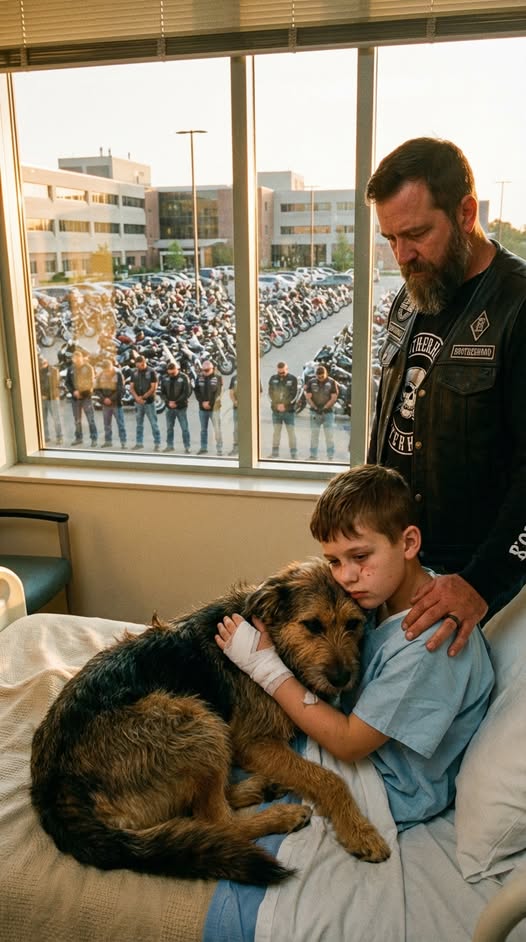
He Was Beaten Protecting a Stranger’s Child — 48 Hours Later, 300 Motorcycles Changed His Life Forever
There are moments in life when the world decides whether you are visible or invisible, and most of us don’t even realize that the choice is being made until it is too late.
Micah Cole had mastered invisibility long before he turned twelve.
He knew how to move through crowded sidewalks without brushing against anyone, how to position himself beneath the underpass on 14th Street where security patrols rarely looked, how to fold a tarp so it didn’t catch the wind and reveal his sleeping spot, and most importantly, how to watch without being watched, because watching kept him alive, and invisibility kept him safe.
Eight months earlier he had lived in a small second-floor apartment that smelled faintly of cinnamon and laundry detergent, where his mother hummed old soul songs while washing dishes and told him that one day he would design buildings that touched the clouds, but addiction is quieter than most disasters, and by the time Micah understood what was happening, the humming had stopped, the bills had piled up, and the paramedics had carried his mother away under fluorescent hallway lights that made everything look unreal.
The foster system had felt colder than the streets, because on the streets, at least, no one pretended to care before disappearing.
So Micah ran.
And that is how he ended up beneath concrete beams and rusted girders, sharing a flattened cardboard mattress with a tan-and-white mutt he named Scout, a dog with one cloudy eye and a tail that wagged even in winter.
Scout had chosen him.
Or maybe Micah had chosen Scout.
It didn’t matter.
They survived together.
Every morning followed a ritual carved into muscle memory: wake before dawn, pack the tarp, count the coins from yesterday’s recycling haul, split stale bread evenly, refill water bottles at the gas station restroom, then walk to Harborview Park where families gathered and the world looked almost normal.
That park became his classroom.
Micah carried a spiral notebook tucked into his backpack, and while other kids might have filled pages with homework or doodles, his pages were crowded with license plates, timestamps, sketches of faces, routes that felt safe, and notes like: “Blue SUV — circled twice — 3:17 PM” or “Man with gray hoodie watching playground — no child.”
He had learned something most adults never do: patterns reveal intention.
Three weeks before everything changed, he noticed a silver crossover SUV idling along the park perimeter every Wednesday morning around 10:40 AM, always parking near the west entrance, always tinted windows, always two silhouettes inside.
And always leaving when a certain motorcycle arrived.
The motorcycle belonged to a man named Darius Vale.
Micah didn’t know his name then, only that he rode a matte-black touring bike with a deep engine growl that vibrated through concrete, and that stitched across the back of his leather vest was a patch that read: Raven Sons MC — Founder.
But what Micah noticed most wasn’t the patch.
It was the way Darius lifted his daughter off the bike.
Carefully.
Like she was made of glass.
Her name was Lila.
Seven years old, freckles scattered across her cheeks like spilled cinnamon, pink sneakers that flashed when she ran, and a laugh that felt like sunlight breaking through winter.
Every Wednesday, she fed ducks at the fountain while her father took phone calls near the parking lot, his posture always alert even when relaxed.
Micah never spoke to them.
Invisible kids don’t insert themselves into other people’s happiness.
But he watched.
And he wrote.
On the morning it happened, the air felt heavier than usual.

The silver SUV arrived earlier.
Parked closer.
Engine still running.
Micah’s stomach tightened.
Darius’s phone rang — Micah saw the shift in his stance, saw him walk thirty feet farther than usual for signal.
Thirty feet is nothing.
Thirty feet is everything.
The SUV doors opened in synchronized silence.
Two men stepped out.
Baseball cap.
Dark jacket despite mild weather.
Purposeful stride.
Micah didn’t think.
He knew.
They approached Lila from opposite sides, their movement rehearsed, their eyes scanning for witnesses rather than conscience.
One hand clamped over her mouth before her scream could fully form.
The other lifted her legs.
Bread scattered across concrete like white confetti.
Micah’s entire body went ice cold.
He heard the voice inside him, the survival voice that had kept him breathing for months.
Run.
Stay out of it.
Invisible kids survive.
But another voice — quieter, older, one that sounded like his mother humming — whispered something else.
If you don’t move, she disappears.
And so he ran.
He didn’t weigh ninety pounds of muscle.
He didn’t have a plan.
He had momentum.
He collided with the taller man’s side with enough force to knock him off balance, just enough for Lila to twist free and scream, “Daddy!”
That scream saved her.
The beating came like a storm.
A fist across his jaw.
A knee to his ribs.
Concrete meeting his skull.
He heard something crack inside him and knew it was bone.
Boots slammed into his side with calculated efficiency.
Professional.
Angry.
Punishing.
Micah curled instinctively, protecting his head as best he could while the world blurred around the edges, and through the ringing in his ears he heard engines — not one, but many — roaring awake as Darius sprinted across asphalt.
The attackers fled before they could be identified, tires screaming, silver SUV fishtailing out of the lot.
Then hands — massive hands — lifted Micah gently.
A deep voice, trembling with fury, said, “Stay with me, kid.”
Micah forced his eyes open long enough to see Lila safe in her father’s arms, crying but unhurt.
That was enough.
Darkness swallowed him.
The doctors at Mercy General later said he had three fractured ribs, a hairline skull fracture, and internal bleeding that required emergency intervention.
They also said he might not wake up.
When he did, nearly eighteen hours later, he woke to antiseptic air, IV tubes, and a nurse adjusting a monitor with careful precision.
“You’re lucky,” she whispered.
He didn’t feel lucky.
He felt hollow.
Until he heard the growl.
Faint at first.
Then multiplying.
Dozens.
Hundreds.
Engines.
Outside the hospital windows, three hundred motorcycles lined the parking lot in perfect formation, chrome glinting beneath mid-morning sun.
The Raven Sons MC had arrived.
Not just Darius.
All of them.
Chapters from neighboring states.
Allies.
Prospects.
Veterans.
Women.
Families.
Three hundred riders who understood a debt when they saw one.
Darius entered Micah’s room alone at first.
He removed his gloves slowly, as if approaching something sacred rather than fragile.
“You saved my daughter,” he said simply.
Micah swallowed through dry throat.
“I couldn’t let them take her.”
Darius nodded once, eyes steady.
“That’s the kind of choice a man makes. Not a kid.”
He paused.
“There are three hundred people outside who think you’re family now.”
Micah stiffened.
Family was a dangerous word.
Family was something you lost.
Family was something that left.
“I don’t want charity,” he whispered.
Darius didn’t smile.
“This isn’t charity. It’s debt.”
And then he gestured toward the door.
A younger club member stepped in carrying a familiar shape wrapped in a clean blanket.
Scout.
Washed.
Fed.
Vaccinated.
Tail wagging so hard it thumped against hospital sheets.
Micah broke in a way he hadn’t allowed himself to since the night under the bridge when his mother’s phone stopped ringing.
He buried his face in Scout’s fur and sobbed.
The club had found the dog within hours.
Paid the shelter.
Covered every hospital expense in advance.
Arranged follow-up care.
Quietly.
Without asking if he’d accept more.
But what happened next was the true twist.
Because it wasn’t just about gratitude.
Darius placed Micah’s spiral notebook on the bedside table.
“We read this,” he said.
Micah’s chest tightened.
Those pages were private.
Survival pages.
But Darius’s expression held something else.
Respect.
“You were tracking that SUV for three weeks,” Darius continued. “License plates. Times. Routes.”
He leaned closer.
“Police used your notes.”
Micah blinked.
“They arrested seven men this morning.”
Silence.
“Four children were recovered alive.”
The room shifted.
The air felt different.
It wasn’t just that he had saved Lila.
He had unknowingly helped dismantle a trafficking ring.
Invisible kid.
Invisible guardian.
Darius’s voice lowered.
“You weren’t invisible, son. You were watching.”
And then came the offer.
Not dramatic.
Not transactional.
A guesthouse on Darius’s property.
Private school enrollment.
Therapy.
Apprenticeship opportunities when older.
A choice — always a choice — to walk away at eighteen if he wished.
No strings.
Just protection.
Micah’s walls resisted.
Systems fail.
Adults disappear.
Promises rot.
But the evidence stood outside on three hundred engines, idling not in intimidation but solidarity.
And the final twist — the one no one expected — came three weeks later.
Because the silver SUV driver turned state’s witness.
Under interrogation, he revealed something chilling.
They hadn’t chosen Lila randomly.
They had been surveilling Harborview Park because it was known as a place where unhoused youth congregated — kids like Micah — kids without immediate guardians, kids who wouldn’t be reported missing quickly.
Micah had not simply interrupted a kidnapping.
He had unknowingly disrupted a pipeline.
And in their planning notes, law enforcement discovered something else.
They had marked him.
The “observant kid with dog.”
Potential future target.
If he had stayed invisible.
If he had not intervened.
He would have disappeared within the month.
The realization hit Darius harder than any physical threat ever could.
The boy who saved his daughter had also saved himself.
Micah didn’t know this detail until Detective Lara Mendes told him gently during a counseling session.
“You changed your own story,” she said.
Not by being invisible.
But by stepping into visibility when it mattered.
Life did not transform overnight.
Healing rarely does.
Micah’s ribs ached for weeks.
Nightmares came in waves.
School felt overwhelming.
Trust came slowly.
But the Raven Sons showed up consistently.
Barbecues.
Homework help.
Engine lessons.
Lila’s drawings taped to his bedroom wall.
Scout sleeping at the foot of a real bed.
Not cardboard.
Not tarp.
Real mattress.
One evening, months later, Micah stood beside Darius in the garage, holding a wrench steady while tightening a bolt on a restored engine.
“You know,” Darius said casually, “family isn’t always blood.”
Micah looked up.
Darius met his eyes.
“It’s who shows up when it counts.”
Micah thought about the bridge.
The park.
The notebook.
The choice.
And for the first time in his life, he didn’t feel invisible.
The Lesson Behind the Story
Not every hero wears a uniform.
Not every protector carries authority.
And not every invisible child is meant to stay that way.
Sometimes courage is messy, impulsive, and terrifying.
Sometimes stepping forward saves more than one life.
And sometimes the family you find is stronger than the one you lost.
Visibility is risky — but it is also where transformation begins.
Micah survived by being invisible.
He healed by being seen.
And the greatest twist of all is this:
The moment he stopped hiding
was the moment his life truly started.