Ryan had never been an easy person to place in my life. He was my husband’s son from a previous marriage. By the time Mark and I married, Ryan was already old enough to be wary of anyone stepping into his family space.
I understood that hesitation. I had made it a point, from the beginning, not to force affection or authority where it was not welcome.
Instead, I aimed for neutrality, respect, and sometimes too much patience, if I was being honest with myself.
When Ryan was younger, I had been careful not to discipline him directly, deferring to Mark whenever issues came up. I did not want to be accused of overstepping, of trying to replace his mother, or of playing a role that was not mine.
As a result, I often found myself smoothing things over rather than addressing them head-on. Ryan learned quickly that I was the easier adult in the room.
By the time he turned 20, he had grown tall and confident, with an easy way of speaking that could sound charming or dismissive depending on the situation.
He talked about independence, about not needing anyone to tell him what to do, and I wanted to believe him. I wanted to believe that this holiday visit would be uncomplicated.
When he arrived for his vacation, suitcase in hand and headphones around his neck, I greeted him with a smile and helped him carry his things inside.
“You can take the guest room,” I said. “Make yourself comfortable.’
“Cool,” Ryan replied, already scanning his phone. “Thanks.”
Mark was still home then, packing for his own extended work assignment overseas. The house felt busy but stable, anchored by routine. At dinner that night, Mark laid out expectations in his usual casual way.
“Just basic stuff,” he said to Ryan. “Be respectful. Don’t trash the place. You know how it is.”
Ryan nodded absently. “Yeah, yeah. I’ve got it.”
Mark squeezed my hand under the table, as if to reassure me. “You’ll be fine together,” he said later. “He’s grown.”
I wanted to believe that, I truly did, knowing too well that maturity was not just about age.
Once Mark left, the house changed in subtle ways. It became quieter, looser, and less structured. Ryan stayed up late and slept until noon.
He ordered food instead of cooking, left empty bottles in his room, and disappeared for hours without explanation.
None of it was alarming on its own, and I deliberately chose not to comment. I reminded myself that adults had different standards and that the messiness was yet to cross the line of disrespect.
I was also wary that constant correction would only reinforce the distance between us. Still, some moments made me pause.
One evening, I came home from work to find the front door unlocked and music blasting from Ryan’s room. Another morning, I discovered a sticky ring on the dining table that took scrubbing to remove.
Each time, I considered saying something and then decided against it.
“Pick your battles,” I told myself. “This isn’t worth it.”
A week into Ryan’s stay, my boss called with an urgent request. A client situation had escalated, and I was needed out of town for two days to help resolve it.
The timing was not ideal, but my job did not leave much room for refusal. That night, I sat at the kitchen table making lists.
I stocked the fridge with groceries Ryan liked, labeled containers, and left clear instructions on the counter — not demands, just reminders.
I told him to lock the doors, take the trash out if it fills up, and please don’t invite people over.
When I mentioned the trip to Ryan, he barely reacted.
“You’ll be fine on your own?” I asked, trying to keep my tone light.
He shrugged. “I’m not a kid.”
“I know,” I said. “That’s why I’m trusting you.”
He glanced at me briefly, then nodded. “Yeah. Don’t worry about anything.”
As I packed my bag the next morning, a faint unease settled in my chest. I paused with my suitcase half-zipped, wondering if I should call Mark, or leave stricter instructions, or cancel the trip altogether.
In the end, I closed the suitcase and dismissed the feeling.
Trust, I reminded myself, had to start somewhere.
I locked the door behind me, unaware that the house I would return to in two days would feel nothing like the one I had just left.
The work trip pulled me away from home faster than I expected. One minute I was merging onto the highway, the next I was standing in a fluorescent-lit conference room, nodding through tense conversations and scribbling notes I barely had time to review.
The days were long and dense with obligation, the kind that left little room for reflection. Still, in the quiet moments — the elevator rides, the late dinners eaten alone — my thoughts drifted back to the house.
I told myself I was being paranoid. Ryan was capable of looking after himself for 48 hours. At worst, I would come home to a sink full of dishes or a few empty boxes stacked by the trash.
The idea of anything more serious never fully formed in my mind.
On the second night, lying in a hotel bed that smelled faintly of detergent and unfamiliar pillows, I felt an unexpected sense of relief.
At least home would be calm, I thought. No meetings, no small talk, and no negotiating professional egos. Just my own space again.
That illusion dissolved the moment I stepped through the front door. I did not immediately move. My hand stayed on the door handle as if my body had instinctively braced itself.
The air inside the house felt thick, heavy, and wrong. A sour, rotten smell hung low, clinging to the furniture. For a brief, disoriented second, I wondered if there had been a break-in, if something catastrophic had happened while I was gone.
Then my eyes adjusted, and the living room was unrecognizable.
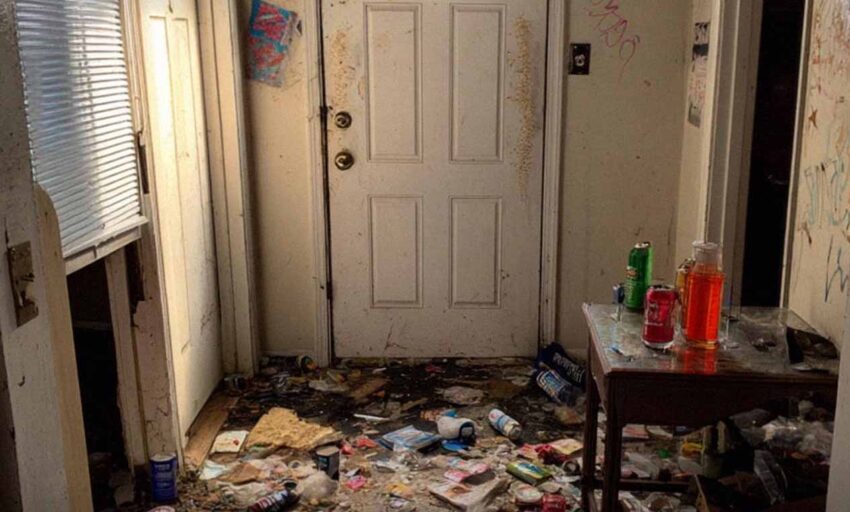
Trash covered the floor in uneven piles, some of it crushed under footprints, some of it torn open and spilling outward. Empty bottles rolled slightly as the door closed behind me.
The coffee table was layered with greasy containers and half-eaten food, congealed and attracting flies. The couch cushions were stained and out of place, as if someone had slept there without bothering to clean themselves first.
I took one careful step forward and felt my shoe stick to the floor.
“No,” I whispered, more to myself than anyone else.
I moved through the house slowly, each room revealing something worse than the last. The kitchen sink overflowed with dishes stacked so high they leaned against the faucet.
Food scraps floated in cloudy water, and the smell intensified, sharp and nauseating.
The trash can was stuffed far beyond capacity, garbage pressed against the lid like it had been forced down by hand.
My chest tightened, not just with anger but with something closer to humiliation. This was my home. The space I maintained, respected, and paid for. And in two days, it had been reduced to something that felt almost deliberately destroyed.
Then I saw Ryan. He was sprawled on the couch, shoes still on, legs stretched out, phone in hand.
A half-empty bottle sat on the floor near his foot. He looked up briefly, eyes flicking to my face, and then returned his attention to the screen.
“Ryan,” I said, my voice unusually steady.
He glanced up again, slower this time. “Hey.”
I stood there, suitcase still by the door. “Why is the house in this horrible state?”
He shrugged, not even bothering to sit up. “I don’t know. It got messy.”
“Messy?” The word tasted strange in my mouth. I gestured around the room. “This isn’t messy. This is destruction.”
Ryan sighed, as though I were the one being unreasonable. “You’re overreacting.”
I felt something shift inside me then, a quiet but decisive movement. “Explain to me why my house looks like this.”
“I invited my friends over for a summer party,” he said casually.
Ryan picked the bottle from the floor and drank some more. “We ordered food and had fun. It’s not that serious.”
“Not that serious,” I repeated. “It looks like the party only stopped a few hours ago. You did not bother to clean up with your friends?”
Ryan rolled his eyes and leaned back against the couch. “Can’t we just hire a cleaner or something?”
The sentence landed harder than shouting ever could have. In that moment, I understood that this was not forgetfulness or immaturity; this was expectation. He expected the problem to disappear because it always had before.
“No,” I said flatly.
Ryan frowned. “What do you mean, no?”
“I mean, you’re not hiring anyone,” I said. “And I’m not cleaning this.”
I scoffed. “Then what, you’re just going to live like this?”
I met his gaze, my expression calm in a way that even surprised me. “No. You are going to fix it.”
Ryan laughed, short and dismissive. “Relax. Dad would just call someone.”
“Your father isn’t here,” I replied. “And I’m not your maid.”
That finally got his attention. He sat up slightly, irritation flashing across his face. “Why are you making such a big deal out of this?”
Because you disrespected me and my home.
Because you assumed I would clean up after you, I thought, but did not say aloud.
Instead, I picked up my suitcase and walked past him, my heart pounding. In the bedroom, I closed the door and sat on the edge of the bed, staring at the floor.
My hands trembled, but my thoughts were clear in a way they had never been before. I could call Mark and ask him to handle it.
I could start cleaning and tell myself it was easier than fighting. I could swallow the anger and preserve the fragile peace I had worked so hard to maintain.
Or I could stop. So, I reached for my phone and opened my contacts.
My thumb hovered for only a second before I started typing in a number, already knowing that whatever happened next would change things permanently.
The next morning began far earlier than Ryan expected.
He was still asleep when the doorbell rang, sharp and insistent, cutting through the quiet house. I did not wake him. Instead, I made coffee, steadying myself, and waited.
When the bell rang again, Ryan stumbled out of his room, hair unkempt and expression irritated. He opened the door and froze.
Three men stood on the porch in work uniforms, clipboards tucked under their arms. Their presence was calm but unmistakably official.
“Ryan?” one of them asked.
“Yeah,” he said slowly. “What do you want?”
“We’re from a community sanitation and responsibility program,” the man continued. “We’re here to speak with you.”
Ryan turned to me, disbelief spreading across his face. “What is this?”
I stepped forward, my voice level. “You suggested hiring help. I did.”
The men explained the program in practical terms. It was a community initiative designed for young adults who needed to learn firsthand what it meant to clean, maintain, and respect shared spaces.
Participation was voluntary and mostly parent-initiated. Ryan, as it turned out, qualified for voluntary placement, and I had completed the paperwork after making the call last night.
Ryan’s face flushed red. “You signed me up to take out trash?”
“I signed you up to understand what it takes to clean messes like the one you left behind,” I replied. “And if you refuse to do it, you won’t be staying here.”
“This is insane,” he snapped. “You can’t do this without Dad.”
“I can,” I said quietly. “You’re an adult, and these are consequences of your actions. Deal with them.”
He left furious, slamming the door behind him. I stood in the entryway long after he was gone, my chest tight but my resolve unshaken.
Ryan returned in casual clothes and brusquely asked the men where they should begin. The house was the first of his chores, and over the next few days, they moved on to tasks in the community.
The house remained spotless, and each day, I received brief updates from the program coordinator.
Ryan had been assigned to clean public parks, sort recycling, scrub dumpsters, and work alongside people who did this labor every day, often without recognition or complaint.
The first few days were rough. He showed up late once and nearly lost his placement.
However, once I involved his father and he supported, Ryan adjusted. Somewhere between exhaustion and embarrassment, something shifted.
When Mark finally returned from his work trip, we had a conversation about Ryan.
“I should have done something like this years ago,” he said.
Relief washed over me, unexpected and profound. “And I should not have ignored his behavior for years. I didn’t want to undermine you,” I said.
“You haven’t,” Mark replied. “You have stepped up and it shows just how much your care about him.”
On the last day he completed the program, Ryan came into the kitchen as I cooked and stood awkwardly in the doorway. He had no bravado left in his posture.
“I wanted to say… I’m sorry,” he said after a moment, his voice low. “I didn’t think about how disrespectful it was. I just assumed someone else would deal with it.”
I did not turn around right away. “Why?” I asked calmly.
Ryan shifted his weight. “Because that’s what I was used to,” he admitted. “And because I didn’t take you seriously. I was wrong.”
I nodded once, still focused on the stove. “Being trusted is not the same as being free from responsibility.”
“I know that now,” he said quickly. “I won’t put you in that position again. I’ll do better.”
I glanced over my shoulder at him. “I expect you to.”
Ryan nodded, relief and resolve crossing his face. “You won’t have to remind me.”
For the rest of his stay, the house remained clean. Ryan washed dishes without being asked, took out the trash, and picked up after himself without comment. The chaos did not return, and neither did the assumption that someone else would clean up his mess.