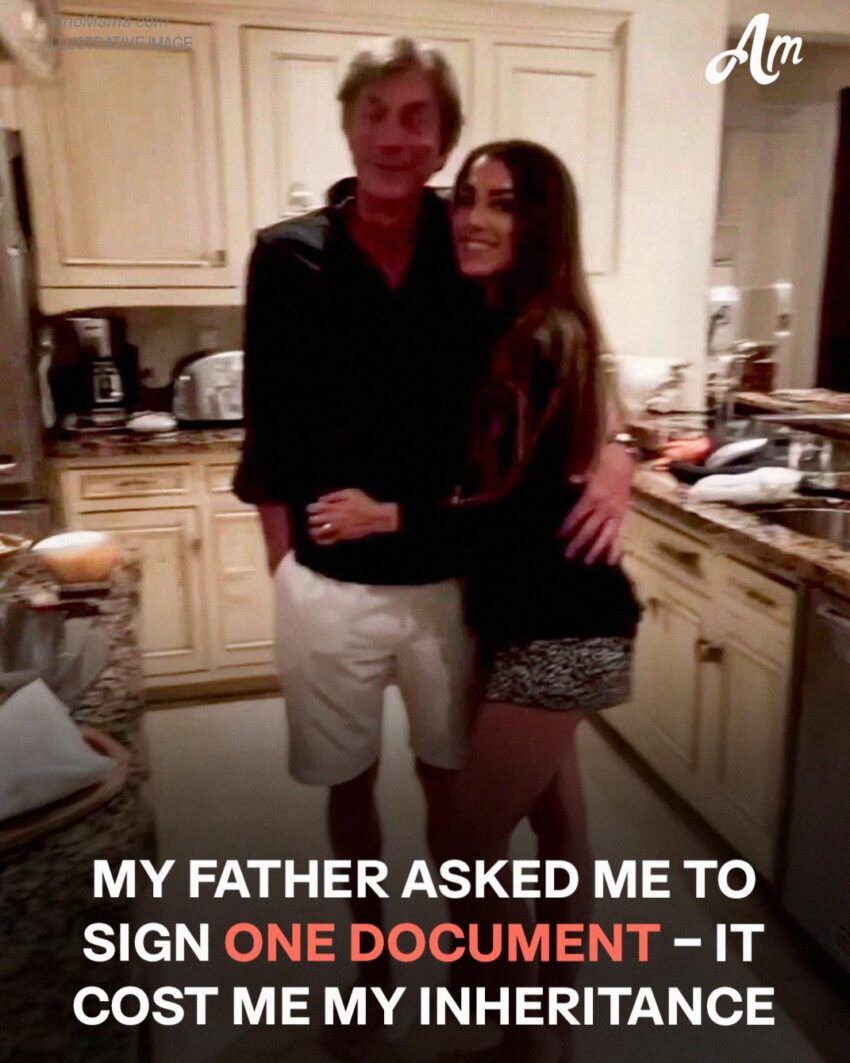
I used to think I understood what trust looked like. I thought it meant safety, comfort, and a kind of invisible bond you didn’t have to question. That was how I saw my relationship with my dad.
We weren’t exactly close in the “movie-dad” kind of way. He wasn’t the type to ruffle my hair or sit through awkward teen conversations.
But I never once believed he would hurt me.
He was stern, yes. Private, often. Still, I always felt chosen. Special. Like I was the one he leaned on.
I’m Sarah, 25 now. I live in Nashville and work as a freelance graphic designer. Nothing too glamorous. Rent is high, coffee is overpriced, and deadlines sneak up like unpaid bills.
But life felt steady. My dad was the steady part. I called him “Dad,” never “Daddy,” not since I was little. He liked things formal and structured.
“Feelings are fine, Sarah,” he used to say, “but don’t let them get in the way of good judgment.”
He raised me alone for most of my life.
My mom passed away when I was eight. Ovarian cancer. Quiet and fast. I still remember the smell of antiseptic and the feel of her cold fingers wrapped around mine.
After that, it was just the two of us. Dad and I. He kept busy with his business, a regional logistics company he had built from scratch. I didn’t understand much about it, but I knew it paid for school, groceries, and everything else we needed.
When I was 22, Dad met Alison. She was soft-spoken, always dressed as if she were on her way to brunch at a country club. Pearls, pressed blouses, perfectly blown-out hair.
I tried, I really did.
I told myself, if Dad’s happy, I’m happy. But there was something… rehearsed about her. Like she said the right things because she’d memorized them.
Still, I smiled through dinners, nodded through their wedding, and told her “Happy Birthday” with a bottle of rosé she probably re-gifted. She was polite. Always polite. The kind of politeness that feels cold underneath.
About a year before he died, Dad asked me to come by the house. It was a Sunday afternoon. Alison was out, probably at a book club or doing whatever women like her do when they’re trying to seem interesting.
The house smelled of lemon polish and stale coffee.
He met me in his study. That was his space, with dark wooden shelves, a worn leather chair, and thick rugs. Everything in there smelled like him, a mix of old cologne and paper.
He stood by the desk, holding a manila folder. He smiled when he saw me, that half-smile he saved for rare moments when he wasn’t pretending to be busy.
“Hey, kid,” he said. “Thanks for coming.”
I shrugged out of my coat. “Sure. Is everything okay?”
He gestured for me to sit, then handed me a pen.
“Just some paperwork,” he said.
“Nothing serious. I’m simplifying the business stuff… You know, getting older and all that.”
I raised an eyebrow. “What kind of paperwork?”
He waved it off.
“Just a formality. You know I’ve got a million things tied up with the company. This’ll make things easier — for me. And eventually, for you.”
I hesitated, looking down at the document. There were at least five pages stapled together. Tiny text, bold headings. Legal language that may as well have been another language entirely.
He leaned forward, eyes softening.
“You know I’d never hurt you, Sarah.”
I looked at him, this man who never cried when Mom died, who never forgot a single birthday, and who taught me how to drive, change a tire, and stand my ground.
“I trust you,” I said quietly.
He smiled and handed me the pen.
“You’re the only one I trust with things like this.”
I didn’t even read it carefully. Why would I? He was my father.
I signed where he pointed, each signature pulling the knot in my stomach tighter.
But I told myself not to overthink it.
He had always taken care of things. He had always taken care of me.
A few months later, he died.
He had a heart attack in his sleep. Alison found him the next morning. She called me from the hospital in a tone that was too calm for someone who’d just lost a husband. I remember the way her voice clipped through the phone.
“I’m sorry, Sarah. He’s gone.”
My world tilted.
The funeral was small and private.
He wasn’t a flashy man.
A few business partners showed up, along with some old neighbors and cousins we hadn’t seen in years. Alison wore black lace and didn’t shed a single tear.
She clutched a silk handkerchief, dabbed at dry eyes, and accepted condolences like a woman who’d just closed a chapter, not lost a husband.
I tried not to let my grief turn into suspicion, but something didn’t sit right. It wasn’t until the lawyer called me in for the will reading that the real unraveling began.
At the reading of the will, I sat still, hands folded tightly in my lap. The room felt too quiet for what it was — a place where my father’s life, everything he had worked for, was about to be divided and closed like a file. My throat was dry, but I stayed silent, holding back both my nerves and the ache I still felt in my chest from losing him.
Alison sat across from me.
Her black dress was perfectly pressed, a single strand of pearls resting against her collarbone. She didn’t cry. She didn’t look at me. She just sat there, legs crossed at the ankle, her hands resting neatly on her lap, like this was a routine appointment.
The lawyer, Mr. Delaney, was an older man with gray hair and tired eyes. He adjusted his glasses and looked down at the stack of papers in front of him. His voice was calm, practiced.
“Thank you both for coming,” he said. “I know this is a difficult time, but we’ll keep this as straightforward as possible.”
I gave a small nod.
Alison didn’t respond.
He started reading through the will, and at first, it was what I expected. There were a few personal bequests, like a watch to one of my dad’s business partners and a small donation to a local charity. Then his tone shifted. He cleared his throat and paused before continuing.
“And regarding the estate,” he said, “according to the documents signed and notarized last year, the entire estate — including the house, the company shares, bank accounts, and other assets — has been transferred to Mrs. Harding, in the event of Mr. Harding’s death.”
I blinked.
It took a few seconds for the words to settle. At first, I thought I had misheard, or that maybe there was more, something else coming next.
But then the silence grew thick. The kind that presses down on you, like being buried under snow.
I felt everyone’s eyes on me.
My jaw tightened. My fingers clenched together, cold and clammy.
“I’m sorry,” I said slowly, looking up at Mr. Delaney. “What did you just say?”
He looked at me carefully, as if he’d been dreading this part.
“The documents your father filed last year included a signed agreement from you. The one that assigned your claim to the estate to his wife, in full. It was signed, notarized, and legally binding.”
I looked at Alison.
She still wasn’t looking at me.
It hit me like a punch to the chest.
That was the moment I realized what I had done. One signature. One moment of trust. That was all it took to lose everything.
I sat back in the chair, heart pounding. The room buzzed faintly in my ears.
“The document I signed,” I said, almost whispering. “He said it was just business paperwork. Something to simplify things.”
Mr. Delaney’s voice softened, but the answer didn’t change.
“Legally, that’s what it did. It simplified his estate by transferring all rights to his spouse. Cleanly. Irrevocably.”
Alison finally shifted. She didn’t meet my eyes, but I caught the faintest twitch of her mouth. It wasn’t a smile, but it was something close to satisfaction. I couldn’t breathe.
It wasn’t just betrayal. It was humiliation.
I had trusted him. Trusted her. Trusted that family meant protection, not traps.
“I didn’t know,” I said quietly. “He never told me that’s what it was.”
“I understand,” Mr. Delaney said. “But legally, the signature holds. I’m sorry.”
The next few days were a blur.
I went through the motions, making phone calls, accepting condolences, and sitting through empty conversations with relatives who didn’t know what to say. But all I could think about was that folder, that moment in the study, and my father’s words: “You know I’d never hurt you.”
How could I have been so blind?
I tried to tell myself maybe he didn’t know what Alison had planned. Maybe he was manipulated, too. But the more I looked into it, the more impossible that seemed.
I got a lawyer.
And that’s when everything started unraveling.
The court process was long. Exhausting. I had to sit there while strangers combed through my father’s records, dissecting his intentions as if he were a spreadsheet. But piece by piece, the story started to come out.
There had been multiple drafts of the agreement.
Alison had been present at most of the legal meetings leading up to the final version. Her name was in nearly every communication with the notary. My father had revised the document three times, all within a month of their first wedding anniversary.
Every change pushed me further out of the picture.
My lawyer tried to argue that I had signed under false pretenses, that I hadn’t been properly informed. But the judge wasn’t interested in emotions. He saw only the paper.
“I’m sorry, Sarah,” he said during the final hearing, “but the document is valid under state law. The court has no grounds to invalidate it.”
Alison sat two rows ahead of me. Her lawyer whispered something in her ear, and she nodded. She never looked back at me. Not once.
When the gavel dropped, it didn’t sound like a decision.
It sounded like the end of something that had already died a long time ago.
I walked out of that courthouse with nothing. No inheritance. No house. No company. Not even a keepsake. Everything that had once been part of my life, including my childhood, my sense of security, and my future, was gone.
But I wasn’t angry anymore.
I was clear.
I understood now what had really happened.
I wasn’t just betrayed by Alison.
I had betrayed myself — by trusting blindly, by assuming that love always meant protection. I thought loyalty was a shield, when really, it had been the weapon used against me.
A few weeks later, I got a message from my cousin Rachel.
She wanted to know if I’d be coming to Thanksgiving.
“Alison will be there,” she added, almost like a warning.
I stared at my phone for a while before replying.
“No, I won’t be coming,” I wrote back. “Thanks for asking.”
I haven’t spoken to Alison since the court ruling.
I don’t plan to.
I don’t visit the house anymore. It doesn’t feel like home. And I don’t show up at family gatherings where people pretend nothing happened. Where silence is easier than honesty.
But I learned something through all of this. Something expensive. Something permanent.
Love should never require blind trust, especially when paperwork is involved. And now, whenever someone asks me what happened, or why I don’t talk to my stepmother, or why I flinch when people say, “Just sign this real quick,” I smile politely and say, “It’s a long story.”
But deep down, I know it’s not that long.
It’s just one sentence.
I trusted the wrong person.
And I signed one document.