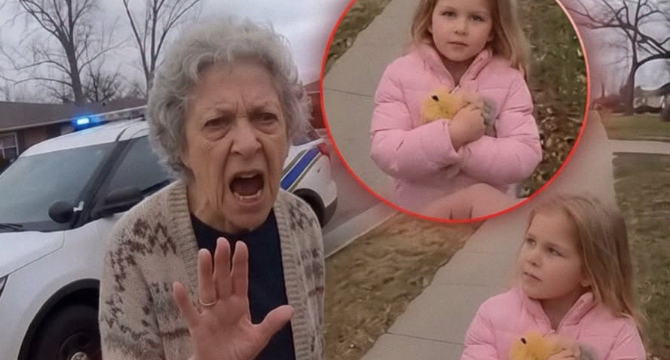
Ivony had spent years protecting Kelly from the pain of being abandoned by her father. But when Mrs. Huntley used that wound against her, one man stepped in with a plan no one saw coming, forcing everyone to face what cruelty can hide.
I’ll never forget the look on my ten-year-old daughter Kelly’s face when our neighbor, Mrs. Huntley, screamed those awful words at her.
It was one of those calm Saturday mornings that looked too pretty to go wrong. The sun was warm but not sharp, the kind that made the sidewalk glow and turned every window on our quiet street into a square of gold.
I had opened the kitchen window while washing breakfast plates, and from where I stood, I could hear Kelly outside, humming to herself as she rode her purple bicycle in slow circles near our driveway.
She had streamers on the handlebars.
Pink and silver. Mark, her godfather, had put them on for her the week before after she mentioned that her bike looked “too plain for a girl with big plans.”
Kelly had laughed when he said that. Really laughed. The kind of laugh I used to hear more often before her father packed his bags and left when she was just four years old.
Back then, she was too little to understand what abandonment meant. She only knew that her dad had kissed her forehead one morning, told her to be good for Mommy, and then never came home again.
For months, she waited by the living room window every evening, clutching her stuffed rabbit and asking, “Is Daddy late again?”
I never knew how to answer without breaking in half.
By the time she turned ten, Kelly had stopped asking. That hurt in a different way.
She was bright, sensitive, and careful with people’s feelings in a way no child should have to be.
She knew when I was tired even if I smiled.
She knew when money was tight, even if I said we were fine.
She knew that other kids had dads who showed up at school plays, soccer games, and father-daughter breakfasts, while she had a mother who clapped twice as loudly and tried to fill a space that was never meant for one person.
And she had Mark.
Mark had been my husband’s best friend once, though that friendship ended the day my husband vanished from our lives like we were an unpaid bill he could ignore. Mark never defended him. He never made excuses. He just showed up.
At first, it was small things. A bag of groceries left on the porch when I had been too proud to admit I needed help. A text asking if Kelly needed a ride to soccer. A Sunday afternoon spent fixing a loose cabinet door after I nearly pulled it off the hinges.
Then, over time, he became the steady figure in our lives.
He built bookshelves in Kelly’s room because she was running out of space for her library books. He came to her school talent show and sat in the front row, grinning like she was performing on Broadway.
He taught her how to check the air in her bicycle tires, how to hold a hammer properly, and how to stand tall when people tried to make her feel small.
He was never trying to replace her father. He never crossed that line. But he made sure she never felt truly abandoned.
That morning, though, Mark had not arrived yet. He usually came by on Saturdays around ten to help with whatever little project I had pretended I could do alone.
I was expecting him later, which was why I was still in my old house slippers, rinsing plates, and listening to Kelly’s bicycle wheels click softly over the pavement.
Then I heard the shouting.
“Stop right there!”
The plate in my hand slipped against the sink with a sharp clatter.
I looked out the kitchen window and saw Mrs. Huntley standing on the edge of her lawn, one hand planted on her hip and the other pointing toward Kelly like she had caught her stealing silver from the dining room.
Mrs. Huntley lived next door in a pale yellow house with white shutters and flower beds so neat they looked measured with a ruler.
Her lawn was her pride, her kingdom, and her favorite excuse to scold anyone under the age of 18. She had once yelled at a delivery boy for stepping too close to her rose bushes.
Another time, she accused the mail carrier of “dragging negativity” onto her porch because he dropped a rubber band near her welcome mat.
Most of us avoided her.
Kelly did too.
But that morning, Kelly’s bicycle tire had barely grazed the edge of Mrs. Huntley’s perfectly manicured lawn.
Barely.
I saw the faint track in the grass, no wider than a ribbon, and then I saw my daughter’s shoulders shrink.
“I’m sorry, Mrs. Huntley,” Kelly called, her voice small but polite. “I didn’t mean to.”
Mrs. Huntley erupted like a volcano.
“You didn’t mean to?” she shrieked. “That’s what children like you always say after ruining something that doesn’t belong to you!”
Kelly stopped pedaling. One foot touched the ground. Her fingers tightened around the handlebars.
I reached for a towel to dry my hands, already moving toward the back door.
Then Mrs. Huntley said it.
“Your father ran off because he couldn’t stand looking at you, and now you’re just a blight on this street! What else can one expect from a fatherless trash like you?”
For a moment, the whole world went silent.
Even the birds seemed to stop.
Kelly froze, her bottom lip trembling, and I felt something inside me tear open. Not anger at first. Pain. Pure, hot pain, because I knew exactly where those words would land.
I knew they would not just hurt her that morning. They would crawl into every quiet corner of her heart where she had stored all the questions she was too proud to ask me anymore.
Why did he leave?
Was it my fault?
Was I not enough to stay for?
She stared at Mrs. Huntley as if she had been slapped.
Then she dropped her bike right there on the pavement and ran sobbing into our house.
“Kelly!” I cried.
She rushed past me before I could catch her, her face soaked with tears, her little chest heaving. I heard her bedroom door slam a second later, and that sound snapped something in me.
I was trembling with rage and heartbreak, ready to storm across the yard and confront Mrs. Huntley. I
did not care that the woman was older. I did not care that she had lived on the street longer than we had. I did not care if every curtain on the block lifted and every neighbor watched.
No one got to talk to my child that way.
No one.
I pushed open the front door so hard it hit the wall, and I stepped onto the porch with my hands shaking.
“Mrs. Huntley!” I shouted.
The woman was still standing near her precious lawn, breathing hard, her mouth pressed into a thin line of satisfaction. She looked at me like she had been waiting for a fight.
I was halfway down the steps when a hand gently caught my shoulder.
“Don’t,” a familiar voice said.
I spun around.
It was Mark.
He must have parked at the curb without my hearing him. He stood there in jeans and a navy shirt, his jaw tight and his eyes fixed across the yard. He had arrived just in time to hear every single word of Mrs. Huntley’s cruel tirade.
For one second, I expected him to be furious.
Honestly, I wanted him to be.
I wanted someone else to feel the same fire burning through my ribs.
I wanted him to march across that lawn and make Mrs. Huntley understand that she had not just insulted my daughter. She had put her hand on a wound that had taken six years to even begin healing.
But Mark did not move toward Mrs. Huntley.
Instead, he looked at me and said softly, “Go to Kelly.”
My throat tightened. “Mark, she can’t just say that to her. She can’t.”
“I know,” he replied, his voice low. “And she won’t again.”
There was something in his tone that made me pause. It was not loud. It was not dramatic. It was steady.
That steadiness scared me more than shouting would have.
I glanced back at Mrs. Huntley, who had turned away and was inspecting the grass like the whole thing had been nothing more than a gardening issue. My hands curled into fists.
“I need to handle this,” I said.
“You need to hold your daughter,” Mark answered.
That stopped me.
Because he was right.
Anger could wait. Kelly could not.
I swallowed the words burning on my tongue and went back inside. Mark followed me, closing the door behind him with care.
Kelly was in her room, curled on the bed with her face buried in her pillow. Her bicycle helmet lay on the floor, one pink strap twisted underneath it. When she heard us come in, she pulled the blanket over her head.
“Sweetheart,” I whispered, sitting beside her. “Please look at me.”
“No,” she sobbed from under the blanket.
I rubbed her back, trying not to cry. “None of what she said is true. Not one word.”
Kelly’s voice cracked. “Then why did Dad leave?”
The question hit me so hard I could barely breathe.
I had answered it before in gentle ways.
“He made choices that had nothing to do with you.”
“Some adults fail the people who love them.”
“You were never the reason.”
But that day, every answer felt thin compared to the cruelty she had just heard shouted across a lawn.
Before I could speak, Mark knelt beside the bed.
“Kelly,” he said gently. “Can I talk to you?”
The blanket shifted, but she did not come out.
Mark waited. He always waited with her. He never rushed her feelings just because they were hard for adults to handle.
Finally, Kelly peeked out. Her eyes were red and swollen, and her cheeks were blotchy. She looked so small that I had to press my hand against my chest to keep myself together.
Mark reached for a tissue from her nightstand and handed it to her.
“I heard what Mrs. Huntley said,” he told her.
Kelly wiped her nose and looked away.
“It was ugly,” he continued. “It was cruel. And it was a lie.”
“She said I’m a ‘blight.’ She called me ‘fatherless trash,’” Kelly whispered.
Mark’s mouth tightened for half a second, but his voice stayed calm. “A blight is something that ruins what it touches. You don’t ruin anything, kiddo. You make things better.”
Kelly sniffed.
“You make your mom smile when she’s trying not to cry,” he said. “You make your soccer team braver because you cheer even when you’re on the bench. You make me buy glitter streamers for a bicycle in the middle of a hardware store while pretending I know what I’m doing.”
Despite herself, Kelly let out a tiny, broken laugh.
I closed my eyes for a second, grateful for that sound.
Mark smiled faintly, then brushed a strand of hair away from Kelly’s damp cheek.
Then he turned serious.
“Give me 24 hours, sweetheart. I promise you, by this time tomorrow, Mrs. Huntley will never say a mean word to you again.”
Kelly stared at him. “How?”
Mark tapped her nose lightly. “That part is my job.”
I looked at him sharply. “Mark.”
He glanced at me, and I saw something there I could not read. Not rage. Not exactly. Purpose.
“I promise,” he repeated to Kelly.
I had no idea what he was planning.
The rest of the day passed in a strange fog. Kelly stayed close to me, quieter than usual. She helped me fold laundry but kept looking out the window toward Mrs. Huntley’s house.
When a car door shut outside, she flinched. When I asked if she wanted to ride her bike again, she shook her head and said, “Maybe not today.”
That broke my heart all over again.
Mark stayed for dinner, though he barely touched his food. He kept his phone face down beside his plate and answered my questions with calm little nods that told me nothing.
After Kelly went to bed, I cornered him in the kitchen.
“What are you going to do?”
He rinsed his glass slowly. “What needs to be done.”
“That is not an answer.”
“It’s the only one I have right now.”
I lowered my voice. “Please tell me you’re not going to threaten her.”
Mark looked almost offended. “Ivony, no.”
“Then what?”
He dried his hands on a towel and leaned against the counter. “Trust me.”
I wanted to. Mark had earned my trust more times than I could count. But fear has a way of making even good people look dangerous when they are too calm.
“I can’t have this turn into a neighborhood war,” I said. “Kelly has already been hurt enough.”
His expression softened. “I know.”
“Do you? Because Mrs. Huntley is awful, but she’s also the type to call the police if someone breathes too loudly near her begonias.”
That almost made him smile. Almost.
“I won’t do anything reckless.”
But he would not tell me more.
I spent the whole night tossing and turning, terrified Mark was going to do something reckless that would land him in trouble or escalate this neighborhood feud into a war.
Every time I closed my eyes, I heard Mrs. Huntley’s voice again.
“Your father ran off because he couldn’t stand looking at you.”
Then I saw Kelly’s face.
Around 3 a.m., I got up and checked on her.
She was asleep with her stuffed rabbit tucked under one arm, the same one she had held years ago while waiting for a father who never returned.
I stood in her doorway and promised myself, silently and fiercely, that I would never let anyone make her feel unwanted again.
By morning, the whole street seemed too quiet.
Kelly picked at her cereal and asked if she had to go outside.
“No,” I said, brushing her hair back. “Not until you’re ready.”
At 8:55 a.m., I saw Mark’s truck pull up to the curb.
My stomach dropped.
He stepped out wearing a clean button-down shirt, dark jeans, and an expression I had never seen on him before.
He did not come to our door first.
He did not wave. He reached into his truck, took out a folder, and walked around the front bumper.
I moved to the living room window, my pulse thudding in my ears.
Kelly appeared beside me, still in her pajamas.
“Is he going to talk to her?” she asked.
I put an arm around her shoulders. “I think so.”
The minute hand on the wall clock clicked into place.
Exactly nine o’clock.
And that was when I saw Mark walking up Mrs. Huntley’s driveway.
The folder was tucked under his arm, and I felt Kelly go stiff beside me.
“Mom,” she whispered, “is he mad?”
I looked down at her pale face and tried to sound calmer than I felt. “I don’t think so, sweetheart.”
That was the truth, but not the full truth. Mark did not look angry. He looked resolved, and somehow that frightened me more.
Mrs. Huntley opened the door before he knocked twice. She wore a cream cardigan and held a mug in one hand, as if she had been expecting trouble and wanted to appear too dignified for it.
Her eyes flicked toward our house. When she saw Kelly and me in the window, her mouth tightened.
I could not hear the first few words through the glass, but I saw Mark speak. His posture stayed straight. He did not point. He did not raise his hands. Mrs. Huntley answered sharply, then tried to shut the door.
Mark held up the folder.
She stopped.
Kelly slipped her fingers into mine. “What’s in there?”
“I don’t know,” I admitted.
A minute later, Mark looked back and lifted one hand, signaling for us to come over.
My stomach dropped. “Stay behind me,” I told Kelly.
She nodded, but her hand shook as we stepped outside.
The street had started waking up. Mr. Ellis from two houses down was pretending to water his already soaked hydrangeas.
Across the road, Tania stood frozen beside her mailbox with a stack of envelopes pressed to her chest. Curtains shifted in three different windows.
Mrs. Huntley noticed too. “This is not a show,” she snapped.
“No,” Mark said quietly. “It’s a chance.”
I stopped at the edge of the driveway, keeping Kelly close. Mrs. Huntley looked at my daughter, and for once, there was no sharp insult ready on her tongue. There was only suspicion.
“What is she doing here?” she demanded.
Mark opened the folder. “Kelly has something for you.”
Kelly looked up at him in panic. “I do?”
He crouched beside her and softened his voice. “Only if you want to hand it to her. You don’t have to say anything.”
I stared at him. “Mark, what is going on?”
He met my eyes, and I saw how tired he was. Not from one sleepless night, but from carrying something heavy and choosing to carry it gently.
“Last night,” he began, “I made some calls.”
Mrs. Huntley’s face changed. The color drained from her cheeks.
“Don’t,” she whispered.
Mark did not look away. “I wasn’t trying to embarrass you. I was trying to understand why a grown woman would look at a child and choose the cruelest words she could find.”
Mrs. Huntley’s hand tightened on the doorframe.
“I found out your house was going into foreclosure,” he continued.
A quiet gasp moved through the street.
Mrs. Huntley closed her eyes.
I felt no satisfaction. That surprised me. I had imagined her being exposed, imagined the hard shell cracking in front of everyone she had judged and frightened.
But seeing her standing there, small and ashamed in her own doorway, did not feel like victory. It felt like looking at a wound through a keyhole.
“You had no right,” she said, but her voice broke.
“Maybe not,” Mark replied. “But you also had no right to punish Kelly because your life was falling apart.”
Kelly pressed against me.
Mrs. Huntley opened her eyes, and tears shone in them. “You don’t understand.”
“No,” Mark said. “I don’t. But I understand fear. I understand what it can do when people let it rot into bitterness.”
Then he took two papers from the folder and placed them in Kelly’s hands.
“This is the foreclosure cancellation notice,” he explained. “And this is the deed paperwork confirming the debt has been cleared.”
My breath caught. “Cleared?”
Mark nodded once.
Mrs. Huntley stared at him as if he had spoken another language. “What are you talking about?”
“I paid it,” he said.
The whole street seemed to hold its breath.
Mrs. Huntley’s mug slipped from her hand and shattered on the porch.
“You… paid my mortgage debt?” she choked.
“With my business savings,” Mark answered. “The payment was made in Kelly’s name.”
I gripped Kelly’s shoulder. “Mark.”
He glanced at me with an apology in his eyes, but he kept going. “You called her ‘fatherless trash’ yesterday. You told her she was a ‘blight on this street.’ So I thought maybe the whole street should learn what kind of person she actually is.”
Kelly stared at the papers, her eyes filling. “I saved her house?”
Mark’s voice turned gentle. “Your name did.”
Mrs. Huntley covered her mouth. Her knees seemed to weaken, and for one alarming second, I thought she might fall. She sank onto the porch step instead, staring at my little girl as tears spilled down her lined face.
“I didn’t know,” she whispered.
I could not hold back. “You didn’t know what? That she was a child?”
Mrs. Huntley flinched, and I did not regret it.
“Ivony,” Mark murmured, not scolding, just steadying me.
But I had spent years swallowing pain, so Kelly would not have to taste it. I had worked late shifts, patched school shoes, smiled through parent events, and watched my daughter search crowds for a man who never came.
I was allowed one honest sentence.
Mrs. Huntley looked at me and nodded, shaking. “You’re right. I knew. I knew she was a child. I was cruel because I was scared, and because seeing her loved made me angry.”
Kelly’s brows pulled together. “Seeing me loved?”
Mrs. Huntley wiped her face with both hands. “My husband died eight years ago. My son stopped calling after the funeral. Then the bills came, and the bank letters came, and every morning I watched you ride your bike while your mother waved from the window and Mark fixed things and brought groceries and cheered at your games.”
Her voice cracked.
“I hated that you still had people. That is not your fault. It was mine. I let my loneliness turn me mean.”
The street stayed silent.
Mrs. Huntley stood slowly, then came down one porch step. She did not come closer than that. Maybe she knew she had not earned the right.
She looked at Kelly, not at me, not at Mark.
“Kelly,” she said, trembling, “what I said to you was unforgivable. Your father leaving was not your fault. You are not trash. You are not a blight. You are a child, and I hurt you because I was too bitter to care who I was cutting. I am so sorry.”
Kelly’s chin quivered.
Mrs. Huntley pressed a hand to her chest. “You saved my home after I tried to make you feel like you didn’t belong on this street. I will spend the rest of my life ashamed of that. Please forgive me, even if it takes years.”
Kelly looked up at me.
I wanted to say she did not have to. I wanted to carry her away and shut our door. Forgiveness should never be forced out of a wounded child just because an adult finally cries.
So I knelt beside her. “You can say whatever is true,” I told her.
Kelly looked back at Mrs. Huntley. Her voice was small but clear.
“I’m still hurt.”
Mrs. Huntley nodded quickly. “I understand.”
“But… thank you for saying sorry.”
Mrs. Huntley broke down then, sobbing into her hands in front of everyone. Tania crossed the street and picked up the pieces of the broken mug. Mr. Ellis turned off his hose and looked away, blinking hard.
Mark stayed beside Kelly, quiet as a wall.
Later, after Mrs. Huntley had taken the papers inside with shaking hands, after the neighbors drifted back into their houses, and after Kelly finally went to check on her abandoned bicycle, I stood with Mark in our driveway.
“You used your business savings,” I said.
He tucked his hands into his pockets. “I’ll rebuild them.”
“You should have told me.”
“I know.”
I watched Kelly lift her bike from the pavement. She brushed a blade of grass off the tire, then looked toward Mrs. Huntley’s house. The old woman stood at the window, crying openly now, one hand pressed to the glass.
Kelly raised her hand in a tiny wave.
Mrs. Huntley covered her mouth and waved back.
My throat burned.
Mark spoke softly beside me. “I couldn’t let Kelly believe the answer to cruelty was more cruelty.”
I turned to him. “And what if Mrs. Huntley hadn’t apologized?”
“Then Kelly still would have known the truth,” he said. “That she can be wounded and still choose who she becomes.”
That was when I understood.
Mark had not done it for Mrs. Huntley. Not really.
He had done it for Kelly. For the little girl who had been abandoned by one man and protected by another. For the child who needed to see that being left did not make her less worthy, and being hurt did not mean she had to grow hard.
That evening, Kelly rode her bike again.
Slowly at first.
Then faster.
When she reached the edge of Mrs. Huntley’s lawn, she stopped and looked uncertain. The front door opened.
Mrs. Huntley stepped out, holding a small plate wrapped in foil.
“I baked cookies,” she called, her voice nervous. “No nuts. I asked Mark.”
Kelly looked at me.
I smiled. “Your choice.”
My daughter got off her bike and walked over.
Mrs. Huntley held out the plate with both hands. “I also put a little sign near the grass,” she said. “It says, ‘Children may ride here.’”
Kelly peeked at the sign and smiled for the first time all day.
It was not perfect.
Pain did not vanish because of one apology, and trust did not bloom overnight. But something had shifted on our street.
For years, I had thought I needed to protect Kelly by standing between her and every cruel thing in the world. That day, I learned protection could look different.
Sometimes it looked like restraint. Sometimes it looked like mercy. Sometimes it looked like a man with a folder, a child with a shaking hand, and a bitter old woman finally seeing the damage she had done.
As the sun dipped low, Kelly rode past our house, silver and pink streamers flashing in the light.
“Mom!” she called. “Look!”
I did.
And for the first time in a long time, my daughter did not look like a child trying to outrun what she had lost.