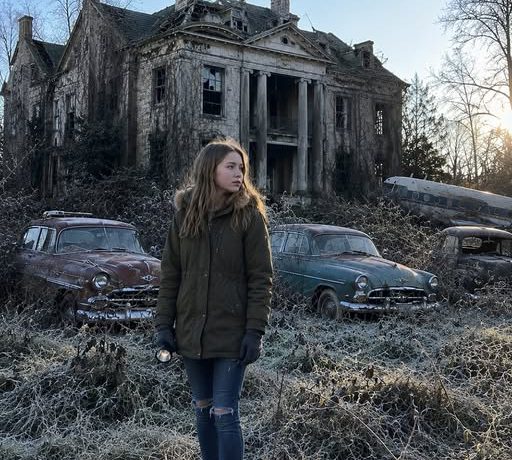
The Mansion Nobody Wanted
After being forced to leave home at 18, I found a forgotten mansion with two planes and eleven cars… and everything changed.
The night my mother closed the door behind me, I remember standing on the front porch with my hand still wrapped around the old brass knob, waiting for her to change her mind. The porch light flickered above me. My green suitcase sat crooked on the step because one of its wheels had broken years earlier and nobody had ever fixed it. Inside the house, the television murmured from the living room, the same late-night weather report my mother always watched while folding towels. I could smell coffee through the thin wooden door. I could hear the pipes knock behind the kitchen wall. Everything about that house sounded ordinary, and that was what made it unbearable.
It was not a stranger’s door. It was not some apartment I had rented for a month or a place where I had only slept a few times. It was the blue door my mother and I had painted together when I was eight years old, one Saturday after a spring rain, when she had put lemonade in a plastic cup on the porch step and told me I had more paint on my elbows than on the wood. I remembered laughing until my stomach hurt. I remembered her smiling at me like I was the best thing she had ever made. Ten years later, she stood on the other side of that same door and let me leave.
My stepfather, Greg, had moved in when I was fourteen. He was not loud in the way people imagine cruel men to be loud. That would have made things easier to explain. He was careful. He had a way of lowering the temperature in a room without raising his voice. If I left a cup in the sink, he would look at it for a long time before saying, “Some people never learn consideration.” If my mother asked me about school, he would clear his throat and remind her about bills. If I came home from my grocery store shift tired and quiet, he would ask whether I was “bringing that attitude into the house again.”
For four years, I tried to become small enough not to bother him. I ate quickly. I kept my shoes lined up. I took extra shifts. I folded my laundry before he could mention it. None of it mattered, because Greg had never wanted me to fit into his life. He wanted my mother, the house, the routines, the quiet, and I was the leftover part of the package he had not agreed to keep.
The final Thursday came in December. Rain had fallen all afternoon, leaving the streetlights blurry and the sidewalks dark. I was in my room, sitting on the edge of the bed with my grocery store polo still on, when I heard his voice through the wall. He said it as if he were discussing a repair bill.
“It’s her or me, Diane.”
My mother did not answer right away.
That silence was the beginning of the end. I knew it before she said anything. I sat there with my hands clasped between my knees, staring at the photo of my grandmother on my dresser, waiting for my mother’s voice to rise, waiting for the version of her I remembered from childhood to come back into the room and say, Don’t make me choose my child. But the house stayed too quiet.
Then my mother said, “Okay. Okay.”
Two words. Soft, exhausted, and final.
The next morning she called me into the living room. Greg was not there, but his coffee mug was on the side table, placed like proof. My mother sat on the edge of the couch with her hands folded in her lap. She did not look angry. That made it worse. She looked tired in a way that made me feel guilty for existing.
“You’re eighteen now,” she said. “It’s time to start thinking about your future.”
I looked at her, waiting for the rest, even though I already knew.
She kept her eyes on the rug. “The situation here has become impossible. Greg and I have talked, and we think it would be healthier if you found another place to stay.”
“We?” I asked.
Her fingers tightened.
“You’ll have a week,” she said. “I’ll help how I can.”
But she did not help. Not really. She gave me a folded twenty from her purse on the third day and could not meet my eyes while doing it. She left a box of granola bars outside my bedroom door. She moved around me like I was already gone, like looking directly at me might force her to admit what she had chosen.
For seven days, I went to work, came home, packed, and stared at the ceiling in the bedroom that had once held glow-in-the-dark stars. I did not cry. People sometimes mistake numbness for strength. It is not strength. It is your body locking every door inside you because the hallway is full of smoke.
On the seventh night, I zipped the green suitcase until the fabric strained. I packed clothes, my documents, a notebook I had written in since I was fifteen, a cracked phone charger wrapped with tape, a photo of my grandmother holding me at a county fair, and the small envelope of savings I had hidden behind the bottom drawer of my dresser. The rest stayed behind: yearbooks, shoes, a lamp with a crooked shade, the blue blanket my mother had bought me after my grandmother died.
Before I stepped out, I paused in the kitchen doorway.
My mother stood by the sink with her back to me, rinsing a mug that was already clean. The yellow light above her made her shoulders look smaller than I remembered. I waited for her to turn. I waited for my name. I waited for anything that would give me permission to forgive her later.
Nothing came.
So I walked out.
Six blocks from the house, I sat at a bus stop with my suitcase between my feet and sixteen dollars in cash in my wallet. I had more money in savings, but it was not much. A little over four thousand dollars from two years of part-time work, birthday cards, and skipped lunches. It was supposed to be for community college. It was supposed to be the beginning of a life that still had a map.
That night, the map burned.
The buses came and went. Doors folded open. People climbed on carrying backpacks, takeout bags, and umbrellas. Nobody looked twice at the girl sitting under the shelter with a broken suitcase and a face too still for December.
I remember thinking about my grandmother. She would have come for me. She would have driven across town in her old Buick with a sweater over her nightgown and told my mother to move aside. I thought about my English teacher, Mrs. Adler, who once wrote on the top of my essay, You notice the details other people miss. I thought about how ridiculous that sounded now. Details did not keep you warm. Details did not pay rent.
Then I had a thought so clear it almost frightened me.
If I did what everyone expected, I would disappear quietly.
Not all at once. Not dramatically. I would take a couch, then a room, then a job I hated, then another job, then a life built entirely out of survival. Years would pass. People would say I had done my best. And maybe that would be true, but some deeper part of me would know I had folded myself into whatever space was left after other people made their choices.
I slept that night on my coworker Val’s couch. She worked closing shifts with me at the grocery store and had the kind of kindness that came with clear limits. She opened the door in sweatpants, looked at my suitcase, and sighed.
“Three nights,” she said. “I’m serious, Mara. I can do three.”
“I know,” I said.
She gave me a blanket, a pillow, and half of a frozen pizza. I ate it sitting on her living room floor while her roommate watched a baking show without asking questions. That silence was a mercy.
On the third day, during my lunch break, I stood outside a diner near the bus station reading the free local paper from a metal rack. I could not afford to buy anything inside, but the owner never chased me away as long as I stayed near the door and did not block customers. The classifieds were thin that week: rooms for rent, used tires, estate sales, part-time cleaning jobs, a dog someone could no longer keep.
Then I saw the ad.
Historic rural property. Large structure. Needs extensive repair. Sold as-is with contents. Serious offers only. No questions about prior occupants.
I read it three times.
The address was in Briar County, about twenty-five miles outside town. I searched it on my phone and found almost nothing useful at first. The road name appeared on old county maps, then vanished into patchy satellite images and real estate forums full of speculation. When I searched the address in a local Facebook group, a photograph loaded slowly on my cracked screen.
I forgot to breathe.
The picture had been taken from far away, probably through a car window. In the middle of an overgrown property stood a two-story mansion with a stone front, broken windows, and vines climbing the walls like the woods were trying to pull it down. The roof had collapsed in several places. Tall grass swallowed the front steps. An iron gate leaned open at an angle, rusted but still grand, like an old woman refusing to bow.
Scattered across the property were cars.
Not one or two.
Many.
Some sat with their doors open, as if the owners had stepped out for a minute and never returned. One old sedan had a young tree growing through the roof. A pickup truck near the side of the house was covered in moss so thick it looked planted. At the far edge of the photograph, half hidden by trees, were two shapes that did not belong in any yard.
Planes.
Small passenger planes, not toy-like and not decorative. Real planes, with wings wide enough to cast shadows over the grass. One had crooked propellers. The other seemed to have sunk into the earth.
The comments beneath the photo were wild.
Nobody lasts a week out there.
My uncle said the place has been empty since the seventies.
There are cars all over the yard. Creepiest thing in the county.
No sane person would buy that.
Do not buy it. Seriously. Leave it alone.
I kept scrolling, and the more people warned each other away, the more something opened inside my chest. I did not see a haunted place. I did not see a joke. I did not see a ruin the way they saw it.
I saw a roof, even if broken. Walls, even if cracked. Land nobody wanted. A door nobody would close in my face because no one else was standing behind it with a claim stronger than mine.
I called the number before I could talk myself out of it.
An older man answered after six rings. His voice sounded dry and careful, as if every word cost him effort.
“I’m calling about the property on Hollow Creek Road,” I said.
A long silence followed.
“You read the whole ad?” he asked.
“Yes.”
“Including the part about no questions?”
“Yes.”
“And you still called?”
I looked through the diner window at people eating grilled cheese and fries under warm lights. My reflection in the glass looked pale and thin, a girl trying to sound like someone who had choices.
“I need a place to live,” I said. “I have four thousand three hundred dollars saved. That’s everything I have. I know it probably isn’t enough, but I can assume cleanup, taxes, whatever paperwork—”
“You seen it in person?”
“Not yet.”
“You should.”
“I can come tomorrow.”
Another silence. Then he said, “Ten in the morning. If you see it and still want it, we’ll talk.”
Val thought I had lost my mind.
“You’re going to buy a ruined mansion from a newspaper ad?” she said, standing in her tiny kitchen with a mug of coffee in one hand and disbelief all over her face.
“I’m going to look at it.”
“With what car?”
“I’ll take the county bus as far as it goes.”
“And then?”
“Walk.”
She stared at me. “Mara.”
I had heard my name in a lot of tones that week. My mother’s tired tone. Greg’s irritated tone. My manager’s distracted tone. Val’s was different. She thought I was about to make a terrible mistake, but she also knew I had no good options to compare it against.
She finally opened a drawer and pulled out a flashlight. “Take this. And text me the address.”
The next morning I took two buses and walked almost two miles along a dirt road lined with bare trees and mailboxes leaning at odd angles. Frost clung to the grass. My suitcase dragged behind me because I had nowhere else to leave it, the broken wheel thumping softly over stones. By the time I reached the iron gate, my hands were numb and my calves ached.
The mansion was larger than the photograph had suggested.
Even damaged, even half-swallowed by vines, it had presence. The stone arches over the windows were elegant, the front steps wide and formal beneath the weeds. A cracked fountain sat in the center of what had once been a circular drive. Wind moved through the empty windows and made the house seem to breathe.
Then there were the cars.
Eleven of them, scattered across the land like pieces of a story interrupted. A rounded sedan from the forties, rusted deep red. A pale blue Chevrolet with one door open and rainwater collected in the floorboard. A delivery truck with faded lettering I could no longer read. A long black car under a sycamore tree, its hood lifted like a question. Three vehicles so weathered that I could only guess what they had once been. And near the back field, past a line of wild shrubs, the two planes rested with their noses slightly down, as if they had been waiting decades for permission to leave.
The old man arrived in a beige sedan that looked nearly as tired as he did. He wore a wool coat, polished shoes, and carried a leather key ring darkened by age.
“Henry Vale,” he said.
“Mara Ellis.”
His eyes flicked to my suitcase but he did not comment. For that alone, I liked him.
He unlocked the gate. The hinges complained but moved. We walked up what had once been a formal garden, past stone planters cracked open by roots. Henry showed me the house without drama. A grand front room with part of the ceiling gone. A kitchen with an old iron stove and a single pot still sitting on top. A dining room with dusty cabinets and broken glass glittering on the floor. Two bathrooms that needed more courage than plumbing. A library with empty shelves, a stopped pendulum clock, and wallpaper peeling in long strips like old skin.
Upstairs were three bedrooms. Two were unsafe. The third had a wall still solid enough to block the wind.
Henry did not tell stories. He did not explain the cars. He did not explain the planes. He simply pointed out rot, cracks, water damage, and a place where the floor dipped too much to trust.
“This property is a burden,” he said when we returned to the front room. “Taxes, liability, complaints from people who like to complain about things they never intend to fix.”
“Why sell it for so little?”
He looked at the broken windows. “Because everyone who could afford to restore it wants to erase it first.”
I understood that better than he knew.
He handed me a yellowed folder. Inside were the deed papers, tax receipts, photographs, and a simple sale agreement. Sold as-is, with all contents, fixtures, outbuildings, vehicles, stored materials, and remaining personal property included unless otherwise excluded in writing. Nothing was excluded.
“You should have a lawyer review it,” Henry said.
“I can’t afford one.”
“I figured.”
“That means you could cheat me.”
His mouth twitched, almost a smile. “Yes.”
“Are you?”
“No.”
I looked at him for a long moment. He held my gaze without flinching. In the silence, wind moved through the house and lifted dust from the floor. A square of winter sunlight fell across the cracked boards between us.
“I want it,” I said.
Henry closed his eyes briefly, not in surprise. In relief.
We signed at a small county office two hours later. My savings became a cashier’s check. My hand shook when I wrote my name. Henry gave me the keys on the sidewalk afterward, three heavy brass ones and a smaller iron key tied together with a strip of old leather.
“Whatever you find there,” he said, “go slow.”
I almost asked what he meant.
But the ad had said no questions.
The first night in the mansion, I slept in my coat on a blanket spread across a corner of the front room I had swept three times. There was no electricity. No running water worth trusting. No heat except what my body could make under two blankets and every sweater I owned. The smell hit me hardest: damp wood, old plaster, mouse droppings, mildew, soil, and something beneath all of it that was not rotten exactly. It was time. Time closed in a house for decades. Time soaking into curtains, floorboards, books, and wallpaper until everything smelled like memory with nowhere to go.
I woke every hour. Wind moved through the broken windows. Branches scraped the siding. Somewhere in the walls, something small shifted and went still. I was not afraid of ghosts. I was afraid of the roof giving way. I was afraid of getting sick. I was afraid of Greg being right when he called me impractical without ever using the word.
At sunrise, light came through the empty windows and touched the floor in long pale strips.
I sat up, cold and stiff, and said out loud, “This is mine.”
My voice echoed back at me.
That was enough.
The first week became a rhythm of survival. I worked morning shifts at the grocery store, took the bus back as far as it went, walked the rest, and cleaned until my hands cracked. I cleared glass from the kitchen. I dragged ruined curtains outside. I found an old broom in a pantry and used it until the bristles fell apart. I bought a camping lantern, two jugs of water, contractor bags, and a cheap padlock from the hardware store. Every purchase hurt because money had become a clock ticking in my pocket.
Still, the house gave me things back.
Under dust and mildew, there was furniture made to last: a carved dining table too heavy for me to move, a writing desk with brass handles, a bedroom dresser whose drawers still slid smoothly after all those years. In the library, the stopped clock ticked once when I cleaned around the pendulum, a single dry sound that made me laugh so suddenly I had to sit down.
I learned the safe path through the house. Avoid the east side upstairs. Step over the third stair. Do not lean on the railing near the landing. Sleep in the back room on windy nights. Open the front doors for ventilation when the sun warmed the stone. Keep my phone charged at work because the mansion could not do that yet.
On the fourth day, while prying up a section of warped flooring in the back parlor, I found the trapdoor.
My boot pressed a board that moved differently. Not rotten. Hinged.
I knelt, brushed dirt and splinters aside, and found an iron ring set flush into the wood. For a while, I simply stared at it. The house seemed to quiet around me. Even the wind paused.
Val’s flashlight sat on the floor beside my knee. I picked it up, held the ring, and pulled.
The trapdoor opened with a long dry groan.
Dust rose in a soft cloud. Beneath it, a narrow staircase descended into darkness. Eight wooden steps, steep and deliberate, leading below the house.
I should have waited. I should have called someone. I should have remembered every warning people had left under that Facebook photo.
Instead, I turned on the flashlight and went down.
The air below was cooler and strangely clean compared with the rooms above. The walls were stone, fitted tightly, rising to a dark wooden ceiling. My flashlight moved across the room, and the beam found faces.
I froze.
Paintings covered the walls.
Not decorations. Not amateur sketches. Paintings. Large canvases, framed and unframed, some hanging, some leaning in careful rows, some wrapped in cloth that had yellowed with age. Faces emerged from shadow with eyes so alive that my breath caught. Landscapes opened into impossible depth. A woman in a green dress stood beside a window with one hand pressed to the glass, her expression so private I felt rude looking at her. Two airplanes flew low over a field under an orange sky. A child sat on a kitchen floor beside a cracked bowl, light falling across her hair like a blessing.
There were dozens. Maybe more than a hundred.
In the center of the room stood a long worktable covered with hardened brushes, glass jars, old tubes of paint, wooden palettes crusted in layers of color, notebooks, letters tied with ribbon, and newspaper clippings in languages I did not recognize at first. Everything had been arranged with care. Not abandoned. Protected.
I sat down on the packed-earth floor with the flashlight in my lap and began to cry.
Not because I was scared. Not because I was suddenly rich, because I did not know anything about value then. I cried because the room felt like proof that a life could be hidden and still matter. Someone had made all of this in silence. Someone had poured years into beauty no one saw. Someone had left evidence that they had been here.
I thought of the bus stop. The blue door. My mother’s back at the kitchen sink.
For the first time since leaving home, I felt something other than survival.
I felt called.
The first notebook had a leather cover cracked at the spine. I opened it with both hands, afraid the pages might break. The handwriting inside was small, slanted, and precise.
Elena Vargas.
April 12, 1948.
I whispered the name into the room.
Over the next several weeks, I built my life around the eight steps. Work, bus, walk, clean, eat, read. Work, bus, walk, clean, read. I learned to wash my hands before touching the notebooks. I learned to set each letter back exactly where I found it. I used my phone to photograph pages in case the paper became too fragile. At night, I sat wrapped in a blanket with the lantern beside me while Elena’s words opened a second house beneath the first.
Elena Vargas had been born in 1912 to a family that crossed an ocean with very little and built a life through work, restraint, and stubborn hope. Her father repaired engines before becoming a builder. Her mother sewed dresses for women who rarely learned her first name. Elena grew up between languages, between expectations, between the practical world of rent and food and the private world of color that lived behind her eyes.
From the time she was young, she drew on anything she could find: grocery paper, cardboard, the blank backs of church flyers, margins of newspapers. Her father thought art was a childhood habit she would outgrow. Her mother secretly saved coins to buy pencils.
In her twenties, Elena earned a scholarship through a cultural association and studied abroad for several years. She wrote about museums, cold studios, bread eaten in train stations, teachers who smelled of tobacco and turpentine, and the strange relief of being among people who did not ask why she needed to make things. She returned older than her age, carrying skill, longing, and a sadness she never explained plainly.
She bought land outside a small county town and designed a house with impossible care.
Or so I thought at first.
The notebooks described the windows, the light, the stone, the hidden studio beneath the parlor. I believed Elena had built the mansion for herself until I found the locked drawer in the library desk. The smallest iron key on Henry’s ring opened it.
Inside were letters.
Rodrigo Mendoza wrote like a man who did not waste words because he trusted them to carry weight.
Elena,
The mason thinks I am unreasonable about the lower room, but I told him the temperature matters. Stone walls, packed floor, no direct light unless you ask for it. Eight steps, as you said. Not seven. Not nine. Eight. You were very firm about that. I hope when you go down them for the first time, you understand I was listening.
I read the letter three times before I understood.
Rodrigo had built the mansion for her.
He was a civilian pilot, a mechanic, a man who loved engines the way Elena loved paint. He owned the planes in the field and most of the cars scattered across the property. He had money once, or access to it, though the letters made clear he cared more about machines than appearances. The cars were not trophies. They were chapters. A sedan driven through three states to bring Elena a crate of canvases. A truck used to haul stone for the house. A roadster that broke down so often Elena teased him it was less a vehicle than a relationship.
Their love story did not unfold like the ones people write in cards. It unfolded in repairs, letters, cups of coffee left on windowsills, weather reports, and the sound of a plane engine passing low over the fields. When Elena hung a white cloth from the garden post, Rodrigo knew he could land. When she wanted to be alone, she hung nothing, and he stayed away.
He understood boundaries. That made me trust him across time.
The two planes in the back field had names painted near the doors, barely visible under moss and peeling paint. The smaller one was Clara. The larger was Saint June. I found both names in Rodrigo’s letters, always written with affection, as if they were old horses with moods.
By then I had stopped thinking of the mansion as mine in the simple sense. Legally, yes. The deed was in my name. But the house had belonged to a devotion larger than ownership. I felt less like a buyer and more like someone who had been handed a room full of sleeping witnesses and told not to wake them carelessly.
Then I found Rodrigo’s final letter.
It was taped to the back of the large painting of the two planes, hidden beneath old brown paper. The envelope had Elena’s name on it. His handwriting, usually steady, wandered in places.
He wrote that certain choices from his past were drawing attention he could not risk bringing to her door. Years earlier, he had used his routes to help families travel quietly when paperwork and timing stood between them and safety. He did not describe it dramatically. Rodrigo did not seem like a man who made himself the hero of his own story. He only wrote that he had done what let him sleep at night, and now there were questions from people with clipboards, questions that could reach Elena’s studio if he stayed.
He left the planes because moving them would invite more questions. He left the cars because they belonged to the property. He left the house because it was never truly his.
The last line made me sit down on the studio floor.
You asked once what it feels like to be in the air. I did not know how to answer. Now I think it is the same feeling I have when I stand in the middle of your paintings: for a moment, I am exactly where I am supposed to be. Guard the room. Guard the work. I will come back when I can.
He never did.
Elena’s later notebooks became shorter after that. She did not write grief in large, obvious ways. She wrote it through weather. Through the silence after engines stopped passing overhead. Through the extra cup she no longer set out. Through paintings of empty fields, grounded planes, and rooms with doors half open.
She lived in the mansion for two more years, maybe three. The records grew thin. The final notebook ended with a sentence I later had carved into a wooden plaque.
The most abandoned place in the world can become the most alive, if someone decides to stay.
I closed that notebook and held it against my chest.
By then the mansion was not only shelter. It was a responsibility.
I called the art department at Briar State University on a Monday morning from the grocery store break room. I expected to be dismissed. Instead, a professor named Dr. June Whitaker called me back an hour later and asked careful questions.
“You found how many works?”
“I haven’t counted all of them.”
“And the artist’s name?”
“Elena Vargas.”
The line went quiet.
“Did you say Elena Vargas?”
“Yes.”
“Do not move anything,” she said. “Do not let anyone else move anything. May I come see it?”
She arrived two days later in a navy coat and practical boots, carrying a canvas tote and a notebook. Her gray hair was clipped at the back of her head. She looked like someone who had spent her life learning how to be excited without causing damage.
When I lifted the trapdoor and showed her the stairs, she inhaled sharply but said nothing.
At the bottom, I turned on the battery lights I had arranged around the studio.
Dr. Whitaker stood still for nearly ten minutes.
She walked from painting to painting with one hand pressed lightly against her chest, not touching anything. She bent close to examine signatures. She stepped back. She whispered dates under her breath. At one large canvas, her eyes filled.
Finally she turned to me.
“Mara,” she said, and my name sounded different in her mouth. Not like a problem. Like a person standing at the edge of history. “Do you understand what you have here?”
“No.”
“Elena Vargas was one of the most gifted painters of her generation. She was known in certain circles, but she refused public exhibition after the early fifties. Scholars argued for decades about what happened to her work. Some believed it had been destroyed. Some thought it had been sold privately. Nobody knew there was a complete body of work still intact.”
I looked around the room. My eyes landed on the jars of hardened brushes, the tied letters, the painting of the woman by the window.
“How complete?” I asked.
Dr. Whitaker’s voice lowered. “Possibly the most important private collection of mid-century American art to surface in decades.”
I should have felt joy.
Instead, fear moved through me.
Val had once told me that when life hands you something valuable, people appear to explain why it belongs to them. I thought she was being cynical. Three weeks after Dr. Whitaker’s visit, I learned she was being practical.
The first letter arrived in a cream envelope with a law firm’s name embossed across the top. It was addressed to Mara Ellis, current occupant, Hollow Creek property.
Current occupant.
Not owner.
The attorney represented two distant relatives of Elena Vargas, grandchildren of a half-brother whose name appeared nowhere in the notebooks, letters, or property documents I had found. They claimed the artwork was family inheritance and had been improperly included in the sale of real property. They demanded immediate access to inspect, inventory, and remove the collection pending resolution.
I read the letter sitting on the mansion steps with mud on my jeans and paint dust on my hands.
My first emotion was not anger.
It was exhaustion.
Of course, I thought. Of course the world would let me find a place no one wanted, wait until I loved it, then send people in polished shoes to take the only living part of it.
The attorney came in person the following week. His name was Calvin Price. He wore a gray suit, a navy tie, and an expression that suggested my driveway had inconvenienced him. Greg would have liked him.
He stood outside the iron gate because I did not open it.
“Miss Ellis,” he said, smiling without warmth, “I think we can resolve this without making things unpleasant.”
I held the padlock key in my hand. “I don’t think we want the same resolution.”
“My clients are willing to offer you a finder’s fee.”
“A what?”
“A fair acknowledgment of your role in locating the materials.”
“Materials,” I repeated.
His eyes moved past me toward the house. “You’re very young. These matters become expensive quickly. Storage, conservation, ownership disputes, court filings. I would hate to see someone in your position overwhelmed by obligations she does not fully understand.”
Someone in your position.
I felt the old familiar shrinking begin. The one Greg had trained into the air around me. The one that said adults with steady voices were probably right, especially when they implied you were foolish.
Then I thought of Elena writing beside a lantern. Rodrigo counting eight steps. My mother at the sink. The bus stop. The blue door.
I straightened.
“You can send letters to the address on the deed,” I said. “But you’re not coming in.”
His smile faded slightly. “You should reconsider.”
“I did.”
I walked back to the house before my hands could start shaking.
The letters multiplied. Calvin Price sent formal notices, deadlines, proposals, revised proposals. One offered me ten thousand dollars for the entire collection, including 134 artworks, journals, letters, furniture, and all related materials. Ten thousand dollars. Less than a used car for a lifetime of work.
Then my mother called.
I had not heard her voice in almost three months.
“Mara,” she said, too gently. “I saw something online.”
By then a local arts blog had posted a vague piece about a possible Elena Vargas collection found in Briar County. Dr. Whitaker had not leaked details, but academic excitement has its own weather. People sensed something. The story spread.
“What did you see?” I asked.
“A house,” she said. “Your name.”
I looked at the cracked kitchen wall, the bucket under the leak, the lantern on the counter.
“It’s my house.”
A pause.
“Greg says you may be in over your head.”
I almost laughed. Not because it was funny. Because some part of me had known he would find a way back into the room once he smelled value.
“He doesn’t need to worry about me.”
“He thinks we should come see it. As a family.”
The word family opened something sharp.
“As a family,” I repeated.
“Mara, don’t be like that.”
I closed my eyes.
Behind my lids I saw her at the sink, not turning around.
“I have to go,” I said.
She sighed. “You always make things harder than they need to be.”
No. I thought of the blue door. I thought of the suitcase. I thought of sixteen dollars and a bus shelter.
I said nothing and ended the call.
The person who helped me hold the line was Nora Bennett, a preservation attorney Dr. Whitaker found through the university’s legal clinic. Nora wore red glasses, carried files in canvas bags, and had the calm, direct manner of someone who enjoyed paperwork because she knew paperwork was where quiet people could win.
The first time she visited, she sat at the dining table under a ceiling patch I had covered with a tarp and read every document Henry had given me.
Then she read Elena’s notebooks.
Then Rodrigo’s letters.
Then the sale agreement again.
Finally she looked up.
“Elena documented everything,” Nora said.
“That’s good?”
“That’s very good.”
She tapped one notebook with her pen. “Dates, titles, materials, intent, storage instructions. And this sale contract includes contents, stored materials, and remaining personal property. It was signed by the authorized property trustee after prior estate claims expired. The relatives may try to pressure you, but pressure is not the same thing as ownership.”
I breathed for what felt like the first time in weeks.
“There’s another path,” she continued. “We petition the county cultural board to recognize the Vargas collection and the studio as a protected historic site. That doesn’t erase ownership questions by itself, but it prevents anyone from quietly removing or breaking up the collection while those questions are reviewed. It also creates public oversight.”
“Would Elena hate that?” I asked.
Nora looked at me carefully.
It was the question that mattered most.
I told her about the gallery offers Elena had rejected. The phrase death by exposure. Her fear that money would flatten the work into product. Nora listened without interrupting.
“Protection is not exploitation,” she said at last. “Selling everything to private buyers would betray her. Preserving the collection, documenting it, and allowing controlled access on your terms may be the closest thing to listening.”
Listening.
That word stayed with me.
The petition took four months.
Four months of forms, inspections, conservation assessments, expert statements, and meetings in beige county rooms where fluorescent lights buzzed and men in sport coats used the word “feasibility” as if it could scare me away. Four months of working shifts, walking home, sealing leaks, keeping the studio dry with borrowed equipment, and sleeping with my phone beside me in case a storm came through. Four months of Calvin Price implying I was an opportunist, Greg leaving voicemails about how I should “handle this like an adult,” and my mother texting, We’re worried about you, as if worry had not arrived too late to be useful.
During those months, the mansion changed slowly.
Don Aurelio, a seventy-year-old contractor Dr. Whitaker knew from a restoration project, came out to inspect the stonework. He stood in the front yard with his hands on his hips for a long time.
“Whoever built this,” he said, “knew what he was doing.”
“His name was Rodrigo,” I told him.
Don Aurelio nodded as if that confirmed something. “Then Rodrigo had standards.”
He patched enough of the roof to keep rain from the safe rooms. He refused to replace old wood when it could be saved. He taught me how to identify rot, how to brace a beam temporarily, how to clean stone without damaging it. He called me kid for three weeks, then stopped one afternoon after watching me carry broken plaster out of the library for six hours without complaint.
After that, he called me boss.
The county hearing happened on a Wednesday in May.
I wore a navy dress Val found at a thrift store and shoes that pinched my toes. My hair would not stay smooth because the morning air was wet. I carried a binder Nora had prepared, Elena’s first notebook sealed in an archival sleeve, Rodrigo’s final letter, the sale contract, photographs of the studio, and the classified ad folded into a plastic page protector.
The hearing room smelled like coffee, old carpet, and printer toner. A county seal hung behind the long table where five board members sat. Dr. Whitaker was there. Don Aurelio was there. Henry Vale sat in the back wearing the same wool coat, though the weather had warmed. I had not expected him, and seeing him made my throat tighten.
Then my mother walked in with Greg.
I turned in my chair.
My mother looked smaller than I remembered. Greg looked exactly the same: pressed shirt, hard mouth, eyes already measuring the room for advantage.
He smiled when he saw me.
Not warmly.
“Well,” he said. “You’ve made quite a production of this.”
Nora leaned toward me. “Do you want them removed?”
I looked at my mother. She would not meet my eyes.
“No,” I said. “Let them listen.”
Calvin Price spoke first. He was smooth, polished, and careful never to sound cruel. He described Elena’s distant relatives as “family members seeking proper stewardship of ancestral works.” He described me as “a young purchaser of distressed property who may not have understood the significance of the contents.” He described the collection as “portable assets” and the mansion as “an unsafe structure unsuitable for long-term preservation under current ownership.”
Under current ownership.
I felt the words press against my chest.
Then he added, almost gently, “No one disputes Miss Ellis’s difficult personal circumstances. But hardship does not create expertise.”
I saw Greg nod.
That nod steadied me more than any encouragement could have. It reminded me of every dinner table silence, every careful insult, every moment I had been treated like a problem with no credentials.
Nora stood.
“My client is not asking this board to recognize her hardship,” she said. “She is asking this board to recognize evidence.”
She placed photographs on the projector. The studio appeared on the screen: stone walls, paintings, the worktable, the eight steps.
The room quieted.
Nora showed Elena’s notebooks, each entry dated and cross-referenced. She showed the inventory list Elena had written in 1969, including titles, sizes, materials, and storage locations. She showed Rodrigo’s letters proving the studio had been purpose-built for the collection, not used as random storage. She showed the sale agreement with its contents clause. She showed county records proving the property had passed through legal channels years earlier without any relatives claiming the contents.
Then Nora lifted the classified ad.
“This is the public notice through which Miss Ellis found the property,” she said. “Sold as-is with contents. No exclusions. No hidden sale. No private removal. No deception.”
Calvin stood. “A distressed eighteen-year-old with no professional background cannot reasonably be considered a qualified steward of a major cultural collection.”
Before Nora could answer, Henry Vale rose from the back row.
Every head turned.
His voice was thin but clear. “May I speak?”
The chair allowed it.
Henry walked slowly to the front and removed an envelope from inside his coat. His hands trembled, but his eyes did not.
“I was trustee for that property,” he said. “Not because I wanted it. Because everyone else walked away from it. For years, I tried to find someone with money to restore it. Every developer wanted to clear it. Every collector wanted to strip it. Every relative who now claims devotion ignored my letters until rumors of value reached them.”
Calvin’s face tightened. “Mr. Vale, this is not—”
Henry turned slightly. “I am not finished.”
The room went very still.
Henry handed the envelope to the board chair. “This was left with the property documents. I did not show it to Miss Ellis when she bought the place because I had no right to test her with a ghost’s wishes. But I watched what she did after. I watched her stay. I watched her protect the house before anyone promised her a dime. So now you should see it.”
The chair opened the envelope.
Inside was a letter from Elena Vargas, dated only months before her final notebook ended. The chair read it silently first. Then aloud.
If this house passes to strangers, let it pass whole. The work belongs with the room, and the room belongs with whoever has the courage to keep it from becoming a transaction. I have refused galleries that wanted pieces of me. I have refused buyers who wanted signatures more than sight. If someone comes after I am gone and sees ruin but chooses care, that person will understand the house better than blood ever did.
Nobody moved.
My mother looked at me then.
Really looked.
I did not look away.
Calvin Price adjusted his papers. For the first time since I had met him, he seemed to have too many words and no useful order for them.
Greg leaned toward my mother and whispered something. She did not respond.
The board voted that afternoon to grant provisional historic protection to the mansion, the studio, and the Vargas collection pending full designation. The works could not be removed, sold, divided, or transferred without review. A preservation trust would be created with me as resident steward, Dr. Whitaker as academic advisor, and county oversight to ensure conservation.
It was not the end of every legal question.
But it was the end of people thinking I could be pressured into handing over the room.
Outside the county building, Calvin Price approached with a tight smile.
“This is one step,” he said. “There are still processes ahead.”
Nora smiled back. “Good. We like processes.”
He left without another word.
Greg waited near the parking lot with my mother. The sky had cleared, and sunlight flashed on windshields behind them. For a strange second, he looked like a man standing outside a house he could not enter.
“You should have told us what you were dealing with,” he said.
I almost laughed. “I did. You called it a production.”
His jaw worked. “Your mother is still your mother.”
“I know.”
“Then you know family should be included when decisions involve this kind of opportunity.”
There it was. Opportunity. Not concern. Not apology. Opportunity.
My mother closed her eyes.
I opened my binder and removed a plastic sleeve. Inside was the text message she had sent me after our phone call weeks earlier.
Please don’t make this harder. Greg thinks you need to sell before you ruin your chance at real money.
I held it up between us.
Greg’s face changed.
Not dramatically. Not enough for strangers to notice. But I had spent four years studying small changes in his expression so I could survive dinner. I saw it.
“You don’t get to call it family after you called it money,” I said.
My mother’s hand went to her mouth.
“Mara,” she whispered.
I turned to her, and the anger I expected did not arrive. Only sadness. Bigger, older, quieter.
“You had seven days to choose me,” I said. “I waited on the porch. I waited at the bus stop. I waited every time my phone lit up. You don’t get to come now and stand beside what I saved.”
She began to cry then, but softly, the way she did everything that mattered too late.
Greg looked around, embarrassed by her tears.
That told me all I needed to know.
I walked away with Nora beside me, the binder against my chest, Elena’s letter inside it like a second spine.
The months that followed were the hardest and most beautiful of my life.
The historic designation brought attention, and attention brought resources when handled carefully. A preservation foundation funded emergency climate control for the studio. A major museum offered a temporary loan fee for a small traveling exhibition of selected works, enough to repair the mansion’s roof without selling a single painting. Briar State University began cataloging the notebooks and letters. Every canvas was photographed, measured, documented, and stabilized.
I went back to school.
Not full-time at first. One evening class. Then two. Art history, archival methods, writing. I was terrified the first night I walked into a classroom again. Everyone seemed cleaner, younger, more certain. I sat in the back with a notebook open and my hands cold.
Then the professor began talking about how objects carry memory.
I knew that. Better than anyone in the room.
The mansion changed too, but not into something new. That mattered to me. Don Aurelio restored the roof with materials that respected the original lines. We saved the stone facade. We kept the irregular stairs Rodrigo had designed so no one could rush into Elena’s studio without paying attention. We repaired the library shelves instead of replacing them. The iron stove stayed in the kitchen, cleaned and honored. The stopped clock ticked again after a clockmaker from two towns over spent three afternoons with it and charged me half his usual rate because, he said, “Some houses deserve sound.”
The cars remained outside.
People argued about that. Some wanted them removed. Some wanted them restored. Some wanted them displayed neatly with plaques. But I could not bring myself to line them up like museum props. Rodrigo had left them where life had stopped. The rust, the moss, the trees growing through them—all of it had become part of the record. We cleared around them, stabilized what could be stabilized, and placed low wooden markers nearby with simple descriptions.
The two planes stayed in the back field.
The smaller one, Clara, still leaned slightly to the left. Saint June remained half sunk into the earth, her wings weathered but proud. In late afternoon light, they looked less abandoned than waiting.
A year after the hearing, we opened the studio to visitors for the first time.
Only twelve people at a time. No flash photography. No touching. No loud voices. Everyone descended the eight steps slowly because there was no other way to do it. Dr. Whitaker read passages from Elena’s notebooks while people stood among the paintings. Some cried. Some took notes. Some simply stared.
I stood near the worktable and watched their faces.
For decades, Elena had kept the world out because she feared what it would do to the work. I understood that fear. But watching people stand quietly in that room, not consuming, not grabbing, not turning her into a price tag, I felt something loosen.
Maybe being seen did not always mean being taken.
On Saturdays, the old carriage shed became a free art workshop for local kids.
That was the part I loved most.
Students from the university volunteered. The preservation foundation paid for supplies. Kids arrived with backpacks, shy smiles, loud sneakers, and hands that did not yet know what they could make. Some came from homes full of support. Some came from homes where art was considered a waste of time. I recognized those kids first. They held pencils like contraband.
I told them the same thing every week.
“Use the good paper.”
At first they laughed, but I meant it. Too many people grow up thinking good materials are for someone else, that beauty should be saved for a future version of themselves who has earned it. Elena’s life had taught me otherwise. So had mine.
One Saturday in October, my mother came to the mansion.
She called first. That mattered.
“I’d like to see it,” she said. Her voice shook. “Only if you’re comfortable.”
Greg was gone by then. She did not tell me the whole story, and I did not ask for it. I had learned that not every ending needed a report.
When she arrived, she brought a lemon pound cake wrapped in foil. It was the kind she used to make when I was little, before grief and bills and Greg had narrowed her into someone I could barely reach. She stood at the front gate, looking at the restored stone, the cleared path, the cars resting under autumn leaves.
“I didn’t imagine it like this,” she said.
“Neither did I.”
We walked through the house slowly. She touched nothing without asking. In the library, the clock ticked steadily. In the kitchen, sunlight lay across the iron stove. At the trapdoor, she stopped.
“This was under the floor?”
“Yes.”
She looked at the eight steps. “May I?”
I nodded.
She went down ahead of me, one hand on the railing Don Aurelio had forged because he refused to put aluminum on old wood. At the bottom, she stood in the studio and covered her mouth.
Elena’s paintings surrounded her. The woman in green. The child by the bowl. The planes at sunset. The field without engines. The self-portrait Elena had painted late in life, her face lined, her eyes steady, one hand stained with blue.
My mother turned slowly, taking it in.
Finally she said, “You protected all this.”
I stood beside the worktable. “I tried.”
She looked at me then with tears in her eyes. “I didn’t protect you.”
The words did not fix anything.
But they were true.
For a long time, that was all I had wanted from her. Not excuses. Not explanations about pressure or marriage or how hard things had been. Just the sentence with its face uncovered.
“No,” I said. “You didn’t.”
She nodded, accepting it. That acceptance did more than her tears.
“I am sorry,” she said.
I looked at Elena’s self-portrait. I thought of Rodrigo leaving to keep trouble from her door. I thought of my mother closing one. I thought of all the ways love can fail when fear is louder.
“I believe you,” I said.
I did not say it was okay. It was not. But believing her apology was a door I could open without moving back inside the old house.
Before she left, I showed her the plaque outside the carriage shed. The words had been carved into dark wood from one of the fallen beams we could not reuse.
The most abandoned place in the world can become the most alive, if someone decides to stay.
My mother read it twice.
Then she touched the edge of the plaque with two fingers and whispered, “Your grandmother would have loved this.”
That almost broke me.
That evening, after she drove away, I walked to the back field where the planes rested. The sun was low, turning the grass gold around the old wheels. The eleven cars sat in their places, each one marked by time, each one still belonging to the story. A breeze moved through the broken cabin of the blue Chevrolet. Somewhere near the carriage shed, children’s laughter from the afternoon seemed to linger in the air.
I stood beside Clara and placed my hand lightly on the weathered metal.
At eighteen, I had thought I needed a house because I had nowhere to sleep. I did not know I was looking for a place that understood abandonment without surrendering to it. I did not know a ruined mansion could teach me the difference between being unwanted and being unfinished. I did not know that under broken boards, behind dust and silence, there could be a room full of proof that someone’s hidden life still mattered.
I had arrived with a broken suitcase, sixteen dollars in cash, and the belief that my mother’s closed door had defined the size of my future.
Now the mansion had a roof that held through rain. The studio breathed in careful light. Elena’s paintings had names, records, witnesses. Kids painted every Saturday in a building that once stored rusted tools. My own name appeared on documents not as current occupant, not as distressed purchaser, not as someone in my position, but as steward.
I still kept the green suitcase.
It sat in my bedroom at the foot of the bed, scuffed and ugly, one wheel missing. People asked why I did not throw it away now that I could afford better. I always said the same thing.
“Because it got me here.”
The mansion nobody wanted had become the place people came to learn how much value can hide inside what the world dismisses. The cars and planes remained outside, not as wreckage, but as witnesses. Rodrigo’s final letter rested in the archive, his promise preserved even if he never returned to fulfill it. Elena’s notebooks sat in climate-controlled drawers, but her words lived on the plaque where children passed every Saturday with paint on their fingers and possibility in their faces.
Sometimes, when visitors leave and the house settles into evening, I walk through the front room and remember the first night I slept there in my coat, afraid of every sound. I remember the blue door closing. I remember my mother’s silence. I remember the bus stop, the broken wheel, the ad in the paper, Henry’s old keys in my palm.
Then I open the trapdoor and descend the eight uneven steps.
Slowly.
With intention.
Because Rodrigo was right. Some rooms should not be entered in a hurry.
At the bottom, surrounded by Elena’s paintings, I stand in the quiet and understand what I could not have understood at eighteen: being forced out was not the end of my story. It was the moment I stopped begging for a place in someone else’s house and found the courage to stay in a place everyone else had abandoned.
And every time the wind moves over the back field and the old planes seem to listen, I think the same thing.
The world can close a door in your face.
But sometimes, if you keep walking, you find a whole mansion waiting under the weeds.